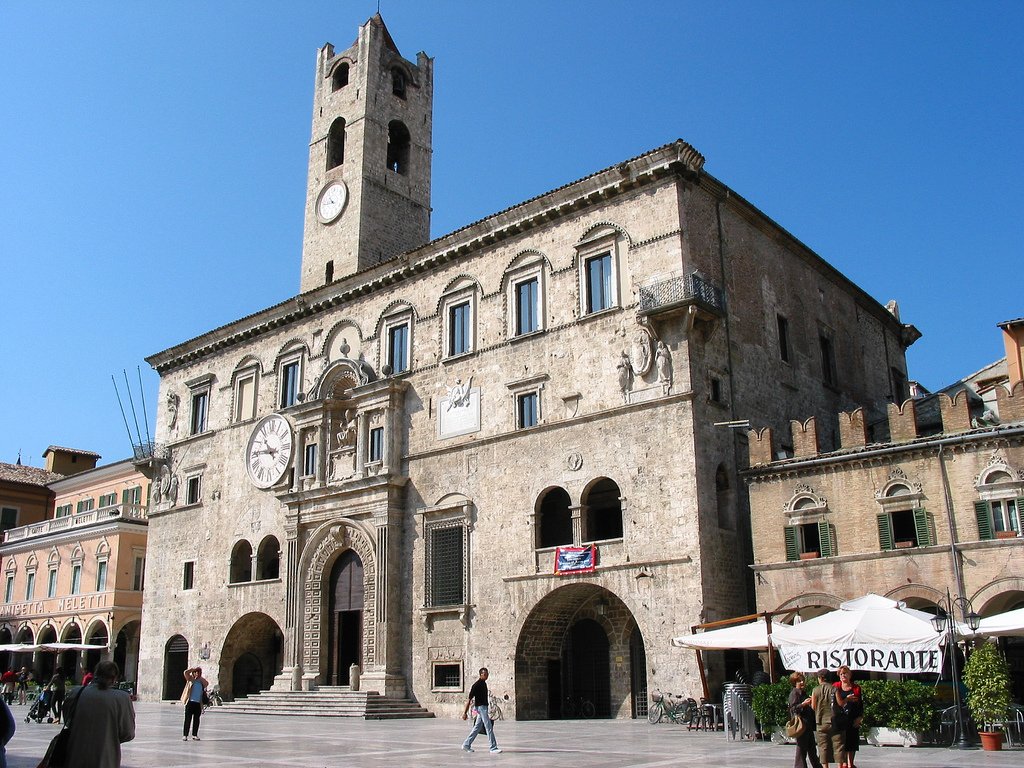
The Palazzo dei Capitani del Popolo is the historic heart of Ascoli Piceno, with free entry and open to the public. Its architecture combines a 13th-century medieval base with a Renaissance loggia added in the 1500s, creating a unique blend of styles.
- Travertine façade with biforate windows and main portal, perfect for photographs
- Inner courtyard with coats of arms of noble families telling centuries of history
- Sala della Ragione with coffered ceiling and notable acoustics, once the seat of city decisions
- Renaissance loggia offering a panoramic view of Piazza del Popolo and the Cathedral
Introduction
Have you ever walked into a square and immediately felt you were at the heart of a place? Piazza del Popolo in Ascoli Piceno does exactly that, and the Palazzo dei Capitani del Popolo is its absolute star. Its Renaissance facade, with those biforate windows and travertine portal, stares back at you like a silent guardian. It’s not just a palace; it’s the symbol of medieval civic power that still dominates the space today. I first saw it in the evening, illuminated, and it seemed to emerge from a painting. Its grandeur instantly makes you realize you’re walking on centuries of history, not just a simple sidewalk. If you love architecture that tells stories, you’ll find plenty here. It’s the perfect starting point for exploring Ascoli, because everything seems to radiate from here.
Historical Overview
The history of this palace is a tapestry of power and community. Built starting from the late 13th century, it served as the seat of the Captains of the People, figures who represented citizens against the nobility. Imagine, a building born to give voice to ordinary people! In the 15th century, it underwent a significant transformation with the addition of the loggia and portal we see today, possibly the work of Cola dell’Amatrice. It hasn’t always been just a town hall: it also hosted a theater and became a cultural hub during the Renaissance.
Every century has left its mark on its stones, sometimes peacefully, sometimes less so – there have been fires and restorations too. It’s like an open history book, but made of bricks and travertine.
- Late 13th century: Construction begins as the seat of the Captains of the People.
- 15th century: Renaissance renovation with loggia and portal attributed to Cola dell’Amatrice.
- 16th-17th centuries: Used as a theater and center of civic life.
- Subsequent centuries: Various restorations have preserved its appearance to this day, maintaining its function as the municipal palace.
The Hall of Reason
If you can get inside (it often hosts exhibitions or public events, so check ahead!), don’t miss the Hall of Reason. It’s the main hall, and I assure you the name isn’t accidental. This is where important decisions for the city were made. The coffered ceiling is a masterpiece of wooden craftsmanship, and the walls, though bare now, let you imagine the heated meetings of the captains. The acoustics are incredible—try speaking softly and you’ll hear the echo. I was struck by the sense of solemnity, different from the elegance of the facade. It’s a space that speaks of governance, disputes, and laws. A detail I loved? The large coats of arms on the walls, faded by time but still recognizable. They make you feel truly inside the administrative machinery of the Middle Ages.
The Loggia and the Viewpoint
Don’t just look at the palace from below. When accessible, climb up or simply stand in Piazza del Popolo and raise your eyes to the loggia on the first floor. It’s that elegant portico that looks like stone lace. From there, the captains observed the square and city life. Try to imagine the scene: merchants, discussions, festivities. Today, it’s one of the best spots to photograph the square in its entirety, with the Cathedral of Sant’Emidio and other architectures creating a uniquely harmonious ensemble. Perspective changes everything. Personally, I find that the loggia adds a touch of lightness to the palace’s grandeur, almost an invitation not to take oneself too seriously despite the power it represented. It’s a detail many overlook, but for me, it makes all the difference.
Why Visit It
First, because it’s free. Yes, admiring the exterior and often the atrium costs nothing, and for a monument like this, it’s a gift. Second, because it’s the best calling card of Ascoli Piceno. You immediately understand the civic pride and history of the city just by standing in front of it. Third, for the architecture: it’s a rare example of a medieval-Renaissance public palace so well-preserved in the Marche region, and the contrast between the severity of the base and the elegance of the upper loggia is fascinating. It’s not just a ‘thing to see,’ it’s an experience that immediately immerses you. And let’s face it, it always looks great in souvenir photos.
When to Go
I would recommend seeing it at two different times: early in the morning, when the square is still half-deserted and the slanting sunlight caresses the travertine facade, making it shine. Or in the evening, after sunset, when the streetlamps illuminate it, creating an almost theatrical atmosphere. In summer, during the day, the square can be crowded and very hot, so to enjoy it leisurely it’s better to avoid the midday hours. In autumn or spring, with softer light, the colors of the stone are magnificent. The magic lies in the light that shapes it, so play with the timing.
In the Surroundings
Leaving the square, take a short stroll towards Caffè Meletti, a historic establishment right across the way. Step inside even just for a coffee (with Meletti Anisetta, of course) – the Art Nouveau atmosphere is a plunge into another era. Then, to continue with the theme of travertine and history, walk to the Church of San Francesco and the nearby Ponte di Cecco. It’s another symbol of Ascoli, a Roman bridge (or perhaps medieval, opinions vary) that spans the Castellano stream. The contrast between the civic architecture of the Palazzo and the religious and infrastructural structures nearby is fascinating and gives you a complete picture of the city.