
The Roman Theater of Ascoli Piceno, built in the 1st century AD, was a social gathering point capable of hosting up to 2,000 spectators. Today, imposing travertine structures remain, such as the cavea, part of the stage, and some vomitoria. Its location in the heart of the historic center, just steps from Piazza del Popolo, makes it an unmissable stop during a visit to the city.
- Well-preserved semicircular cavea made of local travertine
- Vomitoria (side entrances) showcasing Roman engineering
- Position nestled within the medieval urban fabric
- Unusual view of the surrounding medieval buildings
Events nearby



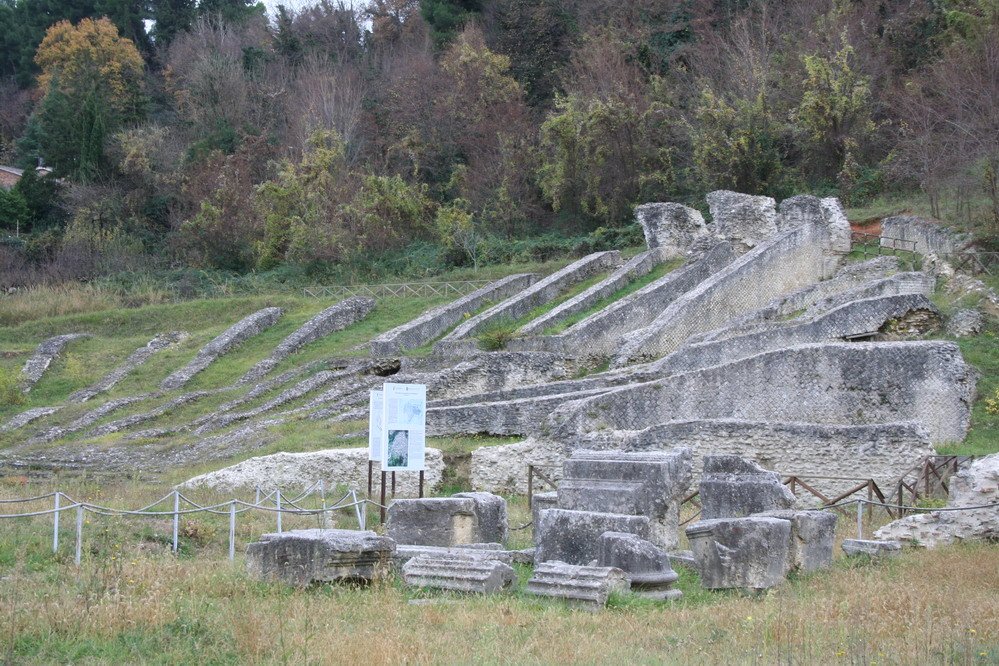
Visit the Roman Theater of Ascoli Piceno, featuring a travertine cavea for 2000 spectators just steps from Piazza del Popolo. Discover the vomitoria and the contrast with the surrounding medieval buildings.
- Via Francesco Ricci, Ascoli Piceno (AP)
- Open in Google Maps
- View on Google Images Teatro Romano a Ascoli Piceno
Good to know
Introduction
Historical Overview
- 1st century AD: Construction during the Augustan age.
- Middle Ages: Abandonment and gradual burial under new buildings.
- 1932: Start of systematic archaeological excavations.
- Today: A visitable monument and integral part of the city’s museum itinerary.
The Architecture That Speaks
A (Nearly) Secret Theater
Why Visit It
When to Go
In the Surroundings
Itineraries nearby

💡 Did You Know…?
A little-known fact: the theatre was discovered almost by chance during renovation work in the 19th century. Excavations revealed that in the medieval period the area was reused as a quarry for materials, but some structures were incorporated into later buildings, saving them from oblivion. Looking carefully, you can still see the holes for the poles of the velarium, the awning that protected spectators from the sun. On rainy days, the water flowing between the stones seems to echo the sound of an ancient Roman aqueduct that probably served the area.