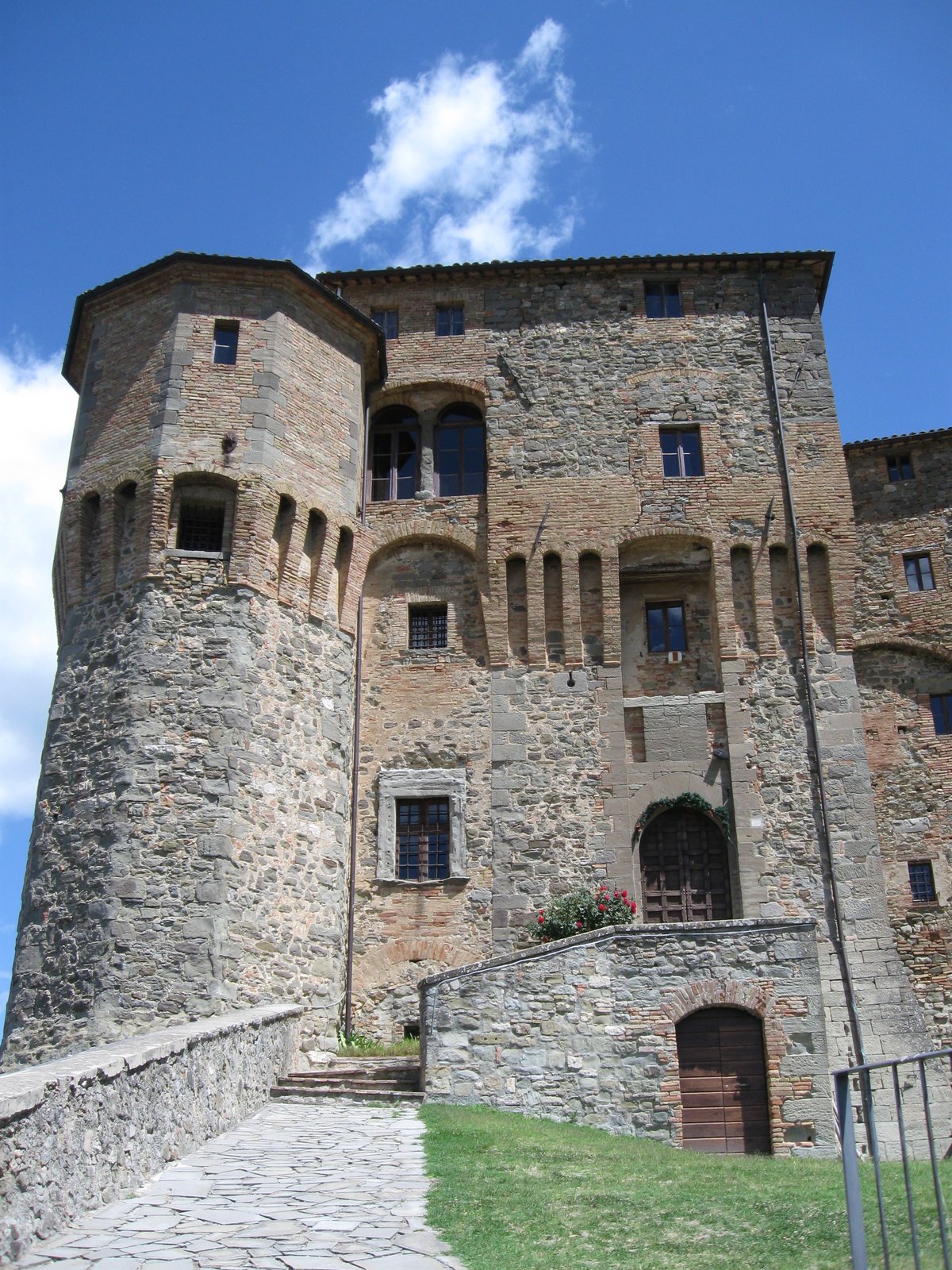
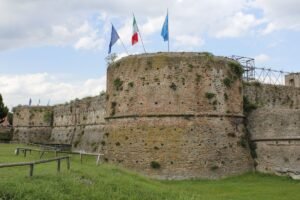
Rocca Fregoso is a perfectly preserved medieval castle that overlooks the village of Sant’Agata Feltria. Built in the 10th century and expanded by the Malatesta and Fregoso families, it offers a 360° view over the hills of the Rimini hinterland. The castle is open to visitors and hosts temporary exhibitions, with internal courtyards and towers that preserve the atmosphere of bygone eras.
- Perfectly preserved 10th-century medieval castle
- 360° panorama over the Montefeltro hills from the Main Tower
- Internal courtyards with central well and accessible towers
- Temporary exhibitions and displays inside the fortress
Introduction
As soon as you arrive in Sant’Agata Feltria, Rocca Fregoso immediately catches your eye: a medieval castle that looks like it’s straight out of a fairy tale, perched on a rocky spur. It’s not a melancholic ruin but a vibrant, perfectly preserved place that dominates the village with its massive towers. As you climb toward the entrance, the air grows cooler, and the 360-degree view of Montefeltro unfolds—a sight worth the trip alone. I felt catapulted back in time, yet with all the comfort of a well-maintained, visitable structure. It’s one of those places that makes you say: ‘This is authentic Italy, far from the crowds.’
Historical Background
The fortress has a dynamic history tied to powerful families. Likely built in the 10th century, it passed to the Malatesta family in the 1300s, but its golden age came with the Fregoso family, lords of Genoa, who transformed it into a Renaissance residence in the 1400s. Federico da Montefeltro, the famous Duke of Urbino, conquered it in 1474—it is said that the fortification project was supervised by Francesco di Giorgio Martini, his trusted architect. Later, over the centuries, it passed to the Della Rovere family and the Papal State. Today, it is municipally owned and carefully restored.
- 10th century: first fortifications
- 1300s: rule of the Malatesta family
- 1474: conquest by Federico da Montefeltro
- 1480-1500: transformation into a Renaissance residence under the Fregoso family
- Today: restored municipal property open to visitors
The Courtyards and Towers
Upon entering, you’re greeted by an inner courtyard with a central well – you can almost hear the chatter of soldiers or servants. The stones are worn by time, yet everything is in order. Climbing the narrow stairs (mind the steps, they’re a bit steep), you reach the towers. The Main Tower is the most impressive: from up there, your gaze sweeps over the Montefeltro hills, fading into the morning mist. In the other towers, you sometimes find temporary displays or small exhibitions. I came across an exhibition of ancient weapons, not too extensive but interesting. The atmosphere is intimate, almost cozy – there are no crowds, so you can take your time imagining life here centuries ago.
The Breathtaking Panorama
If there’s one thing you won’t forget, it’s the view. From the fortress terraces, you can see the entire village of Sant’Agata Feltria clinging to the hillside below, with its terracotta roofs and narrow alleyways. Beyond, the green hills of Montefeltro roll in gentle waves, dotted with woods and cultivated fields. On clear days, you can even glimpse the first peaks of the Apennines. It’s a panorama that invites silence and contemplation – I stayed there for at least half an hour, just looking. Bring a camera, because every corner offers a different perspective. Personally, I preferred the south side, where the afternoon light makes everything warmer and more golden.
Why Visit It
Three concrete reasons not to miss it. First: it’s an authentic medieval castle, not a reconstruction – you can feel the history in the stones, the walkways, the spiral staircases. Second: the view is simply spectacular, one of the best in the province of Rimini for those who love hilltop panoramas. Third: it’s a peaceful place, away from the tourist bustle of coastal resorts – perfect for a rejuvenating day trip. Plus, if you’re passionate about military architecture, here you’ll see a well-preserved example of Renaissance fortification, with defensive elements still recognizable.
When to Visit
I went in late September, and it was perfect: the air was crisp, the crowds were minimal, and the hills were beginning to take on autumn hues. In summer, it can get hot, but inside the fortress, you stay comfortable thanks to the thick walls. In spring, the surrounding meadows are full of wildflowers—a real spectacle. I’d avoid days of heavy rain, as the access roads can become slippery and the view gets lost in the haze. A personal tip: go early in the morning when the light is clear and there are fewer people, or in the late afternoon to enjoy the sunset from the towers.
In the Surroundings
Sant’Agata Feltria itself is worth a stroll: it’s a well-preserved medieval village, with the Church of Sant’Agata housing interesting artworks. Not far away, there’s the Sanctuary of Madonna del Soccorso in Pennabilli, a pilgrimage site with equally beautiful views. If you enjoy truffles, this area is famous for the white variety – in autumn, you can find festivals dedicated to it. For a different experience, visit the Museum of the Forest and Truffle also in Sant’Agata, to discover local traditions tied to nature.