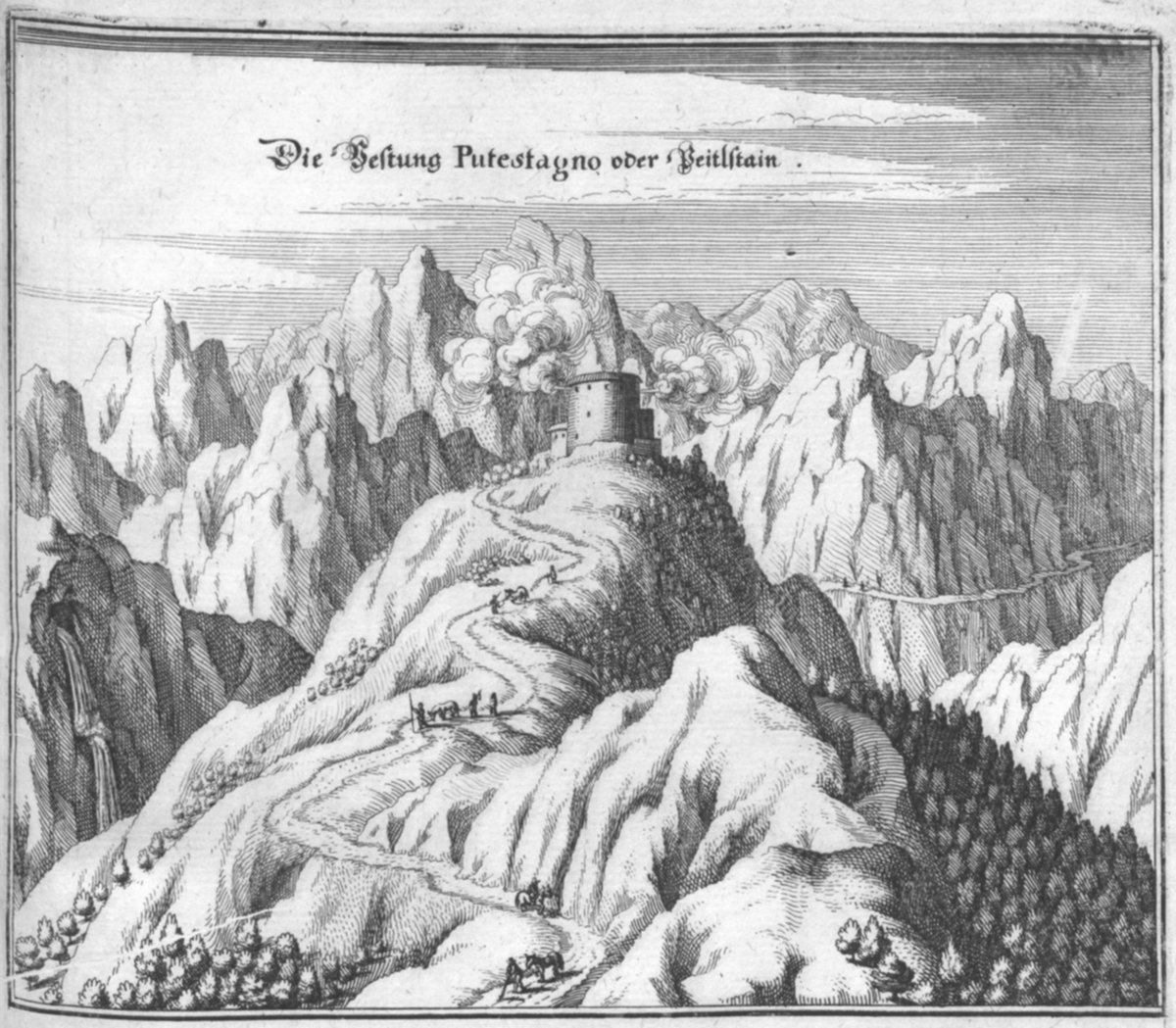
Podestagno Castle, an ancient medieval fortress north of Cortina d’Ampezzo, offers a short but history-rich hike with stunning views. Reachable in about 30 minutes on foot, the ruins overlook the confluence of the Felizon stream with the Boite river. The trail winds through woods and meadows, offering sights of the Tofane and Cristallo mountains.
– Millennia-old history: first mentioned in 1175, passing from patriarchs to Venetians to Habsburgs.
– Excavations and remains: archaeological campaigns have unearthed cisterns and a moat.
– Breathtaking panorama: from the cliff, you can embrace the Ampezzo basin.
– Easy access: marked trail suitable for all, starting from the SS51 road.
Introduction
Perched on a rocky spur at 1513 meters, Castello di Podestagno is today a collection of ruins that speak of centuries of history. Reaching it is a short hike immersed in greenery, with a panorama that stretches from the Ampezzo basin to the Tofane. Don’t expect imposing walls: what remains are fragments of walls and cisterns, brought to life by recent excavations. But the atmosphere is authentic, amid the rustle of the forest and a view that makes you understand why this place was contested for centuries.
Introduction
Perched on a rocky spur at 1513 meters, Castello di Podestagno is today a collection of ruins that speak of centuries of history. Reaching it is a short hike immersed in greenery, with a panorama that stretches from the Ampezzo basin to the Tofane. Don’t expect imposing walls: what remains are fragments of walls and cisterns, brought to life by recent excavations. But the atmosphere is authentic, amid the rustle of the forest and a view that makes you understand why this place was contested for centuries.
Historical Notes
The castle perhaps originated in the Lombard period (7th-8th century), but the first certain mention dates back to 1175 as Botestain. It dominated the crossroads between Cadore and Tyrol, passing from the patriarchs of Aquileia to the Venetians and then to the Habsburgs. It was enlarged several times (1476, 1568, 1619) until it became a four-story fortress with a moat and drawbridge. Abandoned in 1771, it was partially demolished in 1867 and finally destroyed during World War I, when the Italian army excavated positions and tunnels there. Today, excavations have brought to light “Venetian-style” cisterns and traces of Roman presence.
Historical Notes
The castle perhaps originated in the Lombard period (7th-8th century), but the first certain mention dates back to 1175 as Botestain. It dominated the crossroads between Cadore and Tyrol, passing from the patriarchs of Aquileia to the Venetians and then to the Habsburgs. It was enlarged several times (1476, 1568, 1619) until it became a four-story fortress with a moat and drawbridge. Abandoned in 1771, it was partially demolished in 1867 and finally destroyed during World War I, when the Italian army excavated positions and tunnels there. Today, excavations have brought to light “Venetian-style” cisterns and traces of Roman presence.
Historical Notes: Timeline
- 7th-8th c. – Probable Lombard wooden outpost
- 1175 – First documented mention as Botestain
- 1077 – Donation by Emperor Henry IV to the Patriarch of Aquileia
- 1476, 1568, 1619 – Expansions and renovations
- 1771 – Abandoned by the Austrian government
- 1867 – Demolition authorized by the community of Cortina
- 1915-1918 – War destruction and military reuse
- 2013-2015 – Archaeological excavation campaigns
Historical Notes: Timeline
- 7th-8th c. – Probable Lombard wooden outpost
- 1175 – First documented mention as Botestain
- 1077 – Donation by Emperor Henry IV to the Patriarch of Aquileia
- 1476, 1568, 1619 – Expansions and renovations
- 1771 – Abandoned by the Austrian government
- 1867 – Demolition authorized by the community of Cortina
- 1915-1918 – War destruction and military reuse
- 2013-2015 – Archaeological excavation campaigns
The Ruins Today: What Remains
Don’t expect a fairy-tale castle: the ruins are few and fragmentary, but they tell the story well. After the excavations, some cisterns, sections of walls, and the perimeter of the moat are visible. An information panel helps you get your bearings. The real spectacle is the panorama: on one side the Cortina basin, on the other the Cristallo and Tofana groups. The area has been cleared and made accessible with wooden railings, but still retains a wild feel. Traces of the Great War – such as trenches and a water tank inscribed with ‘1916 marsala and sparkling wine’ – blend with the medieval remains.
The Ruins Today: What Remains
Don’t expect a fairy-tale castle: the ruins are few and fragmentary, but they tell the story well. After the excavations, some cisterns, sections of walls, and the perimeter of the moat are visible. An information panel helps you get your bearings. The real spectacle is the panorama: on one side the Cortina basin, on the other the Cristallo and Tofana groups. The area has been cleared and made accessible with wooden railings, but still retains a wild feel. Traces of the Great War – such as trenches and a water tank inscribed with ‘1916 marsala and sparkling wine’ – blend with the medieval remains.
The Trail and the Hike
Start from the bridge over the Felizon stream, along the SS51 Alemagna road. Follow trail no. 201 (an ancient royal road, used until 1830). After about 30 minutes, turn right and climb up to the cliff. The route is short (1.5 km one way, elevation gain 100-150 m) and suitable for everyone, but the path may be uneven. You can continue along a loop that passes through the meadow of Cason de Podestagno and returns to the starting point. In total, at a leisurely pace, it takes about 2 hours. Watch out for the short final section that is a bit exposed: nothing difficult, but hiking boots are recommended.
The Trail and the Hike
Start from the bridge over the Felizon stream, along the SS51 Alemagna road. Follow trail no. 201 (an ancient royal road, used until 1830). After about 30 minutes, turn right and climb up to the cliff. The route is short (1.5 km one way, elevation gain 100-150 m) and suitable for everyone, but the path may be uneven. You can continue along a loop that passes through the meadow of Cason de Podestagno and returns to the starting point. In total, at a leisurely pace, it takes about 2 hours. Watch out for the short final section that is a bit exposed: nothing difficult, but hiking boots are recommended.
Why Visit It
Three good reasons: first, it’s a short but history-rich hike, perfect for a half day. Second, the view over the Ampezzo basin and the Dolomites is breathtaking – an ideal spot for a picnic with a view. Third, it’s a place steeped in Ladin legends and atmosphere: stories of witchcraft and trials took place here, and every year a procession commemorates the blessing of the pastures. Plus, nearby you’ll find the ancient Ospitale with the little church of San Nicolò (1226), the oldest in Cortina.
Why Visit It
Three good reasons: first, it’s a short but history-rich hike, perfect for a half day. Second, the view over the Ampezzo basin and the Dolomites is breathtaking – an ideal spot for a picnic with a view. Third, it’s a place steeped in Ladin legends and atmosphere: stories of witchcraft and trials took place here, and every year a procession commemorates the blessing of the pastures. Plus, nearby you’ll find the ancient Ospitale with the little church of San Nicolò (1226), the oldest in Cortina.
When to Go
The best time to go is from May to November, when the trail is free of snow. To avoid the crowds, choose a weekday morning: the Parco Naturale delle Dolomiti d’Ampezzo is often busy, but on weekdays it’s more secluded. In autumn, the colors of the forest create a special atmosphere. In winter, the path is not cleared and snow equipment (snowshoes) is needed, but some still do it. Personally, I recommend going at first light, when the sun caresses the ruins and the silence is broken only by birds.
When to Go
The best time to go is from May to November, when the trail is free of snow. To avoid the crowds, choose a weekday morning: the Parco Naturale delle Dolomiti d’Ampezzo is often busy, but on weekdays it’s more secluded. In autumn, the colors of the forest create a special atmosphere. In winter, the path is not cleared and snow equipment (snowshoes) is needed, but some still do it. Personally, I recommend going at first light, when the sun caresses the ruins and the silence is broken only by birds.
Nearby
A few minutes’ walk from the castle brings you to Ospitale, an ancient inn (11th century) with the small church of San Nicolò (1226), the oldest in Cortina. It’s worth stopping for a rustic lunch. Also in the area, the Dolomiti d’Ampezzo Natural Park offers other trails: the Ra Stua valley or the Son Forca mountain hut. If you have time, don’t miss the Felizon canyon and its ice waterfalls in winter (ice climbing).
Nearby
A few minutes’ walk from the castle brings you to Ospitale, an ancient inn (11th century) with the small church of San Nicolò (1226), the oldest in Cortina. It’s worth stopping for a rustic lunch. Also in the area, the Dolomiti d’Ampezzo Natural Park offers other trails: the Ra Stua valley or the Son Forca mountain hut. If you have time, don’t miss the Felizon canyon and its ice waterfalls in winter (ice climbing).