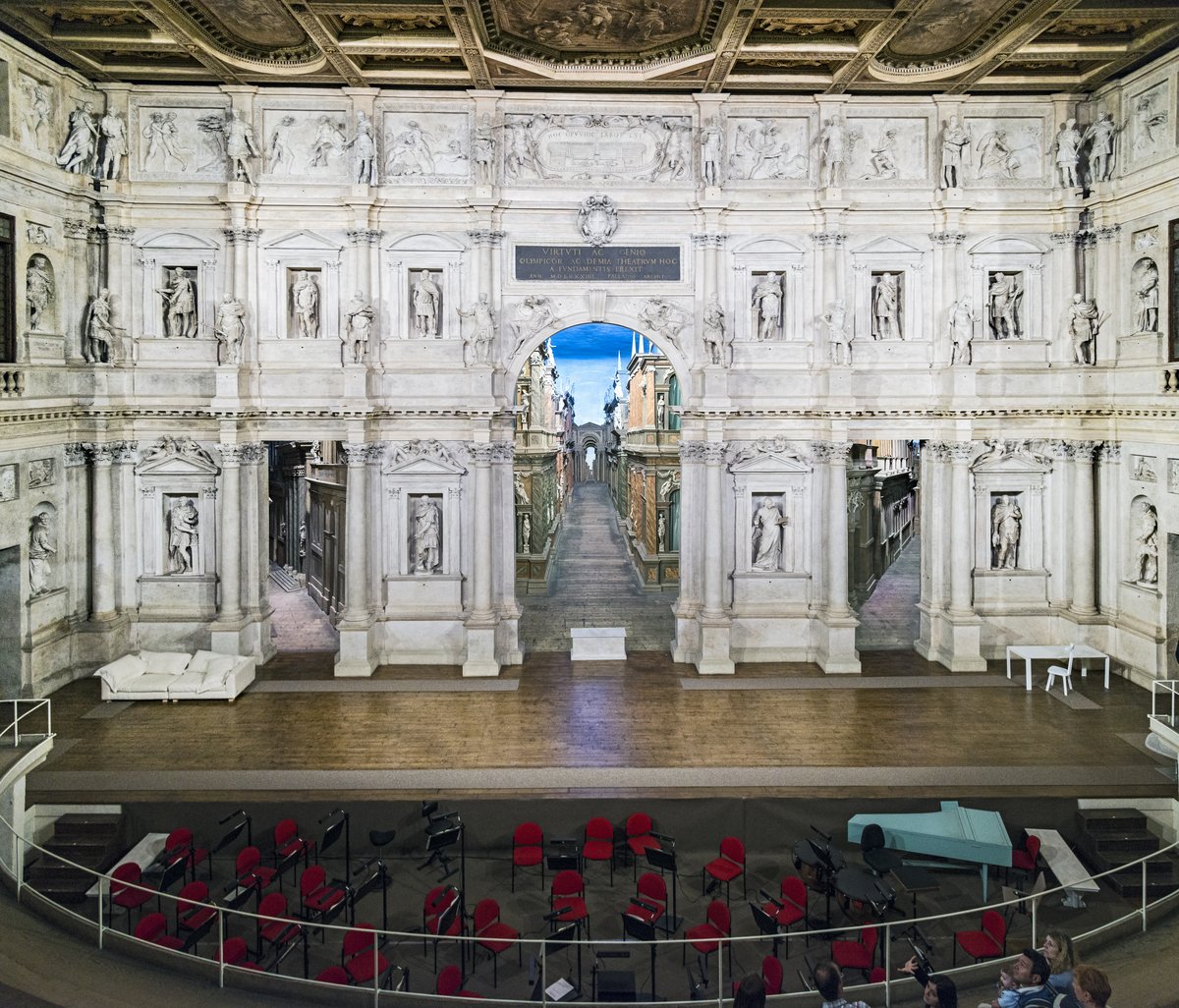
The Olympic Theatre is an absolute Renaissance masterpiece, designed by Andrea Palladio in 1580 and completed after his death. It is the oldest permanent indoor theatre in the world and has been a UNESCO World Heritage Site since 1994. Its wooden stage set, created by Vincenzo Scamozzi for the 1585 inauguration, is still intact and represents the seven streets of Thebes. Key points:
– Palladio’s design: the great architect’s final work, inspired by Roman theatres.
– Original fixed stage: unique in the world, made of wood and stucco, with a perspective effect.
– 95 statues: decorate the cavea and proscenium, depicting the founders of the Olympic Academy.
– Limited capacity: 470 seats, to ensure its preservation.
Welcome to the Teatro Olimpico
Entering the Teatro Olimpico is like stepping back into the Renaissance. The world’s first permanent indoor theater, this masterpiece by Andrea Palladio welcomes you with its intimate and solemn atmosphere. The original wooden stage sets by Vincenzo Scamozzi, with the streets of Thebes seemingly stretching endlessly, leave you breathless. It is a place that speaks of genius, passion for theater, and an era where art and science merged. Prepare to be amazed.
Welcome to the Teatro Olimpico
Entering the Teatro Olimpico is like stepping back into the Renaissance. The world’s first permanent indoor theater, this masterpiece by Andrea Palladio welcomes you with its intimate and solemn atmosphere. The original wooden stage sets by Vincenzo Scamozzi, with the streets of Thebes seemingly stretching endlessly, leave you breathless. It is a place that speaks of genius, passion for theater, and an era where art and science merged. Prepare to be amazed.
A Brief History
It all began in February 1580, when the Olympic Academy, of which Palladio was a member, commissioned a permanent theater. Palladio died a few months later, but his son Silla and Vincenzo Scamozzi completed the work. On March 3, 1585, it was inaugurated with Sophocles’
Oedipus Rex.
Scamozzi’s sets have never been removed and are the only original Renaissance sets. After a period of inactivity during the Counter-Reformation, the theater came back to life in the 19th century. Since 1994 it has been a UNESCO World Heritage site.
- 1580: Commissioned and construction begins
- 1585: Inauguration with Oedipus Rex
- 1782: Visit of Pope Pius VI
- 1994: Declared a UNESCO World Heritage site
A Brief History
It all began in February 1580, when the Olympic Academy, of which Palladio was a member, commissioned a permanent theater. Palladio died a few months later, but his son Silla and Vincenzo Scamozzi completed the work. On March 3, 1585, it was inaugurated with Sophocles’
Oedipus Rex.
Scamozzi’s sets have never been removed and are the only original Renaissance sets. After a period of inactivity during the Counter-Reformation, the theater came back to life in the 19th century. Since 1994 it has been a UNESCO World Heritage site.
- 1580: Commissioned and construction begins
- 1585: Inauguration with Oedipus Rex
- 1782: Visit of Pope Pius VI
- 1994: Declared a UNESCO World Heritage site
The Perspective Illusion of the Stage
The fixed stage of the Teatro Olimpico is a triumph of perspective. Vincenzo Scamozzi created seven streets of Thebes in wood and stucco, with buildings shrinking towards a vanishing point. The effect is so real that it feels like you could walk among those streets. It is a masterpiece of optical engineering, made even more impressive by the light filtering from the coffered ceiling. Don’t miss the details: the statues, the niches, and that sense of depth that makes you forget you are in a theater.
The Perspective Illusion of the Stage
The fixed stage of the Teatro Olimpico is a triumph of perspective. Vincenzo Scamozzi created seven streets of Thebes in wood and stucco, with buildings shrinking towards a vanishing point. The effect is so real that it feels like you could walk among those streets. It is a masterpiece of optical engineering, made even more impressive by the light filtering from the coffered ceiling. Don’t miss the details: the statues, the niches, and that sense of depth that makes you forget you are in a theater.
Visiting the Theater Today
Today the Teatro Olimpico can be visited as a museum and still hosts performances. Capacity is limited to 470 seats to preserve the wooden structures, and there is no heating or air conditioning. Visits take place Tuesday to Sunday: in winter from 9 AM to 5 PM, in summer from 10 AM to 6 PM (closed on Mondays). You can purchase tickets directly at the box office or online. Reservations are only mandatory for groups. Don’t forget to also visit the bookshop, with publications on Palladio and handmade items.
Visiting the Theater Today
Today the Teatro Olimpico can be visited as a museum and still hosts performances. Capacity is limited to 470 seats to preserve the wooden structures, and there is no heating or air conditioning. Visits take place Tuesday to Sunday: in winter from 9 AM to 5 PM, in summer from 10 AM to 6 PM (closed on Mondays). You can purchase tickets directly at the box office or online. Reservations are only mandatory for groups. Don’t forget to also visit the bookshop, with publications on Palladio and handmade items.
Three Good Reasons Not to Miss It
First: it’s the only covered Renaissance theater with original stage sets still in use. Second: the acoustics and atmosphere are magical – if you’re lucky enough to attend a performance, the emotion is indescribable. Third: it’s in the heart of Vicenza, a UNESCO city, and after your visit you can explore the Palladian squares. In short, a leap into the past like no other.
Three Good Reasons Not to Miss It
First: it’s the only covered Renaissance theater with original stage sets still in use. Second: the acoustics and atmosphere are magical – if you’re lucky enough to attend a performance, the emotion is indescribable. Third: it’s in the heart of Vicenza, a UNESCO city, and after your visit you can explore the Palladian squares. In short, a leap into the past like no other.
The Perfect Time
The theater is beautiful in any season, but the most evocative period is spring, when the light filters in softly and performances resume. Autumn also has its charm, with classic productions. If you want to avoid the crowds, visit on the first days of the week (remember it’s closed on Mondays). Arrive early in the morning to enjoy the best light on the stage.
The Perfect Time
The theater is beautiful in any season, but the most evocative period is spring, when the light filters in softly and performances resume. Autumn also has its charm, with classic productions. If you want to avoid the crowds, visit on the first days of the week (remember it’s closed on Mondays). Arrive early in the morning to enjoy the best light on the stage.
What to See Next
A two-minute walk from the theater, don’t miss Piazza dei Signori with the Basilica Palladiana and Palazzo Chiericati, both by Palladio. If you have time, pop into the Civic Museum at Palazzo Chiericati for more wonders. And for a break, the osterie in the center offer excellent wines and Vicenza-style cicchetti.
What to See Next
A two-minute walk from the theater, don’t miss Piazza dei Signori with the Basilica Palladiana and Palazzo Chiericati, both by Palladio. If you have time, pop into the Civic Museum at Palazzo Chiericati for more wonders. And for a break, the osterie in the center offer excellent wines and Vicenza-style cicchetti.