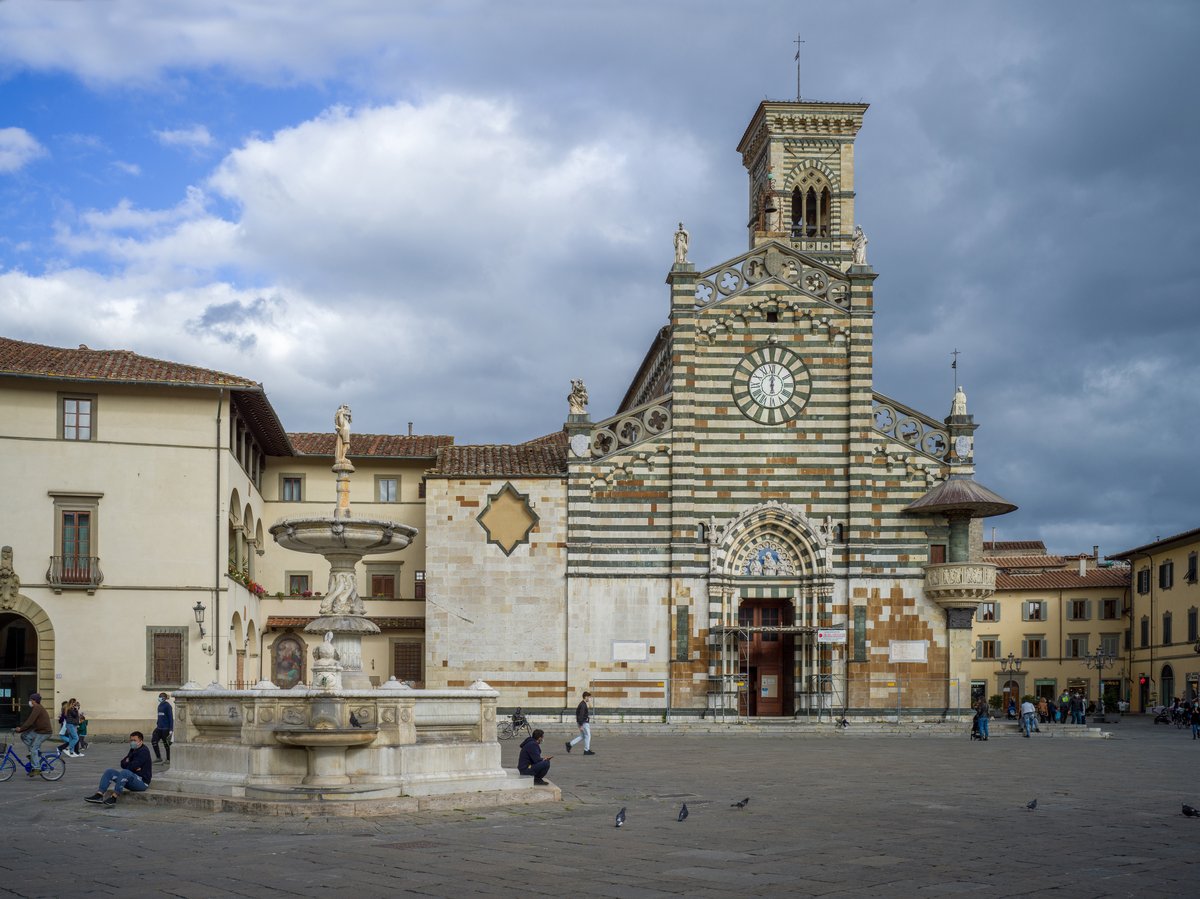
St. Stephen’s Cathedral, the religious heart of Prato, is a remarkable example of Romanesque-Gothic architecture, featuring the characteristic bichrome of alberese and green serpentine stone. Inside, masterpieces such as Filippo Lippi’s frescoes and Mino da Fiesole’s Renaissance pulpit await, while outside, Donatello and Michelozzo’s pulpit and the 46-meter-high bell tower dominate the square. The relic of the Sacred Girdle, housed in its own chapel, is the symbol of the city and is displayed during solemn ceremonies.
Unique Bichrome: façade with white and green marble bands.
Lippi’s Masterpieces: 15th-century frescoes in the Main Chapel.
Donatello’s Pulpit: Renaissance masterpiece for the relic’s exhibition.
Sacred Girdle: venerated Marian relic, displayed on special occasions.
Introduction: The Enchanting Two-Tone
As soon as you emerge into Piazza del Duomo, the Cathedral of Santo Stefano strikes you with its white and green striped skin. It’s not just an aesthetic effect: here the light Alberese and the Prato serpentine alternate like a secret code, and the contrast brightens in the morning light. It’s a Tuscan Romanesque-Gothic, but with a unique personality: the late Gothic façade seems almost like a curtain, and between this and the older structure, a passage leads to Donatello’s pulpit, hanging like a jewel outside. You enter and the surprise continues: three imposing naves, columns of green serpentine that seem alive, and an intimate atmosphere that invites you to look up. It’s not an imposing cathedral like others, but it’s alive, authentic, it speaks to you of centuries of faith and art.
Introduction: The Enchanting Two-Tone
As soon as you emerge into Piazza del Duomo, the Cathedral of Santo Stefano strikes you with its white and green striped skin. It’s not just an aesthetic effect: here the light Alberese and the Prato serpentine alternate like a secret code, and the contrast brightens in the morning light. It’s a Tuscan Romanesque-Gothic, but with a unique personality: the late Gothic façade seems almost like a curtain, and between this and the older structure, a passage leads to Donatello’s pulpit, hanging like a jewel outside. You enter and the surprise continues: three imposing naves, columns of green serpentine that seem alive, and an intimate atmosphere that invites you to look up. It’s not an imposing cathedral like others, but it’s alive, authentic, it speaks to you of centuries of faith and art.
Historical Notes: A Journey Through the Centuries
The roots of the Cathedral date back to the 6th century, when a parish church stood here. The first written record is from 994, but it was in the 12th century that the current Romanesque structure took shape. In 1141, the relic of the
Holy Girdle arrived in Prato, and popular devotion transformed the church: in the 14th century, the transept (perhaps by Giovanni Pisano) and the Chapel of the Holy Girdle were added. The facade was completed between 1385 and 1457, while the bell tower, begun in 1160, was raised in 1356. The external pulpit by Donatello and Michelozzo (1428-1438) marks the peak of the Renaissance in the city. Here is an essential timeline:
- 6th century: first parish church
- 994: first document
- 12th century: Romanesque reconstruction
- 1141: arrival of the Holy Girdle
- 1385-1457: current facade
- 1428-1438: pulpit by Donatello
- 1452-1465: frescoes by Filippo Lippi
Historical Notes: A Journey Through the Centuries
The roots of the Cathedral date back to the 6th century, when a parish church stood here. The first written record is from 994, but it was in the 12th century that the current Romanesque structure took shape. In 1141, the relic of the
Holy Girdle arrived in Prato, and popular devotion transformed the church: in the 14th century, the transept (perhaps by Giovanni Pisano) and the Chapel of the Holy Girdle were added. The facade was completed between 1385 and 1457, while the bell tower, begun in 1160, was raised in 1356. The external pulpit by Donatello and Michelozzo (1428-1438) marks the peak of the Renaissance in the city. Here is an essential timeline:
- 6th century: first parish church
- 994: first document
- 12th century: Romanesque reconstruction
- 1141: arrival of the Holy Girdle
- 1385-1457: current facade
- 1428-1438: pulpit by Donatello
- 1452-1465: frescoes by Filippo Lippi
Donatello’s Pulpit and the Holy Girdle
One of the highlights is undoubtedly the external pulpit, a masterpiece by Donatello and Michelozzo. You can see it jutting out from the right side, like a marble balcony: it was built specifically to show the Holy Girdle, the belt of the Virgin Mary, a relic that arrived in Prato in the year 1000. The dancing putti on the parapet are a burst of movement, almost musical. You feel the weight of history: here, for centuries, the bishop blessed the crowd with the relic (still today, on September 8, the ceremony is repeated with the Historical Procession). The original is in the Museo dell’Opera del Duomo, but the copy outside gives you the idea. It’s a work that makes you understand how the sacred and the popular intertwine in Prato: it’s not just art, it’s a gesture of collective faith.
Donatello’s Pulpit and the Holy Girdle
One of the highlights is undoubtedly the external pulpit, a masterpiece by Donatello and Michelozzo. You can see it jutting out from the right side, like a marble balcony: it was built specifically to show the Holy Girdle, the belt of the Virgin Mary, a relic that arrived in Prato in the year 1000. The dancing putti on the parapet are a burst of movement, almost musical. You feel the weight of history: here, for centuries, the bishop blessed the crowd with the relic (still today, on September 8, the ceremony is repeated with the Historical Procession). The original is in the Museo dell’Opera del Duomo, but the copy outside gives you the idea. It’s a work that makes you understand how the sacred and the popular intertwine in Prato: it’s not just art, it’s a gesture of collective faith.
Masterpieces Within: From Lippi to Gaddi
As soon as you enter, head to the Chapel Maggiore: here Filippo Lippi left a cycle of frescoes (1452-1465) that will leave you speechless. Stories of Saint Stephen and Saint John the Baptist, with scenes like the Funeral of Saint Stephen and the Feast of Herod with the Dance of Salome. The colors are vivid, the faces expressive: it feels like seeing Renaissance Florence in miniature. On the other side, the Chapel of the Holy Girdle envelops you with frescoes by Agnolo Gaddi (1392-1395): the Stories of the Virgin and the Girdle are a 14th-century fairy tale, full of golden details. Don’t miss the Madonna of the Olive Tree by the Da Maiano brothers, in the right transept, and the small wooden crucifix attributed to Giovanni Pisano. Every corner holds a treasure.
Masterpieces Within: From Lippi to Gaddi
As soon as you enter, head to the Chapel Maggiore: here Filippo Lippi left a cycle of frescoes (1452-1465) that will leave you speechless. Stories of Saint Stephen and Saint John the Baptist, with scenes like the Funeral of Saint Stephen and the Feast of Herod with the Dance of Salome. The colors are vivid, the faces expressive: it feels like seeing Renaissance Florence in miniature. On the other side, the Chapel of the Holy Girdle envelops you with frescoes by Agnolo Gaddi (1392-1395): the Stories of the Virgin and the Girdle are a 14th-century fairy tale, full of golden details. Don’t miss the Madonna of the Olive Tree by the Da Maiano brothers, in the right transept, and the small wooden crucifix attributed to Giovanni Pisano. Every corner holds a treasure.
Why Visit
Three practical reasons not to skip Prato’s Duomo. First: it’s one of the rare examples of Romanesque-Gothic with white-green bichromy, an architectural language found only in this part of Tuscany. Second: Donatello’s pulpit is an icon of the early Renaissance, and seeing it in person is far more thrilling than in photos. Third: the Sacred Girdle is one of Italy’s most venerated Marian relics, and its story is fascinatingly intertwined with the city’s history. Plus, the cathedral sits in the heart of the historic center, steps away from bars, restaurants, and shops—perfect for a cultural break during a city getaway to Prato.
Why Visit
Three practical reasons not to skip Prato’s Duomo. First: it’s one of the rare examples of Romanesque-Gothic with white-green bichromy, an architectural language found only in this part of Tuscany. Second: Donatello’s pulpit is an icon of the early Renaissance, and seeing it in person is far more thrilling than in photos. Third: the Sacred Girdle is one of Italy’s most venerated Marian relics, and its story is fascinatingly intertwined with the city’s history. Plus, the cathedral sits in the heart of the historic center, steps away from bars, restaurants, and shops—perfect for a cultural break during a city getaway to Prato.
When to Go
The best time? I suggest late afternoon, around 5 PM: the low light filters through the windows and lights up the green serpentine, creating an almost mystical atmosphere. If you come on Monday, watch out: the cathedral is closed from 12 PM to 4 PM (but reopens until 7 PM). For a special experience, plan your visit on September 8, the Feast of the Nativity of Mary: on that day the Holy Girdle is solemnly displayed with the Historical Procession. It is a spectacle of faith and tradition. In winter the church is quieter, in summer more crowded, but Lippi’s treasure is worth any season.
When to Go
The best time? I suggest late afternoon, around 5 PM: the low light filters through the windows and lights up the green serpentine, creating an almost mystical atmosphere. If you come on Monday, watch out: the cathedral is closed from 12 PM to 4 PM (but reopens until 7 PM). For a special experience, plan your visit on September 8, the Feast of the Nativity of Mary: on that day the Holy Girdle is solemnly displayed with the Historical Procession. It is a spectacle of faith and tradition. In winter the church is quieter, in summer more crowded, but Lippi’s treasure is worth any season.
Nearby
Just a few steps from the cathedral, don’t miss the Museo dell’Opera del Duomo: it houses the original Donatello pulpit and other masterpieces, such as Maso di Bartolomeo’s candelabrum. The ticket also includes the Lippi Chapel, so it’s a great deal. Then, take a stroll around Piazza del Comune with the Palazzo Pretorio (civic museum) and the evocative Palazzo Datini. If you have an hour, head to the Castello dell’Imperatore built by Frederick II of Swabia, a rare Swabian fortress in Tuscany. Everything is walkable: Prato’s city center is small and enjoyable, with alleys and artisan workshops.
Nearby
Just a few steps from the cathedral, don’t miss the Museo dell’Opera del Duomo: it houses the original Donatello pulpit and other masterpieces, such as Maso di Bartolomeo’s candelabrum. The ticket also includes the Lippi Chapel, so it’s a great deal. Then, take a stroll around Piazza del Comune with the Palazzo Pretorio (civic museum) and the evocative Palazzo Datini. If you have an hour, head to the Castello dell’Imperatore built by Frederick II of Swabia, a rare Swabian fortress in Tuscany. Everything is walkable: Prato’s city center is small and enjoyable, with alleys and artisan workshops.