Introduction
If you think archaeology is dusty, you haven’t set foot in the State Archaeological Museum of Ascoli Piceno yet. Housed in Palazzo Panichi, an elegant 16th-century building with original frescoes, this museum catapults you into the history of the Picene civilization, a people who had their capital here. Don’t expect boring display cases: there are reconstructions with mannequins of ladies and warriors in period costumes, and artifacts that seem to speak. From the Stele of Castignano (one of the earliest examples of Italic writing) to the female belts of Salino, each object tells a story. And then there’s the double-headed herm mosaic, spectacular. Three floors, from the Paleolithic to the Roman era, all to be explored at a leisurely pace.
Introduction
If you think archaeology is dusty, you haven’t set foot in the State Archaeological Museum of Ascoli Piceno yet. Housed in Palazzo Panichi, an elegant 16th-century building with original frescoes, this museum catapults you into the history of the Picene civilization, a people who had their capital here. Don’t expect boring display cases: there are reconstructions with mannequins of ladies and warriors in period costumes, and artifacts that seem to speak. From the Stele of Castignano (one of the earliest examples of Italic writing) to the female belts of Salino, each object tells a story. And then there’s the double-headed herm mosaic, spectacular. Three floors, from the Paleolithic to the Roman era, all to be explored at a leisurely pace.
Historical Notes
The museum was founded in 1981 inside Palazzo Panichi, but its roots lie in an 18th-century civic collection, initiated by Bishop Alessandro Odoardi and expanded through donations such as those of Candido Augusto Vecchi and Costanzo Mazzoni. The building itself has a history: built on medieval foundations, it underwent Renaissance and 18th-century interventions. Since 2014, it has been managed by the Marche Museums Authority. The Picene section is the heart of the museum, featuring materials from the necropolises of Salino and Monteprandone. Among the highlights are inscribed glandes missiles from the Social War (91-88 BC), which tell the story of Picene resistance to Romanization.
Historical Notes
The museum was founded in 1981 inside Palazzo Panichi, but its roots lie in an 18th-century civic collection, initiated by Bishop Alessandro Odoardi and expanded through donations such as those of Candido Augusto Vecchi and Costanzo Mazzoni. The building itself has a history: built on medieval foundations, it underwent Renaissance and 18th-century interventions. Since 2014, it has been managed by the Marche Museums Authority. The Picene section is the heart of the museum, featuring materials from the necropolises of Salino and Monteprandone. Among the highlights are inscribed glandes missiles from the Social War (91-88 BC), which tell the story of Picene resistance to Romanization.
The Picene Section: Masterpieces of a Civilization
On the first floor, the Picene section is the largest collection of material culture of this people. The artifacts date from the Bronze Age to the 4th century BC and come from the valleys of the Tronto, Tesino, and Salino rivers. Don’t miss the female parure from Monteprandone (9th century BC), the lozenge-shaped belts from the Salino necropolis, and the extraordinary Stele of Castignano, a rare inscription in the South Picene alphabet. There are also Orientalizing productions and a Praenestine cista from Monsampietro Morico. The layout is modern, with explanatory panels and reconstructions of funerary assemblages: it almost feels like entering a Picene tomb.
The Picene Section: Masterpieces of a Civilization
On the first floor, the Picene section is the largest collection of material culture of this people. The artifacts date from the Bronze Age to the 4th century BC and come from the valleys of the Tronto, Tesino, and Salino rivers. Don’t miss the female parure from Monteprandone (9th century BC), the lozenge-shaped belts from the Salino necropolis, and the extraordinary Stele of Castignano, a rare inscription in the South Picene alphabet. There are also Orientalizing productions and a Praenestine cista from Monsampietro Morico. The layout is modern, with explanatory panels and reconstructions of funerary assemblages: it almost feels like entering a Picene tomb.
Roman Era: Mosaics, Acorns, and an Emperor
On the ground floor, the Roman period surprises you with artifacts ranging from the late Republic to the early Empire. The standout piece? The two-faced herma polychrome mosaic, from a domus beneath the Palace of Justice. Then there’s a marble portrait of Emperor Trajan, and a collection of over five thousand sling bullets – projectiles often bearing offensive inscriptions used during the Social War. Some artifacts are displayed with the original walls of Roman and medieval Asculum, visible in situ. Epigraphs recounting public and private life are also present. A section blending history with a touch of dark humor (reading the bullet inscriptions is an experience in itself).
Roman Era: Mosaics, Acorns, and an Emperor
On the ground floor, the Roman period surprises you with artifacts ranging from the late Republic to the early Empire. The standout piece? The two-faced herma polychrome mosaic, from a domus beneath the Palace of Justice. Then there’s a marble portrait of Emperor Trajan, and a collection of over five thousand sling bullets – projectiles often bearing offensive inscriptions used during the Social War. Some artifacts are displayed with the original walls of Roman and medieval Asculum, visible in situ. Epigraphs recounting public and private life are also present. A section blending history with a touch of dark humor (reading the bullet inscriptions is an experience in itself).
Why Visit
1. Uniqueness of the Picene collection: nowhere else will you find such a vast and complete collection of artifacts from the Picene civilization, with unique pieces like the Stele of Castignano. 2. Scenic reconstructions: the rooms with mannequins of ladies and warriors in period costumes make the visit lively and suitable even for non-experts. 3. Modest price: only 4 euros for a journey through history that lasts about an hour and a half. Plus, the museum is in the city center, so you can combine it with a stroll through the squares of Ascoli.
Why Visit
1. Uniqueness of the Picene collection: nowhere else will you find such a vast and complete collection of artifacts from the Picene civilization, with unique pieces like the Stele of Castignano. 2. Scenic reconstructions: the rooms with mannequins of ladies and warriors in period costumes make the visit lively and suitable even for non-experts. 3. Modest price: only 4 euros for a journey through history that lasts about an hour and a half. Plus, the museum is in the city center, so you can combine it with a stroll through the squares of Ascoli.
When to Visit
The museum is open all year (except Mondays), but the best time is in the afternoon, when the light falls softly on the squares. In spring and autumn, a visit pairs perfectly with a stroll through the historic center. If you come in summer, avoid the midday hours: it’s best to enter around 3 p.m., when the heat subsides. The museum closes at 7:30 p.m., so you have plenty of time. Tip: check for events like ‘Piccoli passi al museo’ (workshops for children) – they could enrich your visit.
When to Visit
The museum is open all year (except Mondays), but the best time is in the afternoon, when the light falls softly on the squares. In spring and autumn, a visit pairs perfectly with a stroll through the historic center. If you come in summer, avoid the midday hours: it’s best to enter around 3 p.m., when the heat subsides. The museum closes at 7:30 p.m., so you have plenty of time. Tip: check for events like ‘Piccoli passi al museo’ (workshops for children) – they could enrich your visit.
Nearby
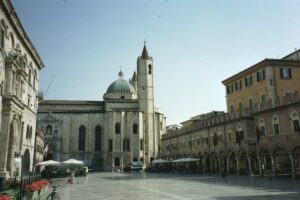
After leaving the museum, you’re already in Piazza Arringo, the heart of Ascoli. A short walk brings you to Piazza del Popolo, one of the most beautiful squares in Italy, with its colonnade and historic café. Don’t miss the Duomo di Sant’Emidio, just a few steps away, with its paleo-Christian crypt. If you have time, also visit the nearby Pinacoteca Civica, right on the square, for a dip into Renaissance art. Or take a hike up to Fortezza Pia for a breathtaking view of the city.
Nearby
After leaving the museum, you’re already in Piazza Arringo, the heart of Ascoli. A short walk brings you to Piazza del Popolo, one of the most beautiful squares in Italy, with its colonnade and historic café. Don’t miss the Duomo di Sant’Emidio, just a few steps away, with its paleo-Christian crypt. If you have time, also visit the nearby Pinacoteca Civica, right on the square, for a dip into Renaissance art. Or take a hike up to Fortezza Pia for a breathtaking view of the city.