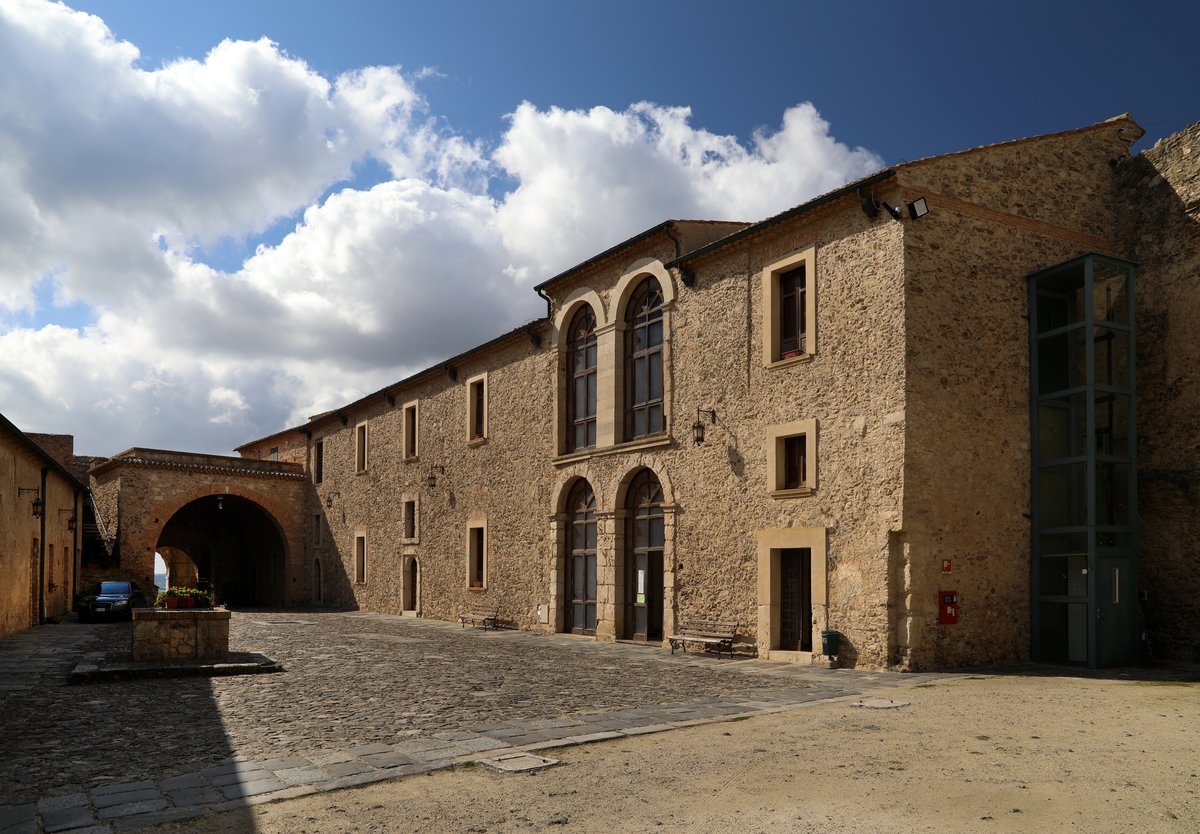
The Museo Archeologico Nazionale Vito Capialbi, housed in the evocative Norman-Swabian Castle of Vibo Valentia, is a must-see for lovers of ancient history. Here are preserved the finds of the Greek colony of Hipponion, including the famous Orphic gold leaf, a unique document on the cult of the afterlife. The museum offers a chronological journey from prehistory to the Roman era, with artifacts from temples, necropolises, and private collections.
– The Orphic gold leaf with instructions for the afterlife
– Bronze helmets and goldsmith works from the sanctuary of Scrimbia
– Locrian pinakes and temple models from Cofino
– Bust of Agrippa and Roman mosaics from the port of Valentia
Introduction
Climbing to the Norman-Swabian Castle of Vibo Valentia is already a breathtaking experience. There, amid medieval walls and a view that stretches from the Tyrrhenian Sea to Mount Etna, hides the Vito Capialbi National Archaeological Museum. It is not just a museum: it is a journey through time that begins in Magna Graecia, with artifacts that speak of gods, heroes, and men. The famous Orphic lamella awaits you, small but incredibly powerful. Step inside, and prepare to get lost among helmets, jewelry, and ancient stories.
Introduction
Climbing to the Norman-Swabian Castle of Vibo Valentia is already a breathtaking experience. There, amid medieval walls and a view that stretches from the Tyrrhenian Sea to Mount Etna, hides the Vito Capialbi National Archaeological Museum. It is not just a museum: it is a journey through time that begins in Magna Graecia, with artifacts that speak of gods, heroes, and men. The famous Orphic lamella awaits you, small but incredibly powerful. Step inside, and prepare to get lost among helmets, jewelry, and ancient stories.
Historical Notes
The museum was founded in 1969 and named after Count Vito Capialbi (1790-1853), a scholar who first collected the remains of ancient Hipponion. The city was founded by the Locrians at the end of the 8th century BC, then became the Roman Valentia in 194 BC, and finally the medieval Monteleone. However, the castle that houses it is not Norman as many believe: it was built by Frederick II in the 13th century, enlarged by the Angevins, damaged by an earthquake in the late 18th century, and used as a prison until 1969. Today it houses artifacts from excavations begun in 1921 by Paolo Orsi.
Historical Notes
The museum was founded in 1969 and named after Count Vito Capialbi (1790-1853), a scholar who first collected the remains of ancient Hipponion. The city was founded by the Locrians at the end of the 8th century BC, then became the Roman Valentia in 194 BC, and finally the medieval Monteleone. However, the castle that houses it is not Norman as many believe: it was built by Frederick II in the 13th century, enlarged by the Angevins, damaged by an earthquake in the late 18th century, and used as a prison until 1969. Today it houses artifacts from excavations begun in 1921 by Paolo Orsi.
The Orphic Gold Tablet: Passport to the Underworld
Among all the treasures, the most thrilling is the golden tablet with an inscription in Doric-Ionic dialect. Found on the chest of a woman in a cappuccina tomb, it contains instructions for the deceased: the spring of Mnemosyne to drink from, the path to follow in the underworld. It is one of the most important testimonies of Orphic worship in Magna Graecia, a veritable ‘passport to the Underworld’. Today it is displayed in the Medieval turret, the only area of the castle that remains intact.
The Orphic Gold Tablet: Passport to the Underworld
Among all the treasures, the most thrilling is the golden tablet with an inscription in Doric-Ionic dialect. Found on the chest of a woman in a cappuccina tomb, it contains instructions for the deceased: the spring of Mnemosyne to drink from, the path to follow in the underworld. It is one of the most important testimonies of Orphic worship in Magna Graecia, a veritable ‘passport to the Underworld’. Today it is displayed in the Medieval turret, the only area of the castle that remains intact.
Arms and Vows: The Sanctuary of Scrimbia
One of the most fascinating rooms is dedicated to the sacred area of Scrimbia, where the ancient Hipponians left offerings to the gods. Here you will see 6th-century BC bronze helmets rendered unusable, Corinthian and Attic pottery, and a reconstructed favissa with hundreds of ex-votos. Also remarkable are the goldsmith works: earrings, rings, fibulae in gold and silver of extraordinary craftsmanship. Then there is the pitcher in the shape of a black woman, a flower vase donated in the sanctuary, which tells of distant contacts.
Arms and Vows: The Sanctuary of Scrimbia
One of the most fascinating rooms is dedicated to the sacred area of Scrimbia, where the ancient Hipponians left offerings to the gods. Here you will see 6th-century BC bronze helmets rendered unusable, Corinthian and Attic pottery, and a reconstructed favissa with hundreds of ex-votos. Also remarkable are the goldsmith works: earrings, rings, fibulae in gold and silver of extraordinary craftsmanship. Then there is the pitcher in the shape of a black woman, a flower vase donated in the sanctuary, which tells of distant contacts.
Why Visit
First: the Orphic lamella is a legendary piece, one of the most important finds from Magna Graecia. Second: the museum is inside a castle with a breathtaking view—from the Tyrrhenian Sea to Sicily, and even Mount Etna on clear days. Third: the full ticket (€5) also includes access to the urban archaeological areas of Cofino and Greek Walls, but only by reservation. In short, an unexpected concentration of history, art, and landscape.
Why Visit
First: the Orphic lamella is a legendary piece, one of the most important finds from Magna Graecia. Second: the museum is inside a castle with a breathtaking view—from the Tyrrhenian Sea to Sicily, and even Mount Etna on clear days. Third: the full ticket (€5) also includes access to the urban archaeological areas of Cofino and Greek Walls, but only by reservation. In short, an unexpected concentration of history, art, and landscape.
Best Time to Visit
The museum is open daily from 9 AM to 7:20 PM, but the best time is late afternoon. The golden sunset light filters through the castle windows, illuminating the artifacts in a magical way. Additionally, from June to September, the same ticket grants entry to the archaeological areas at 6 PM, after the heat. If you prefer peace and quiet, choose a weekday: weekends can be busier, but it’s always worth it.
Best Time to Visit
The museum is open daily from 9 AM to 7:20 PM, but the best time is late afternoon. The golden sunset light filters through the castle windows, illuminating the artifacts in a magical way. Additionally, from June to September, the same ticket grants entry to the archaeological areas at 6 PM, after the heat. If you prefer peace and quiet, choose a weekday: weekends can be busier, but it’s always worth it.
Nearby
A stone’s throw from the castle, don’t miss the Urban Archaeological Park with the Greek walls of Hipponion and the Cofino area, where pinakes and temple models were found. Then, treat yourself to a stroll in Vibo Marina: here stood the ancient Roman port of Valentia, and today you can see the 3rd-century mosaic displayed in the museum courtyard. For a dip in nature, climb Monte Poro: panoramic views and trails among olive groves and Mediterranean scrub.
Nearby
A stone’s throw from the castle, don’t miss the Urban Archaeological Park with the Greek walls of Hipponion and the Cofino area, where pinakes and temple models were found. Then, treat yourself to a stroll in Vibo Marina: here stood the ancient Roman port of Valentia, and today you can see the 3rd-century mosaic displayed in the museum courtyard. For a dip in nature, climb Monte Poro: panoramic views and trails among olive groves and Mediterranean scrub.