Introduction: A Temple on a Hill That Didn’t Exist
If you thought you’d seen everything in Paestum, get ready for a surprise. The Temple of Athena, the smallest of the three, stands on a green hillock. Too bad that hill, according to archaeologists, isn’t natural. A team from Colgate University discovered it was reshaped and raised by several meters to enhance the temple’s monumentality. Basically, an engineering feat before its time. Walking there means stepping on centuries of history reshaped by man. It’s one of those places where ancient beauty blends with a modern secret revealed by technology. The temple, a UNESCO World Heritage site since 1998, dominates the Sele plain with sober elegance. You don’t expect it, and when you find out, you stand there staring at that hill that seems so innocent, but hides a past of colossal interventions.
Introduction: A Temple on a Hill That Didn’t Exist
If you thought you’d seen everything in Paestum, get ready for a surprise. The Temple of Athena, the smallest of the three, stands on a green hillock. Too bad that hill, according to archaeologists, isn’t natural. A team from Colgate University discovered it was reshaped and raised by several meters to enhance the temple’s monumentality. Basically, an engineering feat before its time. Walking there means stepping on centuries of history reshaped by man. It’s one of those places where ancient beauty blends with a modern secret revealed by technology. The temple, a UNESCO World Heritage site since 1998, dominates the Sele plain with sober elegance. You don’t expect it, and when you find out, you stand there staring at that hill that seems so innocent, but hides a past of colossal interventions.
From the goddess Athena to the church: a 2,500-year history
Built around
500 BC in the Northern Sanctuary, the temple stands on the site of an earlier sanctuary destroyed by fire. Dedicated to
Athena, as evidenced by the terracotta figurines found, it features a unique blend of Doric and Ionic styles. In the late Roman period, around the
8th century, it was transformed into a church, with walls built between the columns and burials in the southern ambulatory. Restored in
2019 thanks to private patrons via Art Bonus, it is now one of the three main temples of Paestum. Georadar surveys in
2017 revealed the secret of the artificial hill, while research with Colgate University continues to investigate the subsoil.
- 500 BC – Construction of the Temple of Athena
- 8th century – Conversion into a church
- 1937 – Excavations by Amedeo Maiuri and discovery of terracottas
- 1998 – UNESCO inscription
- 2017 – Georadar surveys reveal the artificial hill
- 2019 – Restoration with Art Bonus funds
From the goddess Athena to the church: a 2,500-year history
Built around
500 BC in the Northern Sanctuary, the temple stands on the site of an earlier sanctuary destroyed by fire. Dedicated to
Athena, as evidenced by the terracotta figurines found, it features a unique blend of Doric and Ionic styles. In the late Roman period, around the
8th century, it was transformed into a church, with walls built between the columns and burials in the southern ambulatory. Restored in
2019 thanks to private patrons via Art Bonus, it is now one of the three main temples of Paestum. Georadar surveys in
2017 revealed the secret of the artificial hill, while research with Colgate University continues to investigate the subsoil.
- 500 BC – Construction of the Temple of Athena
- 8th century – Conversion into a church
- 1937 – Excavations by Amedeo Maiuri and discovery of terracottas
- 1998 – UNESCO inscription
- 2017 – Georadar surveys reveal the artificial hill
- 2019 – Restoration with Art Bonus funds
The Artificial Hill: An Ancient Engineering Work
In 2017, georadar and geomagnetic surveys revealed massive earthworks on the western side of the hill. The park director, Gabriel Zuchtriegel, described it as an ‘X-ray’ of the entire hill. Geo-archaeological core samples in November 2017 confirmed that the hill was artificially raised by several meters, likely using soil and bricks. If confirmed, this would be a mega-structural intervention on the landscape of Paestum, predating the architecture itself. A project reminiscent of the sacred topography of Athens and Sparta, where the temples of Athena dominate the urban space. Additionally, the eruption of Mount Vesuvius in 79 AD deposited ash and lapilli on the edges of the hill, altering its morphology. Research continues to uncover what lies beneath.
The Artificial Hill: An Ancient Engineering Work
In 2017, georadar and geomagnetic surveys revealed massive earthworks on the western side of the hill. The park director, Gabriel Zuchtriegel, described it as an ‘X-ray’ of the entire hill. Geo-archaeological core samples in November 2017 confirmed that the hill was artificially raised by several meters, likely using soil and bricks. If confirmed, this would be a mega-structural intervention on the landscape of Paestum, predating the architecture itself. A project reminiscent of the sacred topography of Athens and Sparta, where the temples of Athena dominate the urban space. Additionally, the eruption of Mount Vesuvius in 79 AD deposited ash and lapilli on the edges of the hill, altering its morphology. Research continues to uncover what lies beneath.
A Mix of Styles: First Example of Mixed Orders
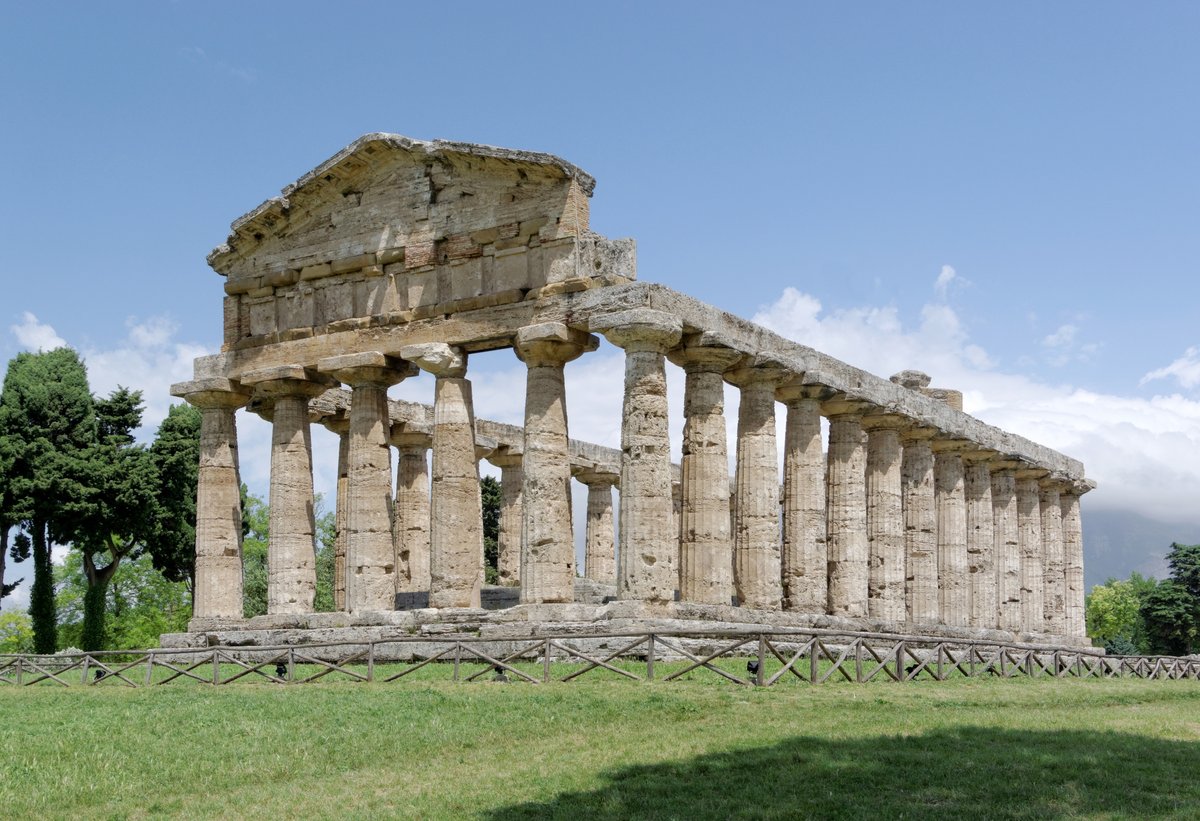
The Temple of Athena is considered the first example of the coexistence of Doric and Ionic orders in the same building. On the facade, slender Doric columns support a pediment and a frieze with metopes set into the sandstone. But the spacious pronaos housed six Ionic columns (four in front and two on the sides), of which only the bases and two capitals with an ornate collar remain. This detail makes it unique in the panorama of Magna Graecia. The cella, raised about a meter high, housed the statue of the goddess. The original polychromy must have been splendid. During excavations in 1937, Amedeo Maiuri discovered architectural terracottas that allowed the reconstruction of the archaic roof, one of the oldest in Poseidonia. The temple has 6 frontal columns and 13 lateral columns, all of the same size and shape.
A Mix of Styles: First Example of Mixed Orders
The Temple of Athena is considered the first example of the coexistence of Doric and Ionic orders in the same building. On the facade, slender Doric columns support a pediment and a frieze with metopes set into the sandstone. But the spacious pronaos housed six Ionic columns (four in front and two on the sides), of which only the bases and two capitals with an ornate collar remain. This detail makes it unique in the panorama of Magna Graecia. The cella, raised about a meter high, housed the statue of the goddess. The original polychromy must have been splendid. During excavations in 1937, Amedeo Maiuri discovered architectural terracottas that allowed the reconstruction of the archaic roof, one of the oldest in Poseidonia. The temple has 6 frontal columns and 13 lateral columns, all of the same size and shape.
Three Reasons Not to Miss It
First: it is the oldest temple in Paestum, with an intimate atmosphere that sets it apart from its larger siblings. Second: the discovery of the artificial hill is a fascinating story that changes your perception of the place – you are not on a simple hillock, but on a man-made platform. Third: the architectural contrast with the Temple of Neptune and the Basilica offers a complete view of the evolution of Greek architecture in Italy. Moreover, the temple is less crowded, ideal for those seeking a more intimate contact with history. Bring binoculars to admire the details of the frieze and the Ionic capitals. The combined ticket for the Archaeological Park includes all three temples and the museum.
Three Reasons Not to Miss It
First: it is the oldest temple in Paestum, with an intimate atmosphere that sets it apart from its larger siblings. Second: the discovery of the artificial hill is a fascinating story that changes your perception of the place – you are not on a simple hillock, but on a man-made platform. Third: the architectural contrast with the Temple of Neptune and the Basilica offers a complete view of the evolution of Greek architecture in Italy. Moreover, the temple is less crowded, ideal for those seeking a more intimate contact with history. Bring binoculars to admire the details of the frieze and the Ionic capitals. The combined ticket for the Archaeological Park includes all three temples and the museum.
The Right Time to Visit
The park is open year-round, but I recommend visiting in spring or autumn when temperatures are mild and the light is low. In the early morning or late afternoon, the temple glows with a golden light that enhances the colors of the travertine. In summer, it’s best to avoid the midday hours due to heat and crowds. The artificial hill creates shifting shadows that change throughout the day: at sunset, the temple seems to float over the plain. If you’re a photographer, aim for the golden hour. The eruption of Mount Vesuvius in 79 AD left traces in the soil, but the view today is serene and evocative.
The Right Time to Visit
The park is open year-round, but I recommend visiting in spring or autumn when temperatures are mild and the light is low. In the early morning or late afternoon, the temple glows with a golden light that enhances the colors of the travertine. In summer, it’s best to avoid the midday hours due to heat and crowds. The artificial hill creates shifting shadows that change throughout the day: at sunset, the temple seems to float over the plain. If you’re a photographer, aim for the golden hour. The eruption of Mount Vesuvius in 79 AD left traces in the soil, but the view today is serene and evocative.
What to See Nearby
In addition to the other two temples, the Temple of Neptune and the Basilica, don’t miss the National Archaeological Museum of Paestum, which houses the site’s artifacts, including the famous painted tombs like the Tomb of the Diver. A few kilometers away, the medieval village of Capaccio Vecchio offers a stunning view of the Sele plain and the Gulf of Salerno. For a gastronomic break, stop at one of the local educational farms to taste buffalo mozzarella DOP or Paestum artichokes. If you have time, also visit the nearby town of Agropoli with its castle.
What to See Nearby
In addition to the other two temples, the Temple of Neptune and the Basilica, don’t miss the National Archaeological Museum of Paestum, which houses the site’s artifacts, including the famous painted tombs like the Tomb of the Diver. A few kilometers away, the medieval village of Capaccio Vecchio offers a stunning view of the Sele plain and the Gulf of Salerno. For a gastronomic break, stop at one of the local educational farms to taste buffalo mozzarella DOP or Paestum artichokes. If you have time, also visit the nearby town of Agropoli with its castle.