
The province of Vercelli is famous for its rice fields, but it also hides a remarkable historical heritage. This 2-day itinerary takes you to discover three castles and Lucedio Abbey, set in a unique landscape. Start from Moncrivello Castle, dating back to the 12th century, surrounded by moats and rice fields. Continue to Buronzo Castle with its crenellated tower, and then to Vettignè Castle, overlooking the hills. The second day is dedicated to the Sacro Monte di Varallo, a UNESCO site since 2003, with 45 frescoed chapels that tell the story of Jesus’ life. A route that combines nature, spirituality, and medieval architecture, ideal for an off-the-beaten-path weekend. The green roads will give you breathtaking views among rice fields and canals. A slow journey that will make you fall in love with authentic Piedmont.
🗺️ Your trip at a glance
A perfect itinerary for those seeking an experience between history and nature, away from the crowds. The castles, rice fields, and Sacro Monte will give you unforgettable memories.
- Ideal for travelers who love history and nature, with an eye to culture and spirituality.
- Highlights: three medieval castles, endless rice fields, and a UNESCO Sacro Monte. Slow itinerary on secondary roads.
- For whom? Enthusiasts of cultural tourism, photographers, and families seeking an adventure out of town.
Itinerary stops
Day 1 – Stop no. 1
Monument to the Mondina: A Tribute to the Rice Field Women
 The first stop on our itinerary could only be a tribute to the true protagonists of the rice fields: the mondine. In Vercelli, in Piazza Roma, you’ll find the Monument to the Mondina, a work by sculptor Agenore Fabbri inaugurated in April 1984 in the presence of President Pertini. The statue is anything but predictable: the woman is depicted standing, with a proud and accusatory gesture, one hand clutching rice stalks and the other reaching forward. An expressionist style that sparked debate at the time – some criticized the bare breast, and even the mondine themselves found it unrealistic (they worked bent over). The base was meant to be a fountain evoking the water of the rice fields, but it has often remained dry due to technical issues. Today the monument is somewhat degraded, tilted and with a broken base, but it remains a landmark full of meaning for the city. It is a symbol of the hard work and dignity of the women who made Vercelli the rice capital. A quick stop to pay homage before venturing among castles and abbeys.
- Piazza Roma, Vercelli (VC)
- Open in Google Maps
- View on Google Images

You should go if…
Day 1 – Stop no. 2
Castle of Moncrivello
 Perched atop the only hill in the area, the Castle of Moncrivello welcomes you with its mighty crenellated walls. Its origins date back to the 11th century, but it was in the 15th century that it experienced its golden age thanks to Duchess Yolande of France, who transformed the ancient fortress into an elegant noble residence. The courtly atmosphere still lingers: climb the spiral staircase, admire the coffered ceilings and terracotta fireplaces, and then lean out from the Ghibelline battlements. The history is filled with noblewomen such as Bianca of Monferrato and Beatrice of Portugal, but also sieges and fires. Declared a national monument in 1908, after years of neglect it was restored starting in 1972. Today it is a private residence used for events and ceremonies, and it can be visited by appointment on certain Sundays of the month. A place that blends medieval and Renaissance charm, with a view that stretches over the rice fields and the moraine amphitheater.
- Via Duchessa Jolanda, Moncrivello (VC)
- Open in Google Maps
- View on Google Images
You should go if…
Day 1 – Stop no. 3
The Consortile Castle of Buronzo
 Leaving Castello di Moncrivello behind, you expect a fortress, but this is different. The Consortile Castle of Buronzo is a European unicum: seven noble residences fused into a single labyrinth of courtyards and halls. Go up the stairs and you find yourself in the Appartamento delle Imprese, five rooms with coffered ceilings and a continuous frieze of allegorical figures: here the salamander of Mario Bevilacqua, there the elephant squeezing a grape cluster, taken from sixteenth-century texts. Every motto is a moral riddle. The eighteenth-century loggia offers a view that embraces rice fields, the Prealps, and on clear days, Monte Rosa. After the restorations of 2006-2008 (6 million euros), it is now managed by the municipality and volunteers from the Friends of the Castle. Open on selected Sundays – check the calendar – and by reservation for groups. Admission 5 euros, free up to age 14. Here you are not in a castle, you are inside the history of an entire family.
- Via Chiesa, Buronzo (VC)
- http://www.castellodiburonzo.it/
- Open in Google Maps
- View on Google Images
You should go if…
Day 2 – Stop no. 4
Castle of Vettignè: Between History and Decay
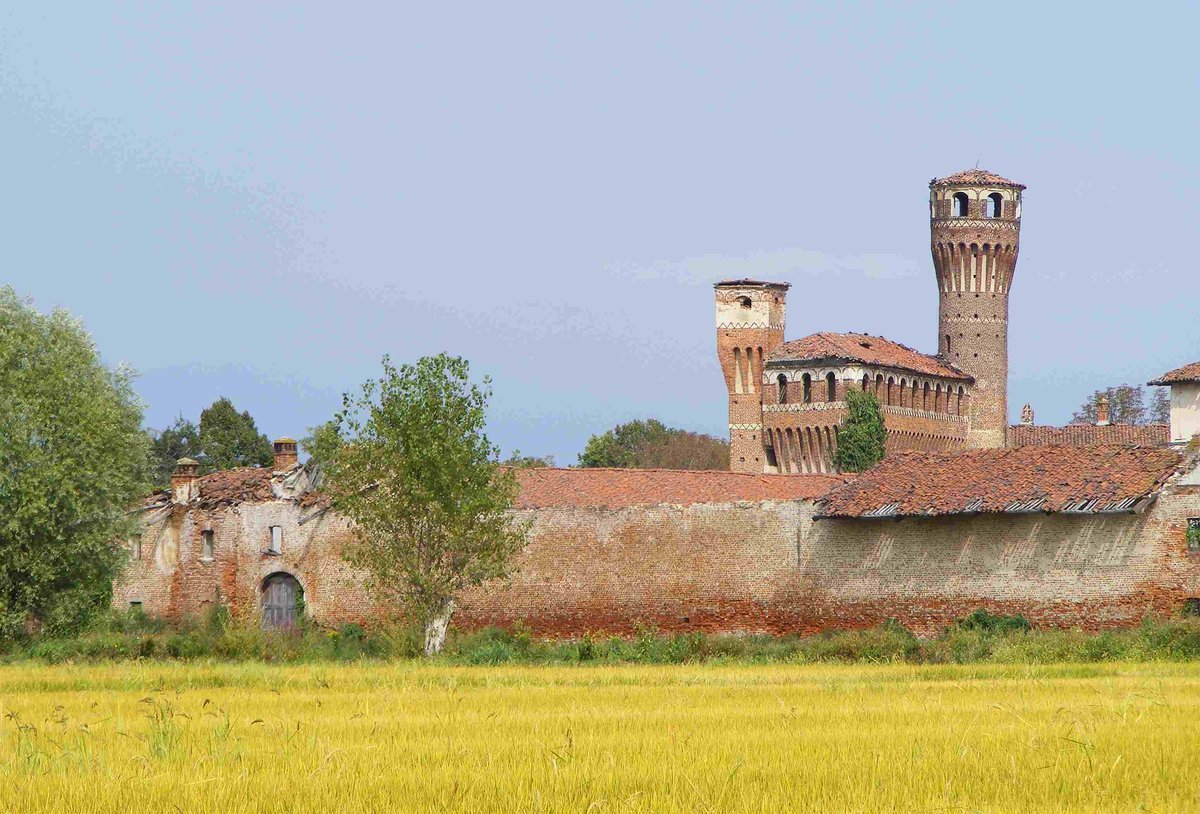 After Buronzo, take the SP52 and within minutes you arrive at Vettignè, a hamlet of Santhià. Here the castle is a different story: abandoned since the 1960s, today it’s a ghost of swallowtail battlements and cylindrical towers, surrounded by endless rice fields. Its origins date back to the 15th century, when it served as a crossroads between the Via Francigena and the Via Svizzera – hence the name Vettignè, from the Latin Vectigal (toll). Passed to the Savoy family in 1867 with the marriage of Maria Vittoria Dal Pozzo della Cisterna and Amedeo of Savoy, it was later sold to private owners. Today the village has few inhabitants, but things are stirring: the estate houses a B&B in the ancient inn and, in the courtyard, ‘Passatempo di Enrica’, a camper area with grass, electricity, and showers. Perfect for those who love a decadent and authentic atmosphere. Note: the castle is in ruins, not accessible inside, but the view is striking.
- SP52, Santhià (VC)
- Open in Google Maps
- View on Google Images
You should go if…
Day 2 – Stop no. 5
Sacro Monte di Varallo
 Last stop of the day, but certainly not the least important: the Sacro Monte di Varallo, a UNESCO World Heritage site since 2003. Conceived by Friar Bernardino Caimi in 1491 as the “New Jerusalem”, it is the oldest of the Sacri Monti. Here, 44 chapels populated by over 800 terracotta and wood statues and 4000 frescoes tell the story of Christ’s life. The absolute masterpiece is the Cappella della Crocifissione by Gaudenzio Ferrari, a triumph of realism that leaves you breathless. Climbing on foot from the center of Varallo (20-minute uphill walk) or by the cable car – the steepest in Europe – you reach a plateau that looks like a fortified citadel, with squares, arcades, and the Basilica dell’Assunta. The atmosphere is unique: mystical and theatrical, with the backdrop of Monte Rosa. Free admission, paid parking. Don’t miss the wooden statue of the Sleeping Madonna brought by Caimi from the East. A perfect ending for two days between history and nature.
You should go if…


