
If you have only one day to visit Cremona, this walking itinerary will take you straight to the heart of the city, from the iconic Torrazzo to the famous Violin Museum. In 5 compact stops, you’ll discover the charm of the Cathedral, the prestigious Ponchielli Theatre, and the collections of the Ala Ponzone Civic Museum. A route combining art, history, and music, perfect for those who love a cultural itinerary without rush. The Torrazzo, at 112 meters, is Italy’s tallest medieval bell tower and offers breathtaking views of the Po Valley. Next to it, the Cathedral of Santa Maria Assunta will surprise you with its Romanesque frescoes. Then, a stroll leads you to the Ponchielli Theatre, a 19th-century gem, and the Ala Ponzone Civic Museum with paintings and sculptures. The final stop is the Violin Museum, where you can admire Cremonese lutherie instruments, including the legendary Stradivari. A complete experience that will make you fall in love with Cremona in just a few hours.
🗺️ Your trip at a glance
A compact yet rich itinerary, ideal for a weekend or a day trip. Cremona offers you art, music, and history in a walkable route perfect for strolling.
- Ideal for: city breakers and music enthusiasts wanting to discover the cradle of the violin.
- Highlights: Torrazzo (unique view), Violin Museum (historic instruments), historic center at a leisurely pace.
- For: curious travelers with limited time but eager to immerse in local culture.
Itinerary stops
Stop no. 1
The Torrazzo: the symbol of Cremona
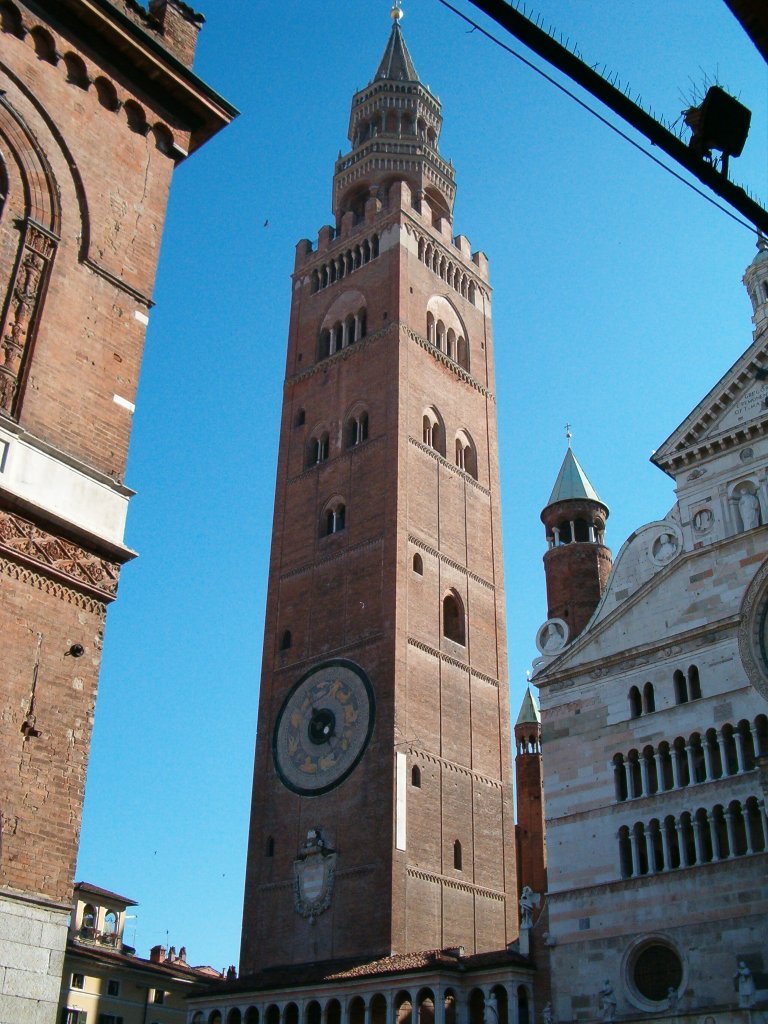 We start the day from the highest point of Cremona: the Torrazzo, the bell tower that soars to 112.54 meters next to the Cathedral. Built between 1230 and 1309, it is the tallest medieval brick tower in Italy. The double-barrel structure is an engineering masterpiece: you climb through a cavity of 502 steps that, I admit, test your legs a bit, but it’s worth it. On the fourth floor, the largest astronomical clock in the world (1583-1588) awaits you, with a dial over 8 meters that marks lunar phases, constellations, and even eclipses thanks to a dragon-shaped hand. Right after, the Vertical Museum (open since 2018) immerses you in the history of time measurement. From the final terrace, the 360° view stretches over the city, the Po River, and on clear days, all the way to the Alps. An itinerary start that combines effort, history, and unforgettable panoramas.
- Largo Boccaccino, Cremona (CR)
- Open in Google Maps
- View on Google Images

You should go if…
Stop no. 2
Cathedral of Santa Maria Assunta
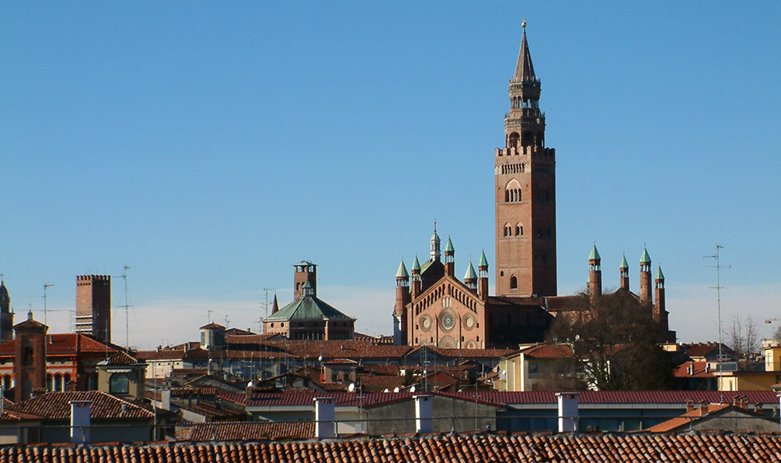 After admiring the Torrazzo, crossing the threshold of Cremona Cathedral is like stepping into an art history book. Construction began in 1107, but an earthquake ten years later forced a reconstruction that left visible traces to this day. The façade, a blend of Romanesque, Gothic, and Renaissance elements, is dominated by the 13th-century rose window and the 14th-century porch. Inside, the central nave is a triumph of 16th-century frescoes: Boccaccino, Bembo, Melone, Romanino, and Pordenone painted the life of Mary and Jesus in a cycle that enchants with its vibrancy and detail. Don’t miss the crypt, where the ancient shrine of martyrs Marcellinus and Peter rests, and the two Renaissance pulpits with reliefs attributed to Amadeo. Admission is free, but it’s worth climbing the Torrazzo with a combination ticket. The light filtering through the rose window creates an almost mystical atmosphere: take time to sit and observe.
- Go to the page: Cremona Cathedral: Renaissance Frescoes and Record-Breaking Torrazzo
- Piazza del Comune, Cremona (CR)
- Open in Google Maps
- View on Google Images
You should go if…
Stop no. 3
Violin Museum
 Leave the Duomo behind and immerse yourself in the history-laden silence of the Violin Museum, just steps from the main square. Housed in the Palazzo dell’Arte (a 1941 building renovated and opened in 2013), this museum is a sensory journey into Cremonese violin-making tradition, a UNESCO heritage. Inside, the Treasure Chest holds 12 iconic instruments, from the Carlo IX violin by Andrea Amati (1566) to the most recent by Simone Fernando Sacconi (1941). The Friends of Stradivari section displays masterpieces by Stradivari, Guarneri del Gesù, and other masters, rarely seen elsewhere. Don’t miss the reconstruction of a luthier’s workshop, where a craftsman works wood as in the old days, and the Giovanni Arvedi Auditorium, praised for its exceptional acoustics, where you can hear a Stradivari live during weekend auditions. The tour is completed by multimedia installations and a collection of contemporary lutherie. Open Tuesday to Sunday, with varying hours (check the website for updates); full ticket is 14 euros (audition included). A place that moves both enthusiasts and the simply curious.
- Piazza Guglielmo Marconi 5, Cremona (CR)
- https://www.museodelviolino.org/it/
- Open in Google Maps
- View on Google Images
You should go if…
Stop no. 4
Teatro Ponchielli
 After the Museo del Violino, you will visit one of Italy’s oldest and most enchanting theatres. The Teatro Ponchielli, on Corso Vittorio Emanuele II, has a history that begins in 1747: commissioned by the Cremonese nobility and designed by Giovanni Battista Zaist, it was destroyed by two fires and rebuilt in Neoclassical style by Luigi Canonica, a pupil of Piermarini. The horseshoe-shaped auditorium, with four tiers of boxes and one of Italy’s largest stages, still retains the historic curtain painted by Antonio Rizzi in 1891, depicting the allegory of music. Here you can breathe in the great operatic tradition: the theatre is named after the Cremonese composer Amilcare Ponchielli, and every year it hosts the Monteverdi Festival, as well as seasons of opera, theatre, and dance. Don’t miss the foyer and the red room, where two instruments once owned by Ponchielli are displayed. The theatre is open to the public with guided tours by reservation; for shows, the box office is open Monday to Friday (10:00-18:00) and weekends (10:00-13:00). A place that tells centuries of culture, thrilling for any music and history enthusiast.
- Corso Vittorio Emanuele II 52, Cremona (CR)
- https://www.teatroponchielli.it/
- Open in Google Maps
- View on Google Images
You should go if…
Stop no. 5
Museo Civico Ala Ponzone: Unmissable Masterpieces
 After the theater, the itinerary concludes at the Museo Civico Ala Ponzone, housed since 1928 in the elegant 16th-century Palazzo Affaitati on Via Ugolani Dati. The core of the collection comes from the legacy of Marquis Giuseppe Sigismondo Ala Ponzone, who in 1842 donated his collections to the city for educational purposes. Today, the art gallery boasts over two thousand works, though only a portion is on display. The tour is chronological: starting with the Middle Ages with sculptures and frescoes, moving to the 16th century in Cremona with the Bembo and Campi families, and culminating in two absolute gems: Caravaggio’s Saint Francis in Meditation and Giuseppe Arcimboldo’s famous The Vegetable Gardener (Ortolano), a double-sided painting that is a true masterpiece of the still-life genre. Not to be missed: the Sala del Platina, with its inlaid cabinet from the Cathedral, and the Stanze per la Musica (Music Rooms), which house an extraordinary collection of antique string instruments. The museum is open Tuesday to Sunday, closed on Mondays. A perfect finale to a day dedicated to art and music.
- Via Ugolani Dati 4, Cremona (CR)
- https://musei.comune.cremona.it/it/musei/museo-civico-ala-ponzone
- Open in Google Maps
- View on Google Images
You should go if…

