
Lecco in a day is possible with this walking itinerary that covers the city’s most iconic spots. Start at Villa Manzoni, where Alessandro Manzoni wrote part of The Betrothed, now a museum. A short walk away, the Archaeological Museum tells the story of the area. Heading up to the historic center, you’ll find the Torre di San Nicolò, a medieval symbol with a stunning view of the lake and mountains. The route continues along the lakeside promenade, perfect for a break with gelato or coffee. Each stop is just a short distance apart, ideal for those who love a leisurely stroll. A tour that combines art, history, and picture-perfect landscapes, in a day that will stay in your memory.
🗺️ Your trip at a glance
A walking itinerary to discover Lecco in a day: culture and views just steps away. Ideal for those who love art and the lake.
- Ideal for: families and visitors short on time.
- Highlights: Villa Manzoni, museums, tower, and lakeside.
- Why choose it: easy route, close stops, spectacular views.
Itinerary stops
Stop no. 1
Villa Manzoni: The Literary Heart of Lecco
 We begin the itinerary right here, at Villa Manzoni, the historic residence of the writer’s family. With its neoclassical facade punctuated by sandstone moldings, the villa welcomes you with a porticoed courtyard and an Italian-style garden. Ascending to the piano nobile, you’ll find the original furnishings from 1818 and the Manzoni Museum, where first editions, manuscripts, and personal memorabilia recount the creation of The Betrothed. I was struck by the breathtaking view of the lake and Mount Resegone from the windows: you immediately understand where Manzoni drew his inspiration. On the second floor, the Municipal Art Gallery exhibits works by local artists, including Ennio Morlotti. I recommend dedicating at least an hour to savor every room: it’s a dive into the 19th century that you won’t forget.
- Go to the page: Villa Manzoni in Lecco: The House-Museum with Original Furnishings and Garden on Lake Como
- Via Giovanni Amendola, Lecco (LC)
- Open in Google Maps
- View on Google Images

You should go if…
Stop no. 2
Archaeological, Historical and Natural History Museum
 Continuing towards Corso Matteotti, the second gem of the day is the Archaeological, Historical and Natural History Museum, housed in the underground rooms of Palazzo Belgiojoso. Inaugurated in 2001, this museum tells the story of human evolution in the Lecco area from the Paleolithic to the Early Middle Ages. The itinerary is divided by period: from the Mesolithic to the Polada culture, from the Golasecca civilization to the La Tène Celts, up to Romanization. Among the most fascinating finds, the engraved menhir of Ello, dating back to the Copper Age, stands out, along with the room dedicated to metallurgy, a tribute to the local industrial tradition. Reconstructions of environments and clothing, together with faithful copies made using experimental archaeology techniques, make the visit vivid and engaging. The museum is part of the Lecco Urban Museum System and admission is free. An unmissable stop for those who love to discover the deep roots of the territory.
- Corso Giacomo Matteotti 32, Lecco (LC)
- http://www.museilecco.org/oraritariffe.htm
- Open in Google Maps
- View on Google Images
You should go if…
Stop no. 3
San Nicolò Tower: The ‘Matitone’
 After the Archaeological Museum, it’s time to look up: the San Nicolò Tower, affectionately called the “Matitone” by locals for its slender shape, dominates the city with its 96 meters of height. If you’re up for the climb (and facing 400 steps, no elevator), the reward is an incredible view: Lake Como, the mountains, the historic center. The neo-Gothic bell tower was built between 1882 and 1904 on an old Spanish defensive bastion, and its story is also that of a community: work stopped in 1894 due to lack of funds, but citizens raised the money to complete it. On Christmas night 1904, the concert of 9 bells (the largest weighs 27 quintals) rang out for the first time. But beware: the climb is not suitable for those suffering from vertigo or claustrophobia, and children under 6 cannot go up. But if you can make it, it’s one of the most authentic experiences in Lecco.
- Via San Nicolò, Lecco (LC)
- https://www.campaniledilecco.it/
- Open in Google Maps
- View on Google Images
You should go if…
Stop no. 4
Former Hotel Croce di Malta
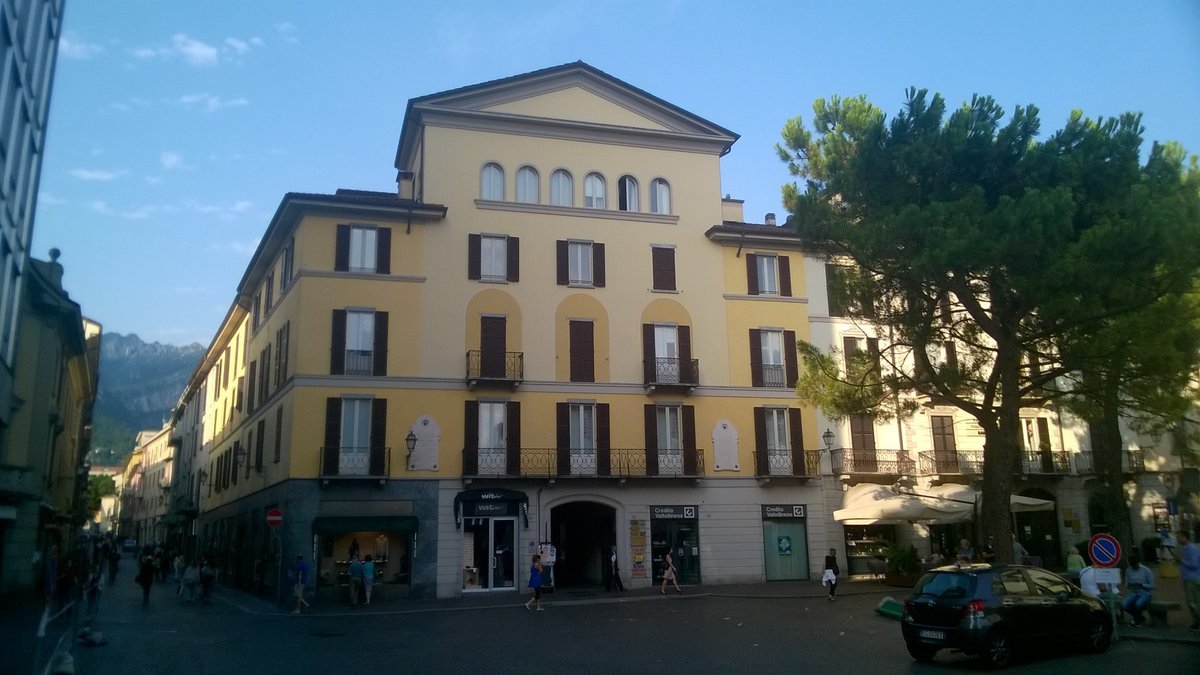 After leaving the tower, you find yourself in Piazza Garibaldi, and the building that catches your eye is the former Hotel Croce di Malta. There are no hotel rooms here anymore, but its façade tells incredible stories: on its walls, two marble plaques commemorate the visits of Giuseppe Garibaldi (four stays between 1859 and 1866) and Giosuè Carducci, who came for the inauguration of the monument to Manzoni. But it doesn’t end there: in July 1839, the painter and statesman Massimo d’Azeglio also stayed there, writing to his wife about the hardships of the journey in Valsassina. During World War II, the hotel became a German command post and later Allied headquarters. Its balconies echoed with political speeches, such as that of Pietro Nenni, and within its walls, trade unionist Giuseppe Di Vittorio died in 1957. The hotel closed its doors on October 1, 1993, and today it has been converted into private residences, but strolling here, it’s easy to imagine the carriages and characters that have walked this square.
- Via Roma, Lecco (LC)
- Open in Google Maps
- View on Google Images
You should go if…
Stop no. 5
Monument to Mario Cermenati
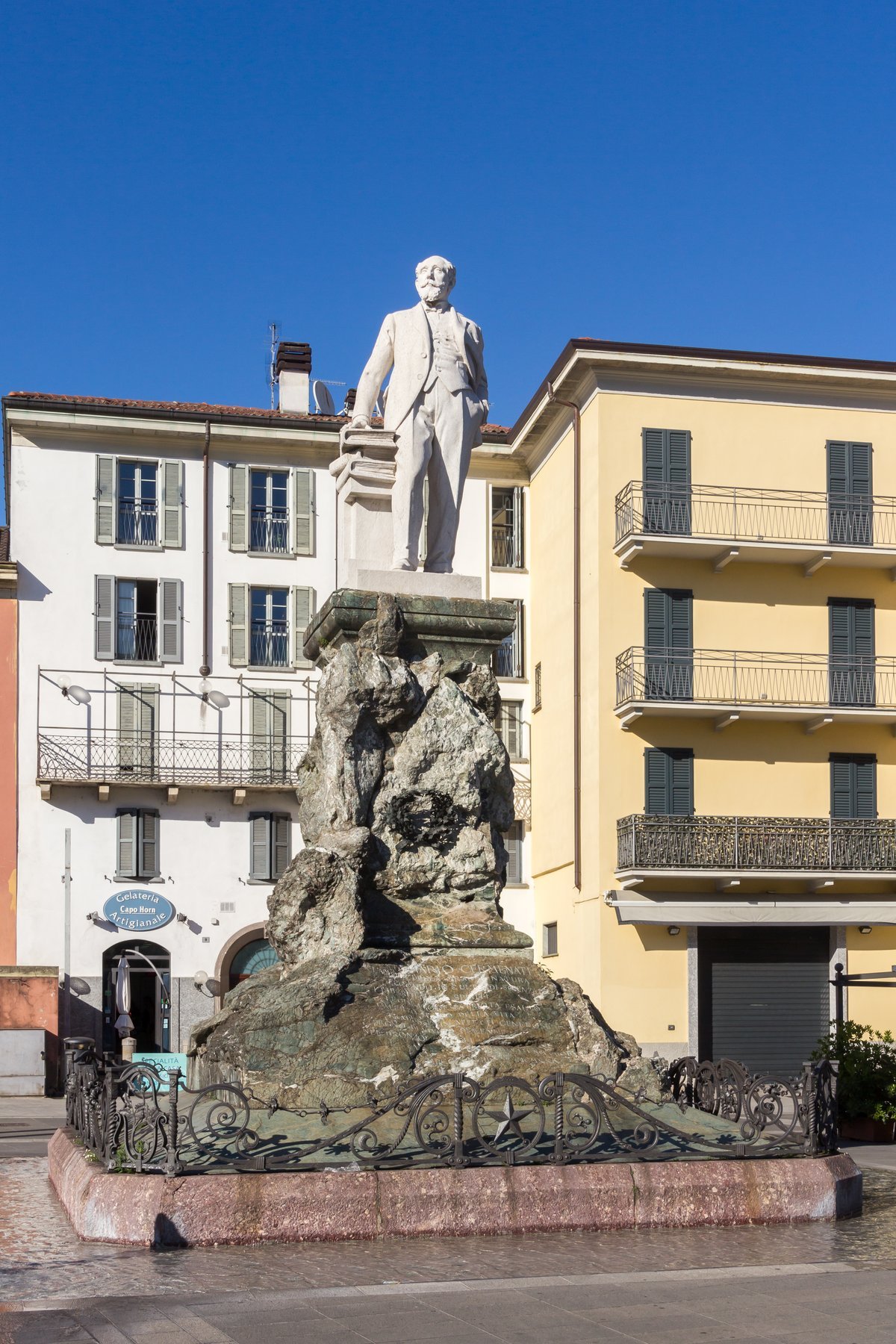 After leaving the square of the former Hotel Croce di Malta, you find yourself in one of the most scenic squares of Lecco: Piazza Mario Cermenati. At the center, the marble statue of this naturalist and geologist from Lecco, created by Francesco Modena, replaces the original bronze one that was melted down during the war. Observe the right hand resting on three volumes: they symbolize his interests in Leonardo, geology, and the history of science. The base, which mimics a rocky mass (in line with his studies), bears an epigraph by the poet Giovanni Bertacchi. Around it, a wrought-iron railing and four fountains at the cardinal points create a fresh atmosphere. From here, the view stretches over the Basilica of San Nicolò and Lake Como. It is said that the statue was placed with its back to the basilica due to dissent toward the clergy: a detail that adds charm to this corner of history.
- Piazza Mario Cermenati, Lecco (LC)
- Open in Google Maps
- View on Google Images
You should go if…
Stop no. 6
War Memorial: Memory and Sculpture by the Lake
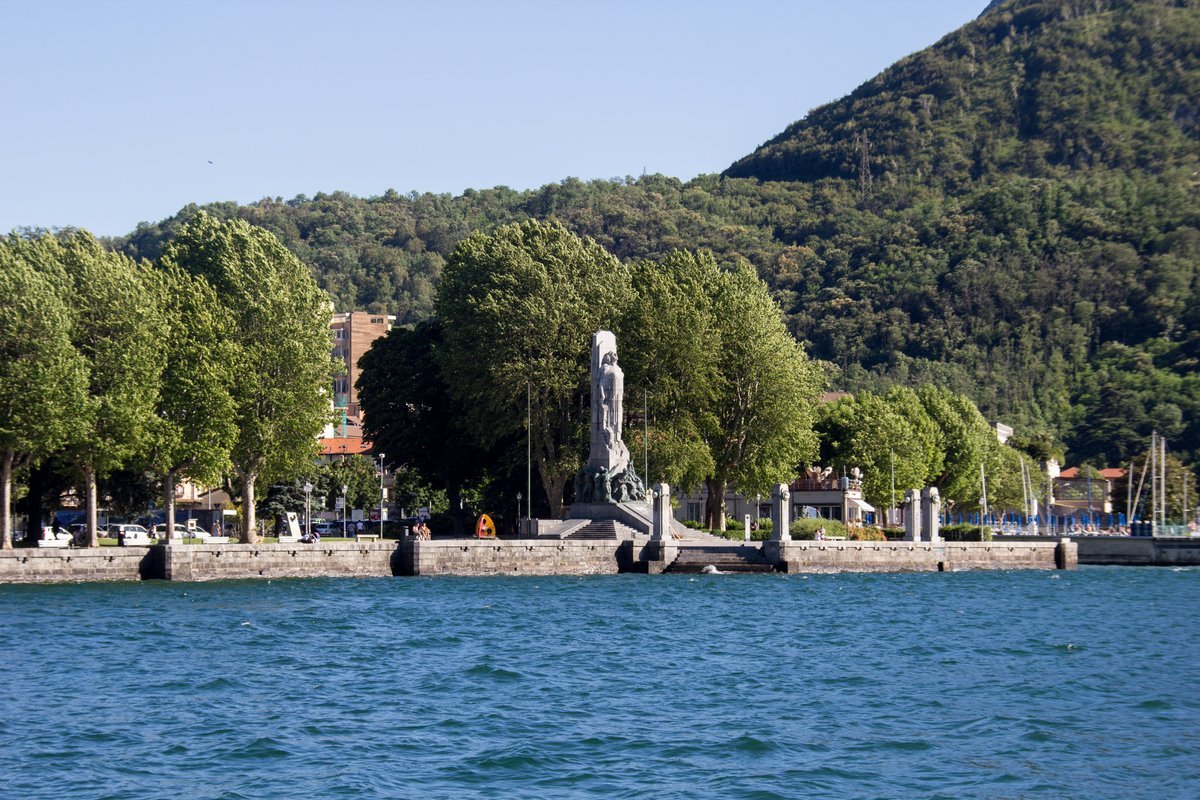 Continuing along the lakeside, you reach the city’s most imposing monument: the stele by Giannino Castiglioni, inaugurated in 1926. The female figure on top, with folded wings and face turned to the sky, is the symbol of the grieving homeland – locals affectionately call it ‘la balìa de pèss’. At the base, a series of bronze bas-reliefs tell the story of the soldier’s departure, farewell to family, and victorious fall. Between the granite and the lake, the atmosphere is solemn yet intimate: you will stop to read the inscribed names, including those who fell in Africa and World War II. After the 2017 restoration, the monument has returned to its original splendor, perfectly integrated into the lakeside landscape.
- Riva Martiri delle Foibe, Lecco (LC)
- Open in Google Maps
- View on Google Images
You should go if…
Stop no. 7
Church of St. George
 Leave the war memorial behind, walk down Via Don Abbondio and reach the churchyard of the Church of St. George, in the heart of the Acquate district. Here, among low houses and cobblestones, you are welcomed by a building steeped in history: the first records date back to the 13th century, but its current appearance is the result of a 19th-century reconstruction designed by Adriano Gazzari. The neoclassical façade, with its tetrastyle pronaos and Tuscan columns, conceals a single-nave interior embellished with artworks: notable are the altarpiece of the Nativity by Jacopo Palma the Younger, a 17th-century canvas of Saint Catherine attributed to Camillo Procaccini, and the 19th-century organ donated by Maximilian of Habsburg-Lorraine. Don’t miss the lunette above the entrance, with the artistic stained glass of the Trinity, and the bell tower that rises over the village. The church is linked to Manzoni’s places – it was here that Renzo and Lucia would have married – and the atmosphere is intimate, almost timeless. Take a moment to sit on a bench and listen to the silence broken only by the chiming of the bells.
- Sagrato don Abbondio, Lecco (LC)
- https://www.lombardiabeniculturali.it/istituzioni/schede/8114088/
- Open in Google Maps
- View on Google Images
You should go if…

