Welcome to Piazza San Marco
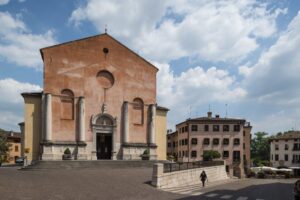
Stepping into the Co-Cathedral of St. Mark is like diving into the history of Pordenone. The deliberately unfinished facade hides a treasure of art and spirituality. You’re immediately struck by the bell tower nearly 80 meters high, one of the most elegant in Italy, soaring over the square like a lighthouse. Then, crossing the threshold of Pilacorte’s Renaissance portal, you find yourself in an intimate and cozy interior, where the works of Pordenone – frescoes and altarpieces – seem to speak to you up close. There’s no crowd, only the flicker of candles and the silence broken every so often by a curious tourist. It’s a place that takes you by surprise: you expect a provincial church, and instead you find masterpieces of European stature.
Welcome to Piazza San Marco
Stepping into the Co-Cathedral of St. Mark is like diving into the history of Pordenone. The deliberately unfinished facade hides a treasure of art and spirituality. You’re immediately struck by the bell tower nearly 80 meters high, one of the most elegant in Italy, soaring over the square like a lighthouse. Then, crossing the threshold of Pilacorte’s Renaissance portal, you find yourself in an intimate and cozy interior, where the works of Pordenone – frescoes and altarpieces – seem to speak to you up close. There’s no crowd, only the flicker of candles and the silence broken every so often by a curious tourist. It’s a place that takes you by surprise: you expect a provincial church, and instead you find masterpieces of European stature.
Historical Overview
The origins of the Duomo date back to the 13th century, when a single-nave church was built on a pre-existing chapel. In 1347 the bell tower was completed, but the earthquake of 1348 halted work. Reconstruction in Romanesque-Gothic style began in 1363 and the consecration took place on 2 October 1468. Between the 15th and 16th centuries, artists such as Giovanni Antonio Pilacorte (portal, holy water stoup, baptismal font) and Giovanni Antonio de’ Sacchis, known as Il Pordenone, arrived, leaving some of his most famous works here. The 1976 earthquake damaged the building, but subsequent restorations have brought to light medieval frescoes and original structures.
Historical Overview
The origins of the Duomo date back to the 13th century, when a single-nave church was built on a pre-existing chapel. In 1347 the bell tower was completed, but the earthquake of 1348 halted work. Reconstruction in Romanesque-Gothic style began in 1363 and the consecration took place on 2 October 1468. Between the 15th and 16th centuries, artists such as Giovanni Antonio Pilacorte (portal, holy water stoup, baptismal font) and Giovanni Antonio de’ Sacchis, known as Il Pordenone, arrived, leaving some of his most famous works here. The 1976 earthquake damaged the building, but subsequent restorations have brought to light medieval frescoes and original structures.
The Works of Pordenone
The Cathedral is a veritable gallery of Pordenone, who left here both his first known work and his last, unfinished. On the right octagonal pillar, three frescoes stand out: the Madonna and Child (before 1506), Saint Erasmus (1512-14), and the famous Saint Roch (1515-18), traditionally considered a self-portrait. Behind the high altar, the large Altarpiece of Saint Mark consecrating Saint Hermagoras (1533-35) is a powerful but unfinished work. Don’t miss the Altarpiece of the Madonna of Mercy, restored in 2006, and the baptistery doors (now in the Civic Museum) with scenes from the life of Saint John the Baptist. Each work tells a piece of the artist’s life and the city’s.
The Works of Pordenone
The Cathedral is a veritable gallery of Pordenone, who left here both his first known work and his last, unfinished. On the right octagonal pillar, three frescoes stand out: the Madonna and Child (before 1506), Saint Erasmus (1512-14), and the famous Saint Roch (1515-18), traditionally considered a self-portrait. Behind the high altar, the large Altarpiece of Saint Mark consecrating Saint Hermagoras (1533-35) is a powerful but unfinished work. Don’t miss the Altarpiece of the Madonna of Mercy, restored in 2006, and the baptistery doors (now in the Civic Museum) with scenes from the life of Saint John the Baptist. Each work tells a piece of the artist’s life and the city’s.
The Bell Tower and the City View
The bell tower of the Duomo is one of Pordenone’s landmarks. Standing 79.47 meters tall, it is considered among the most beautiful in Italy for its slender profile and 17th-century octagonal spire. With a reservation, you can climb up to the bell chamber and enjoy a 360° panoramic view of the city and the surrounding hills. The ascent is on foot (about 130 steps), but the effort is rewarded by the vista stretching from the historic center to the Carnic Prealps. Along the way, you’ll encounter historic bells and small architectural details that tell centuries of history. An experience not to be missed, especially at sunset when golden light bathes Piazza San Marco.
The Bell Tower and the City View
The bell tower of the Duomo is one of Pordenone’s landmarks. Standing 79.47 meters tall, it is considered among the most beautiful in Italy for its slender profile and 17th-century octagonal spire. With a reservation, you can climb up to the bell chamber and enjoy a 360° panoramic view of the city and the surrounding hills. The ascent is on foot (about 130 steps), but the effort is rewarded by the vista stretching from the historic center to the Carnic Prealps. Along the way, you’ll encounter historic bells and small architectural details that tell centuries of history. An experience not to be missed, especially at sunset when golden light bathes Piazza San Marco.
Why Visit It
Three reasons to include the Duomo in your itinerary: 1) Masterpieces by Pordenone: here you can admire the entire creative arc of one of the greatest painters of the Venetian Renaissance, with works spanning from his youth to old age. 2) The panoramic bell tower: climbing the tower gives you a unique perspective on Pordenone, with a view that embraces mountains and plains. 3) Authentic atmosphere: far from mass tourist circuits, the Duomo retains an air of devotion and everyday life – the 7 a.m. Mass, the faithful entering for a prayer, the silence broken only by the chiming of the hours. A living place, not a museum.
Why Visit It
Three reasons to include the Duomo in your itinerary: 1) Masterpieces by Pordenone: here you can admire the entire creative arc of one of the greatest painters of the Venetian Renaissance, with works spanning from his youth to old age. 2) The panoramic bell tower: climbing the tower gives you a unique perspective on Pordenone, with a view that embraces mountains and plains. 3) Authentic atmosphere: far from mass tourist circuits, the Duomo retains an air of devotion and everyday life – the 7 a.m. Mass, the faithful entering for a prayer, the silence broken only by the chiming of the hours. A living place, not a museum.
When to Visit and Nearby
The best time to visit the Duomo is early in the morning, when light filters through the stained glass and illuminates the frescoes by Pordenone. If possible, choose a weekday to avoid crowds – Saturdays are livelier for guided tours. In autumn, the bell tower is tinged with the warm colors of foliage. Nearby, just a few steps away is Piazza XX Settembre with its porticoes and historic cafés, perfect for an aperitivo. A short distance away, the Civic Art Museum (Palazzo Ricchieri) houses more works by Pordenone, including the baptismal font doors. A walk to the Noncello River completes the morning with art and nature.
When to Visit and Nearby
The best time to visit the Duomo is early in the morning, when light filters through the stained glass and illuminates the frescoes by Pordenone. If possible, choose a weekday to avoid crowds – Saturdays are livelier for guided tours. In autumn, the bell tower is tinged with the warm colors of foliage. Nearby, just a few steps away is Piazza XX Settembre with its porticoes and historic cafés, perfect for an aperitivo. A short distance away, the Civic Art Museum (Palazzo Ricchieri) houses more works by Pordenone, including the baptismal font doors. A walk to the Noncello River completes the morning with art and nature.