A balcony over the city
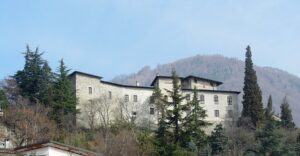
Just climb up to the Rocca’s square and your gaze takes off on its own. On one side, the Orobie Alps; on the other, the plain that on certain days reaches all the way to Milan. We are on Sant’Eufemia hill, the ancient heart of Bergamo, and this 14th-century fortress immediately conveys why the city was contested for centuries. The keep dominates, massive, with the Venetian tower recalling past dominations. Even before entering, the view is everything. Then you discover the square, the military buildings, and the greenery of the Remembrance Park. It’s not just a monument: it’s a place where Bergamo’s history enters your eyes.
Historical Background
The Rocca was founded in 1331 at the behest of John of Luxembourg and completed by Azzone Visconti in 1336. With the Venetians, who took over in 1428, came new structures: the circular tower and the bombardiers’ school. During Austrian rule, the fortress was a stage for the Risorgimento: in 1848, several patriots were executed by firing squad there. After the unification of Italy, it became a barracks and a prison; in 1933, restored, it housed the Risorgimento Museum. Since 2004, the Museum of the Nineteenth Century has told the story of the city.
- 1331-1336: construction commissioned by John of Luxembourg and completed by Azzone Visconti
- 1428: arrival of the Venetians
- 1455-1458: circular tower
- 1848: execution of patriots by firing squad
- 2004: opening of the Museum of the Nineteenth Century
A fortress to explore
There’s a real fortress feel here, not the postcard kind. Walk along the sentry walk, spot traces of the postern gate, and you’ll find the keep, 23 metres high, telling of the builders’ toil. My favourite is the Venetians’ circular tower: erected between 1455 and 1458 to withstand artillery, its shape was devised to deflect cannonballs. Close by is the bombardiers’ house, now home to the museum. And in the Memorial Park, among headstones and trees, the memory of two wars makes it all the more moving.
Museum of the Nineteenth Century: between relics and Garibaldi
Inside the bombardiers’ house — the sixteenth-century School of Bombardiers — today stands the ‘Mauro Gelfi’ Museum of the Nineteenth Century. Besides uniforms, weapons and proclamations, it preserves a rare treasure: the piano on which Garibaldi’s Hymn was played for the first time in 1858. You’ll also discover the deep connection between Bergamo and the Risorgimento: the 180 men from Bergamo who sailed with Garibaldi’s Thousand are not just a number in a book, but something you sense as you wander through the rooms. For families, there are workshops and games, the best way for children to engage with history and memory.
Why Visit It
At least three good reasons: first, the view from the tower is unforgettable—the Orobie Alps, Città Alta, and the plains stretching to Milan. Second, the museum is a real one, with artifacts and stories of the city, and a must-see for anyone passionate about the Risorgimento. Third, the Rocca is meant to be experienced: walking along the sentry path, stepping into the keep, and wandering among the memorial stones of the Parco delle Rimembranze gives you something different from the usual monuments. It’s not enormous, but every corner has a story to tell. And with the combined ticket, you can also visit the Museo dell’Ottocento stress-free.
When to go
My advice is to aim for the last hours of the afternoon. The light becomes warm, the sky lights up over the Orobie Alps, and even the plain seems to disappear into a golden haze. In spring and autumn you find clean air and colors that enhance the walls. If you’re lucky, the sunset gives an effect that lasts a few minutes but stays in your mind. Early morning is quieter, with the city waking up below you; in winter, if there’s snow on the mountains, the contrast is sharp and beautiful. In short: choose the moment with calm, not haste.
Nearby
After the Rocca, it’s worth continuing your exploration. Just a few steps away is the Citadel of Firma Fides, the other half of the defensive system commissioned by Bernabò Visconti in 1355. The ideal is to stroll between the two fortifications and soak up the atmosphere of medieval Bergamo. And for a moment of peace, the Parco delle Rimembranze is perfect: with its memorial stones and trees surrounding the Rocca, it offers a silent rest. Then, naturally, you set off again to discover Città Alta: squares, churches, and historic corners just steps away.