
🧭 What to Expect
- Upper Town: a medieval jewel with Unesco walls, squares, and alleyways to explore on foot.
- Lower Town: museums, theaters, and shops for a mix of culture and modernity.
- Funiculars: two lines connecting the two cities, offering panoramic views.
- Gastronomy: polenta e osei, casoncelli, and typical cheeses to absolutely taste.
- Ideal for: a cultural weekend, a family trip, or an artistic tour.
Events nearby

Bergamo is a city that surprises you: divided between the Upper Town, medieval and nestled within the Venetian walls, and the Lower Town, modern and lively, it offers a concentration of art, history, and good cuisine. If you're wondering what to see in Bergamo, get ready for an itinerary that starts from Piazza Vecchia, the beating heart of the old city, where the Palazzo della Ragione and the Basilica of Santa Maria Maggiore are located. Don't miss the Colleoni Chapel, a Renaissance masterpiece, and the Campanone that marks the hour every evening with 100 chimes. Then head down to the Lower Town to visit the Accademia Carrara, one of the richest art galleries in Italy, and the Donizetti Theatre, dedicated to the famous composer. For a green break, the Botanical Garden and the city parks offer relaxation. With this guide, you'll discover the stops that make Bergamo an unforgettable destination.
Overview
- Piazza Vecchia: The Renaissance Heart of Città Alta
- Basilica of Santa Maria Maggiore
- Colleoni Chapel: The Renaissance Masterpiece of the Condottiero
- Bergamo Cathedral (St. Alexander's Cathedral)
- The Campanone: The Beating Heart of Bergamo Alta
- Accademia Carrara: The Gem of Italian Art Collecting
- Teatro Donizetti: a Jewel of Music and History
- San Vigilio Castle: Bergamo's Panoramic Terrace
- Rocca of Bergamo
- Palazzo Nuovo: The 17th-century Jewel of Piazza Vecchia
- Palazzo del Podestà and the Museum of the 16th Century
- Church of San Michele al Pozzo Bianco
- Bergamo Botanical Garden 'Lorenzo Rota'
- Porta San Giacomo: the marble jewel of the Venetian Walls
- Torre del Galgario, Bergamo's Skittle
Itineraries nearby
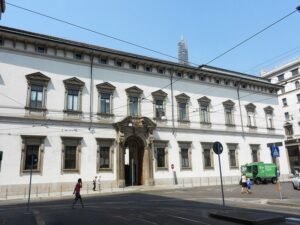
Piazza Vecchia: The Renaissance Heart of Città Alta
- Bergamo (BG)
- Open in Google Maps
- View on Google Images
 If there is one place that captures the essence of Bergamo, it's Piazza Vecchia. Located in the heart of Città Alta, this Renaissance living room seems frozen in time. Here, the buildings are arranged with such perfect geometry that Le Corbusier said you couldn't even touch a stone. At the center stands the Fontana Contarini, donated in 1780 by podestà Alvise Contarini, its sphinx-shaped spouts still offering drinking water today. Overlooking the square are architectural gems like the Palazzo della Ragione (late 12th century), the oldest Lombard town hall, and Palazzo Nuovo, which since 1873 has housed the Angelo Mai Library with its collection of incunabula and manuscripts. The Torre Civica, known as Campanone, dominates the scene and every evening at 10 p.m. chimes 100 times, re-enacting the ancient closing of the city gates. Under the portico of Palazzo della Ragione, don't miss the ancient 18th-century sundial: at noon, a ray of light filters through a shield, indicating the date and zodiac sign. As you walk, you'll notice the medieval iron measures on the side of the Basilica of Santa Maria Maggiore, once used to ensure fair trade. Our tip? Sit at a café table, order a cappuccino, and let yourself be enveloped by the timeless atmosphere. In September, the square transforms with the green installations of 'I Maestri del Paesaggio', an event that blends nature and architecture.
Basilica of Santa Maria Maggiore
- Go to the page: Basilica of Santa Maria Maggiore: Florentine Tapestries and Baroque Stuccoes in Bergamo Alta
- Piazza Padre Reginaldo Giuliani, Bergamo (BG)
- Open in Google Maps
- View on Google Images
 Stepping into the Basilica of Santa Maria Maggiore is like moving from one world to another. Outside, the Romanesque stone and 14th-century porches by Giovanni da Campione—with the famous red and white lions—tell the story of a vow made in 1137 to ward off the plague. Inside, it's a Baroque explosion: gilded stuccoes, Flemish and Florentine tapestries narrating the life of Mary, and countless details to discover. The contrast is incredible, and perhaps that's exactly the beauty of it. Walking through the aisles, you feel enveloped in an almost theatrical atmosphere. The highlight? Without a doubt the wooden choir with inlays by Lorenzo Lotto (1522-1555): a masterpiece of perspective and symbolism, where each intarsia is a small biblical scene. Nearby, the funerary monument of Gaetano Donizetti (by Vincenzo Vela, 1855) and that of his teacher Simone Mayr recall the deep connection between this basilica and music. Yes, because the Musical Chapel has been active here for centuries: just stop by the Sunday 11 am mass to experience the perfect acoustics. And if you're a fan of curious details, look outside on the external wall: there are carved the ancient medieval measures of Bergamo, the cavezzo and the braccio. Small things that make the visit even more special.
Colleoni Chapel: The Renaissance Masterpiece of the Condottiero
- Piazza Padre Reginaldo Giuliani, Bergamo (BG)
- Open in Google Maps
- View on Google Images
 In the heart of Città Alta, a stone's throw from the Duomo, the Colleoni Chapel is one of those places that leave you breathless. Commissioned by the condottiero Bartolomeo Colleoni as his personal mausoleum, construction began in 1472 under the design of Giovanni Antonio Amadeo. To make room, no less than the sacristy of Santa Maria Maggiore was demolished—a bold move that caused quite a stir at the time. The façade is a triumph of white and red marble inlaid in geometric patterns, a Renaissance spectacle that stands out against the surrounding architecture. Inside, the Baroque interior welcomes you with frescoes by Giambattista Tiepolo (1733) depicting scenes of glory. Dominating the center is the gilded wooden equestrian statue of Colleoni, attributed to Sisto di Norimberga: an icon of power that seems to gaze at visitors. On the sides, inlaid marble sarcophagi hold the remains of the condottiero and his daughter Medea. There's also a legend: it's said that touching the heraldic crest on the entrance gate at midnight brings good luck. Admission is free, with varying hours: from March to October 9:30-12:30 and 14:00-18:30; from November to February 9:00-12:30 and 14:00-16:30; closed on Mondays. In short, an unmissable stop for art and history lovers.
Bergamo Cathedral (St. Alexander's Cathedral)
- Go to the page: Bergamo Cathedral: from the Early Christian Crypt to the Neoclassical Dome
- Via Mario Lupo, Bergamo (BG)
- Open in Google Maps
- View on Google Images
 Bergamo Cathedral is the beating heart of Città Alta. Overlooking Piazza Duomo, next to the Palazzo della Ragione and the Basilica of Santa Maria Maggiore, it is the city's main church, dedicated to the patron saint St. Alexander. Its origins are ancient: a paleo-Christian church stood here as early as the 5th century. Over the centuries, the building was remodeled multiple times. The current structure began in the mid-15th century under the design of Filarete, but the neoclassical façade in white Botticino marble was only inaugurated in 1889. The copper-clad dome was added in 1829. A curious detail: the bell tower dates to 1690 and was raised in the 19th century. Upon entering, you'll be struck by the harmony of the space: a single nave with barrel vaults in Baroque style. The side chapels house true treasures. Not to be missed: the Chapel of St. Catherine with the altarpiece by Giovan Battista Moroni (1576) and the Chapel of St. Benedict with a work by Andrea Previtali. In the apse, seven paintings by 18th-century masters stand out, including Tiepolo and Pittoni. The wooden choir, carved by Gian Carlo Sanz between 1693 and 1698, is a masterpiece of craftsmanship. Descending into the Crypt of the Bishops, you can admire twelve tombs and a bronze risen Christ. Also unmissable is the Cathedral Museum, which displays paleo-Christian remains unearthed during excavations: 5th-century floor mosaics, medieval frescoes, and sarcophagi. Facing the façade is the octagonal Baptistery, dating to 1340 and moved here in 1900. Good to know: admission is free, open daily from 7:30 AM to 6:30 PM. Wheelchair access is partial (the side entrance has a ramp). Whether you're an art enthusiast or simply seeking a moment of peace, Bergamo Cathedral will offer you a unique experience.
The Campanone: The Beating Heart of Bergamo Alta
- Piazza Vecchia, Bergamo (BG)
- https://www.museodellestorie.bergamo.it/luogo/campanone/
- Open in Google Maps
- View on Google Images
- info@museodellestorie.bergamo.it
- +39 035 247116
 If there’s one thing you absolutely can’t miss in Bergamo, it’s climbing the Campanone. This is the civic tower, 52.76 meters high, dominating Piazza Vecchia. But it’s more than a monument: it’s the city’s beating heart. Every evening at exactly 10 p.m., the largest bell in Lombardy—cast by Bartolomeo Pesenti in 1656—rings a hundred chimes. A tradition dating back to the Venetian era, when it signaled the closing of the city gates. Getting to the top? You can do it on foot (230 steps) or by elevator. I preferred the stairs to savor the climb, but if you’re short on time or have small children, the elevator is convenient. Once at the summit, the view is breathtaking: on one side, Bergamo Alta with its rooftops; on the other, the lower city, and on the horizon, the Orobie Prealps. And then there’s the bell itself: a colossus weighing 5,580 kg, with Mannerist decorations and Latin inscriptions. Next to it, two smaller bells: one from 1474, the other from 1948. The Campanone is part of the Museum of Bergamo Stories, so with the same ticket you can also visit the Palazzo del Podestà and the Museum of the 16th Century. A tip: go around sunset—the light is incredible. Bring your camera, but prepare to be left speechless. And don’t forget to listen to the 10 p.m. chimes if you’re still in the area: it’s an experience that stays with you.
Accademia Carrara: The Gem of Italian Art Collecting
- Go to the page: Accademia Carrara: Masterpieces from Raphael to Botticelli in Bergamo
- Via San Tomaso 82, Bergamo (BG)
- https://www.lacarrara.it/
- Open in Google Maps
- View on Google Images
- info@lacarrara.it
- +39 035 234396
 If you think Bergamo is only Città Alta, the Accademia Carrara will change your mind. Founded in 1796 by Count Giacomo Carrara, this art gallery is considered the museum of Italian collecting: it was born from the bequests of patrons who wanted to share their treasures. Housed in an elegant neoclassical building in Piazza Giacomo Carrara, the collection boasts over 1,800 paintings, more than 3,000 drawings, and 8,000 prints. Wandering through the sixteen rooms, you'll encounter masterpieces spanning five centuries: from Raphael's San Sebastiano (1501-1502) to Pisanello's Portrait of Leonello d'Este, from Lorenzo Lotto's Mystic Marriage of Saint Catherine to Francesco Hayez's Caterina Cornaro. The second section of the route is dedicated to the figurative tradition between Lombardy and Veneto, with works by Giovan Battista Moroni and Evaristo Baschenis. After seven years of restoration, the museum reopened in 2015 with a modern layout, and since 2024 it has been enriched by the PwC Gardens, a free green space with a bistro and a romantic park. Practical info: open Tuesday to Sunday (closed Monday), last admission 45 minutes before closing. Full ticket €10, reduced €8, free for under 18s. I recommend buying online to avoid queues. Visit time? A couple of hours fly by amid such beauty.
Teatro Donizetti: a Jewel of Music and History
- Piazza Camillo Cavour 15, Bergamo (BG)
- https://www.teatrodonizetti.it/
- Open in Google Maps
- View on Google Images
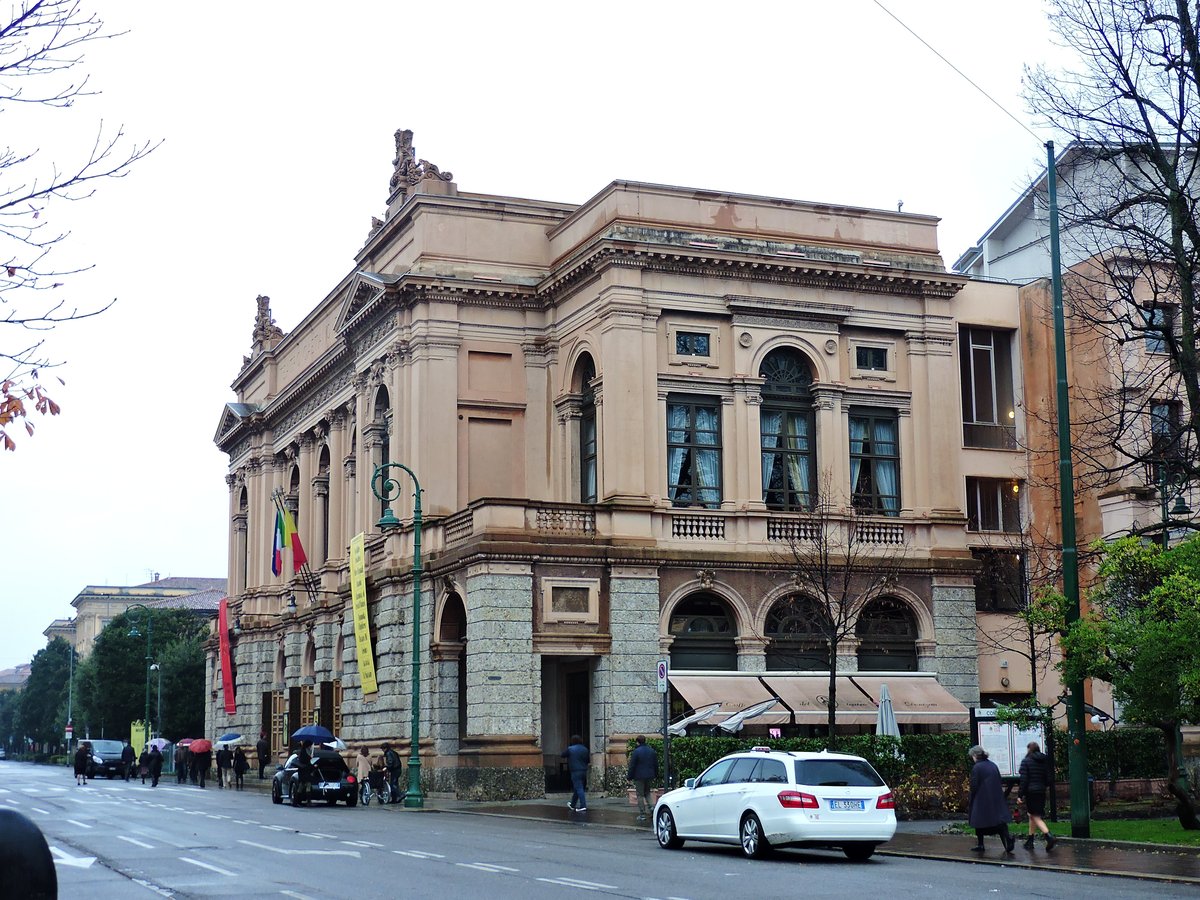 In the heart of Bergamo Bassa, in Piazza Cavour, stands the Teatro Donizetti, a temple of opera and culture. Built between 1786 and 1791 as Teatro Riccardi, it was destroyed by arson in 1797 and reopened in 1800. In 1897, on the centenary of Gaetano Donizetti's birth, it took its current name. The elliptical hall retains its original design: 360 square meters, 532 seats, and 102 boxes for a total of 1,154 places. At the center, a crystal chandelier with 78 lamps illuminates a space renowned for its acoustics, among the best in Italy. Today, the theater is a vibrant cultural hub: in addition to the opera and ballet season (Doremix), it hosts the Donizetti Opera festival, the Bergamo Jazz Festival, plays, operetta, and the International Piano Festival. Here, Giuseppe Verdi premiered Ernani in 1844, with the composer present in the hall. Recent renovations (2018-2020) modernized the systems and upgraded the spaces, making the theater accessible and functional. Practical info: partner parking at €3 for spectators (validate ticket at the box office), or by bus (lines 1, 6, 8, 9, 10, 15, stop Porta Nuova). The box office is open Tuesday to Saturday (tel. 035.4160601). Come discover a place where history and music merge.
San Vigilio Castle: Bergamo's Panoramic Terrace
- Via al Castello, Bergamo (BG)
- Open in Google Maps
- View on Google Images
 If there's one place that truly shows you why Bergamo is called the 'city of two faces,' it's the San Vigilio Castle. Perched on the hill of the same name at 496 meters above sea level, it overlooks the Upper Town and all its surroundings. And what a view: from here you can take in the plain all the way to Milan, the Orobic Prealps, and on clear days even Monviso. It's the panoramic spot par excellence, a place where time seems to slow down.
The castle's history is long and layered. The first fortifications date back to the 6th century, but it was expanded by the Visconti in the 14th century and later by the Republic of Venice, which gave it its characteristic star shape with four towers: Castagneta, Belvedere, Del Ponte, and San Vigilio. The Venetians also built a secret tunnel that connected the castle to Fort San Marco, now visitable by reservation thanks to the speleological group Le Nottole. A thrilling experience for adventure lovers.
Today the castle is a free public park with terraces and lawns where you can stop and enjoy the view. You can reach it comfortably via the San Vigilio funicular (operating since 1912, restored in 1991) departing from Porta Sant'Alessandro. If you prefer, you can walk up on a short but steep path. At the top you'll also find two luxury restaurants, perfect for a special lunch. Hours vary with the seasons: in winter it opens at 8 AM and closes at 5 PM, in summer until 9 PM. In short, a place that combines history, nature, and relaxation, not to be missed.
Rocca of Bergamo
- Piazzale Brigata Legnano, Bergamo (BG)
- https://museodellestorie.bergamo.it/luogo/rocca-di-bergamo/
- Open in Google Maps
- View on Google Images
 From the funicular in Città Alta, head to Piazzale Brigata Legnano: here you are at the Rocca, a 14th-century fortress dominating Bergamo from the hill of Sant'Eufemia. Built between 1331 and 1336 by John of Luxembourg and completed by Azzone Visconti, it's a dive into the Middle Ages immediately enriched by Venetian touches: the circular tower (1455–1458) and the Scuola dei Bombardieri, now home to the Museum of the 19th Century. Here you breathe the Risorgimento: relics, weapons, documents, and the story of the 180 Bergamaschi who followed Garibaldi on the Expedition of the Thousand. Climb the keep – 23 meters high – and prepare for a 360-degree view spanning from the Orobie Prealps to the plains and, on clear days, Milan. The surrounding Parco delle Rimembranze, with plaques and a self-propelled 75/18 tank, invites a contemplative pause. The Rocca is open Tuesday to Sunday and holidays, 11:00 AM – 6:00 PM (last entry 5:30 PM). Full ticket €5, reduced €3, free for under 18. Unfortunately, it is not accessible for visitors with mobility impairments, but small dogs in carriers are allowed. Events like 'Rocca by Night' and summer camps keep it lively year-round. A tip? Come at sunset: the golden light on the Venetian walls and the silence of the park offer an emotion you'll hardly forget.
Palazzo Nuovo: The 17th-century Jewel of Piazza Vecchia
- Piazza Vecchia, Bergamo (BG)
- Open in Google Maps
- View on Google Images
 Overlooking Piazza Vecchia, Palazzo Nuovo embodies the contrast between medieval power and Renaissance refinement. Designed by Vincenzo Scamozzi (a pupil of Palladio), its construction began in 1604 and was completed... only in 1958 with the addition of statues on the façade. Today, it appears as if just finished: the façade in white Zandobbio marble (1928, based on the original design) is a triumph of Doric columns and windows with balustrades. Six allegorical statues by Tobia Vescovi look down: Artisanship, Industry, Agriculture… almost a manifesto of industrious Bergamo.
Enter the atrium and discover the neoclassical atmosphere: marbles, commemorative plaques, and twenty plaster medallions of illustrious figures. Among the busts, that of Bartolomeo Colleoni stands out, alongside Paolina Secco Suardo and Ambrogio Calepio. The Colonna Camozzi, a lectern shaped like a tree with the coats of arms of Bergamo and Brescia, is a small gem. But the true treasure is the Angelo Mai Civic Library, which since 1928 has housed 677,145 volumes, 2,280 incunabula, and 16,830 manuscripts. In the Tassiana Room, admire the large globes by Vincenzo Coronelli (1688 and 1692) – almost three and a half meters in circumference, made of 50 illustrated sheets. An unmissable stop for lovers of ancient books and paper stories.
Practical info: free entry to the library, winter hours Mon-Fri 8:45 AM-5:30 PM, Saturday 8:45 AM-1:00 PM (reduced hours in summer). Accessible with ramp and elevator for people with reduced mobility. And if you thirst for knowledge, the Tassiani and Giovanni XXIII study centers are right next door.
Palazzo del Podestà and the Museum of the 16th Century
- Piazza Vecchia, Bergamo (BG)
- https://www.museodellestorie.bergamo.it/luogo/palazzo-del-podesta/
- Open in Google Maps
- View on Google Images
- info@museodellestorie.bergamo.it
- +39 035 247116
 If you pass through Piazza Vecchia, you can't miss Palazzo del Podestà, which houses the Museum of the 16th Century. Right at the entrance, on the ground floor, the remains of Roman Bergamo welcome you: layers that testify to millennia of history. Then you go up to the first floor and enter a new world. Here, Renaissance frescoes decorate the courtyard, but the real magic begins in the seven interactive rooms of the museum. Images, sounds, and suggestions take you back in time, when Bergamo was under the Serenissima. Discover how the city transformed with the Venetian Walls (UNESCO World Heritage), listen to the stories of nobles, merchants, and condottieri, and admire the bird's-eye view by Alvise Cima from 1693, showing the contrast between the medieval walls and the new fortifications. Among the highlights, a rare 16th-century portolan chart and the virtual reconstruction of the ancient Fair of Sant'Alessandro. The museum is part of the Museo delle Storie di Bergamo network, so you can combine it with other stops like the Campanone or the Rocca. Hours: Tuesday-Friday 10am-6pm, Saturday and Sunday 10am-7pm (closed Monday). Full ticket €9, reduced €6, free under 18. Prepare for an engaging experience, perfect for understanding Bergamo's Renaissance soul.
Church of San Michele al Pozzo Bianco
- Via Porta Dipinta, Bergamo (BG)
- Open in Google Maps
- View on Google Images
 Among the oldest churches in Bergamo, San Michele al Pozzo Bianco is a true treasure chest of history and art, often overlooked by tourists crowding Città Alta. Located at Via Porta Dipinta 45, it is recognizable by its neo-Romanesque stone facade from 1915, but its beating heart is much older: its Lombard origins date back to the 8th century, with the first mention in Taidone's will of 774. The curious name comes from a white marble well that once stood on the churchyard, now remembered by a circular stone. Upon entering, silence envelops everything: it is one of the quietest places in Bergamo, ideal for a contemplative pause. The interior is a single nave divided by two pointed arches into three bays, with exposed beams and frescoes ranging from the 13th to the 16th century. The real gem is the left chapel, frescoed by Lorenzo Lotto in 1525 with Scenes from the Life of Mary: the Nativity, the Presentation in the Temple, the Marriage, and a very particular Annunciation, where the Archangel Gabriel is replaced by God sending the infant Jesus towards Mary. Climb the stairs and discover the crypt, the oldest in the Bergamo area, with 13th-century frescoes including a Madonna enthroned. Admission is free and opening hours vary: from October to April 9 AM–5 PM, from May to September 9 AM–6 PM. Unfortunately, the crypt is not accessible to people with disabilities due to narrow stairs. If you love art and quiet, do not miss this corner of history.
Bergamo Botanical Garden 'Lorenzo Rota'
- Scalinata Colle Aperto, Bergamo (BG)
- https://www.ortobotanicodibergamo.it
- Open in Google Maps
- View on Google Images
 If there's a place in Bergamo that makes you feel far from the chaos, it's the Bergamo Botanical Garden 'Lorenzo Rota'. Perched on the Venetian Walls (a UNESCO World Heritage site), just a stone's throw from Colle Aperto, this garden is a true gem. You enter via a staircase of 141 steps and find yourself in a world of biodiversity: over 1,000 species including alpine plants, carnivorous ones like the Drosera, and succulents. The best part? The view of the Orobic Prealps and the rooftops of Città Alta will leave you breathless. I love to linger here, especially in spring when tulips and irises bloom. The garden is named after Lorenzo Rota, a 19th-century botanist who described the local flora – his herbarium contains 50,000 specimens preserved here! Don't miss the lily pond and, if you have time, the Astino section (the 'Valley of Biodiversity'), reachable on foot in half an hour, with over 1,200 varieties of food plants. The garden is also a research center: it has reintroduced the fern Osmunda regalis and promotes educational projects for children. Admission is free. Open from March to November, hours vary (e.g., June until 8 PM), closed on Mondays. Contacts: 035 286060, ortobotanico@comune.bg.it. In short, a perfect stop for families and nature enthusiasts.
Porta San Giacomo: the marble jewel of the Venetian Walls
- Via Sant'Alessandro, Bergamo (BG)
- Open in Google Maps
- View on Google Images
 If there's one gate that leaves an impression in Bergamo, it's definitely Porta San Giacomo. It is the only one of the four gates of the Venetian Walls completely clad in pinkish white marble from the Zandobbio quarry in Val Cavallina. A striking contrast with the gray stone of the fortifications, making it visible from afar, from Viale Vittorio Emanuele. Designed by Buonaiuto Lorini and completed in 1592, it was the main entrance for those arriving from Milan. The façade is a triumph of classical style: two arches, half-columns, a triangular pediment, and two elegant side pinnacles. On the entablature stands the Lion of St. Mark, but what you see today is from 1958, the work of Piero Brolis: the original was destroyed in the Napoleonic era. The gate had a wooden drawbridge, replaced in 1780 by the current masonry viaduct by order of Podestà Contarini. Walking on the balustrade, the gaze spans from the fortifications to the lower city and as far as the Apennines. A curiosity: until the mid-20th century, every evening at 10:00 PM the gate was closed with the hundred chimes of the Campanone. Today it is only passable on foot, but it is the perfect place for a postcard photo. Since 2017 it has been a UNESCO World Heritage Site, and occasionally it lights up in special colors – such as orange against violence against women or green for rare diseases. In short, a must for anyone visiting Bergamo.
Torre del Galgario, Bergamo's Skittle
- Via Teodoro Frizzoni, Bergamo (BG)
- Open in Google Maps
- View on Google Images
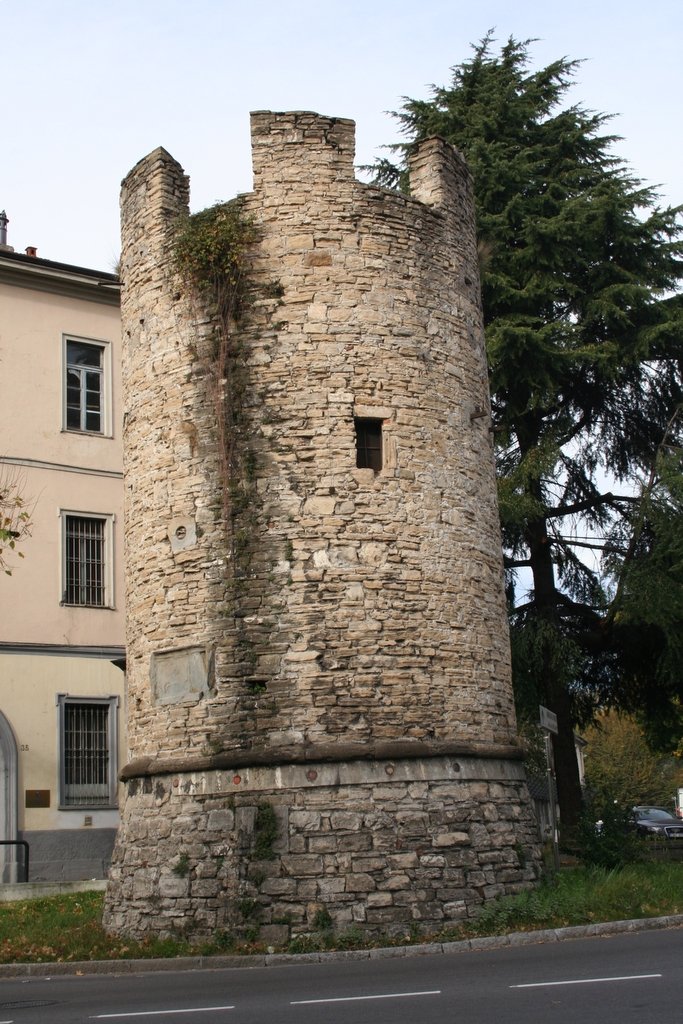 Amid the chaos of intersections and traffic in Lower Bergamo, at the corner of Via Frizzoni and Largo Galgario, a curious stone cylinder pops up. It's the Torre del Galgario, nicknamed by the Bergamaschi as "Ol Biril" (the skittle) for its tapering shape. Built around 1430 by the Visconti, it was part of the Muraine, the defensive wall that protected the boroughs of the lower city. Today it's the only round tower still standing after the entire wall was dismantled in 1901 with the abolition of the toll. The tower is closed to the public and completely empty inside, but from below you can still notice the details: larger sandstone blocks at the base, iron bars that perhaps held torches, and at the top a brick cover that replaced the original tiled roof. Looking closely, you can make out three Visconti coats of arms and a marble slab from 1950 depicting the layout of the Muraine. The name "Galgario" comes from "calchera," meaning lime kiln, due to the limestone-rich waterways in the area. For a while, the tower was used as a gunpowder depot. In the 1940s it risked demolition because of increasing traffic, but was saved. Today it's in a state of decay, but remains a historical symbol that tells a piece of Bergamo that no longer exists.