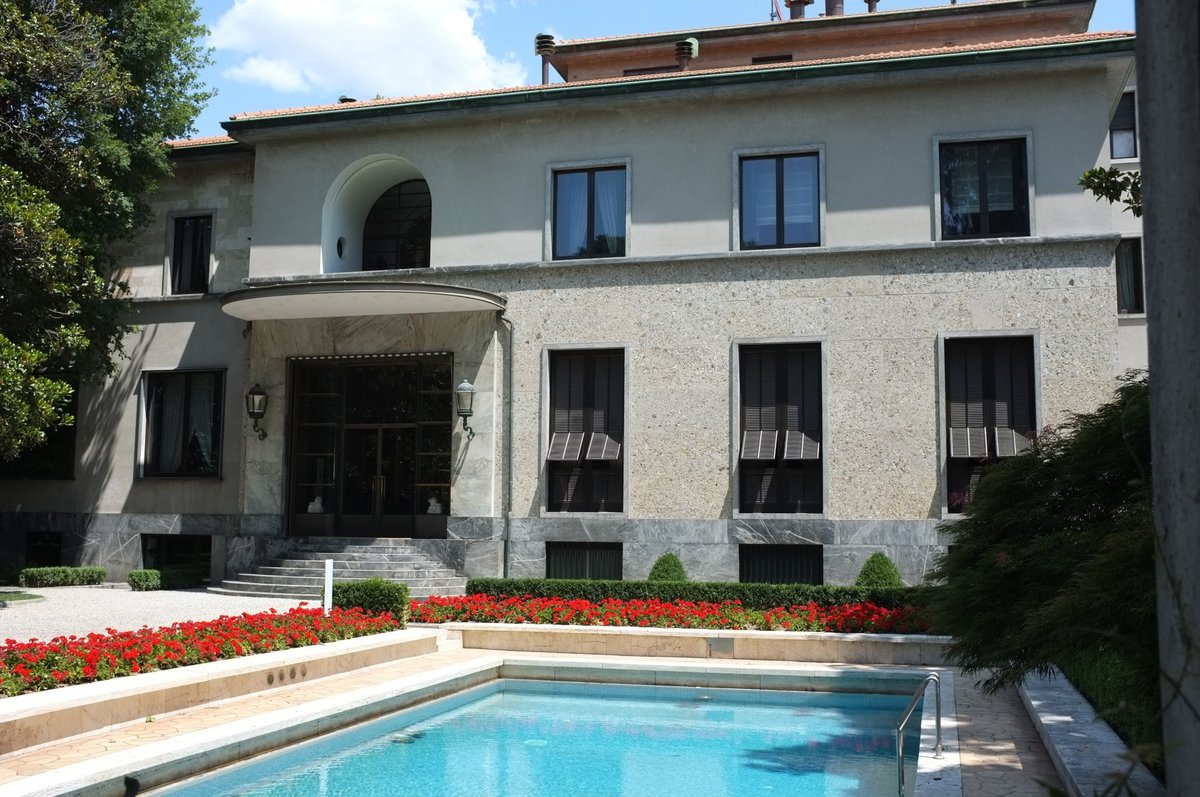
Villa Necchi Campiglio is one of Milan’s most fascinating house museums, completed in 1935 to a design by Piero Portaluppi for the Necchi Campiglio family. In the garden with private swimming pool and tennis court, the elegance of the 1930s is in the air; inside, works by Morandi, Sironi, De Chirico, Canaletto and Tiepolo are on view. The entrance is at Via Mozart 14, reachable from the Palestro metro station; the villa is open Wednesday to Sunday, 10am-6pm, last entry 5pm. Full ticket €15, reduced €9. Don’t miss: the salon with garden veranda and smoking room; the dining room with its constellation-decorated ceiling; the 18th-century rooms redesigned by Tomaso Buzzi; and the historic swimming pool surrounded by greenery.
Villa Necchi Campiglio, a 1930s House-Museum in Milan
It hardly feels like you’re in Milan: you’re on Via Mozart, a stone’s throw from the center, yet the city disappears. Beyond the gate, Villa Necchi Campiglio is a lovely surprise of gardens, a swimming pool, and a house where the twentieth century has remained intact. No museum showcases here: the FAI has preserved original furnishings, family objects, and that intimate atmosphere that makes you speak softly. You walk through the living room, the library, and the plant-filled veranda, and at some point you feel like a guest from the 1930s. It’s elegant, yes, but also alive: some rooms seem just used, with the fireplace unlit or the desk ready. I found it moving precisely for this reason, for its slightly timeless air in one of Italy’s most frenetic cities. A house-museum that doesn’t feel like a museum, and which I recommend to anyone who wants to understand another side of Milan.
Historical Notes
Behind this quiet lies the story of two industrial families. In 1935, the villa designed by
Piero Portaluppi was completed for the sisters Nedda and Gigina Necchi and for Angelo Campiglio, sewing machine entrepreneurs. The house is modern, rationalist, with Art Déco touches and cutting-edge technology. In the following years,
Tomaso Buzzi remodeled it with eighteenth-century furnishings: the owners wanted a softer, more ‘Lombard’ drawing room. In 2001, Gigina Necchi Campiglio donated everything to FAI; after restoration, in 2008 the villa opened to the public. A quick timeline for orientation.
- 1930-1935: construction designed by Portaluppi
- 1938: Buzzi’s interventions
- 2001: donation to FAI
- 2008: opening to the public
Architecture: Rationalism with an Extra Gear
The facade is made of travertine, porphyry, and marble, but it’s upon entering that you realize how much the 1930s loved the future. The dining room has a ceiling decorated with constellations and zodiac signs, the veranda is a greenhouse of plants and glass where leaves grow between the double windows. Then there are the futuristic amenities: elevator, dumbwaiter, intercoms, central heating, and even a private swimming pool, among the first in Milan. Portaluppi didn’t stop at the exterior: he designed lamps, window frames, and even the walnut and rosewood details. What you see today, however, is not pure rationalism: after the war, Buzzi covered some walls with tapestries and softened the lounges with a more classic style. The result is a unique hybrid that tells the story of changing tastes: from enthusiasm for modernity to a return to tradition.
Three Collections That Turn the Home into a Museum
The villa would already be interesting with its furnishings, but FAI has made it a rich and surprising house-museum. Along the route you’ll find the Gian Ferrari Collection with paintings by Balla, Boccioni, De Chirico, Morandi, Sironi, and Wildt, mostly displayed in the atrium and the salon. Then there’s the De’ Micheli Collection, a true journey into the eighteenth century with views by Canaletto, Tiepolo, and Rosalba Carriera, as well as Chinese porcelain and Lombard ceramics, set in the Princess’s Room. And, since 2017, the Sforni Collection gathers works on paper by artists such as Picasso, Modigliani, and Fontana. The beauty is that the works are not hung in orderly rows, but coexist with the furniture and household objects. That is how art returns to being part of daily life, and not just something to view in a line.
Why Visit
The practical reasons are plentiful. First, it’s one of the few house museums in the city where everything is still in its original place: not borrowed furnishings but the family’s own furniture and objects—an authenticity money can’t buy. Second, since 2022 the FAI management has added an immersive video installation on Milan’s urban development, a way to understand the context without getting bored. Third, if you’re a film buff, you’ll recognise some of the rooms from the movie ‘I Am Love’, which was filmed here. And don’t forget practicality: the full ticket costs €15, but the reduction brings it down to €9 for those under 25. Furthermore, with the Case Museo Card (€25) you can enter all four of Milan’s house museums in the circuit, a small investment that pays off if you have time.
When to go
If I may offer a piece of advice, choose a weekday and arrive shortly after opening. The villa is almost empty, there are few noises, and you can breathe a silence suspended in time. There isn’t an absolutely right moment: the beauty is that it changes with the light. In the late afternoon, when the sun slants through the veranda windows, the glass and marble glow with warm reflections. But even a gray morning has its charm: the house feels like a precious box, with the damp garden making it even more intimate. The real advice is not to rush: take a break, sit in the garden for a few minutes, and let the hum of the city stay outside the gate.
Nearby
The villa is located in the so-called ‘quiet quarter’, but there are plenty of other attractions in the area. You can combine a visit with the Indro Montanelli Gardens, a green lung that invites you for a stroll, or the Brera Art Gallery for a dive into ancient and modern art. If you still have energy left, the Porta Venezia district offers Art Nouveau buildings and historic cafés where you can end the day peacefully.