
If you only have one day to visit Syracuse, this itinerary takes you to discover the best of the city, from the Neapolis Archaeological Park with the majestic Greek Theatre and the fascinating Ear of Dionysius, to the island of Ortigia, the historic and lively heart. You will stroll through the alleys of Ortigia, admire the Maniace Castle and the magnificent Baroque Cathedral, and get lost in the scents of the traditional markets. A walking route that combines art, history, and daily life, perfect for those who love to travel at a pace without sacrificing depth. With this itinerary ‘Syracuse in a Day: Art and Traditions between Ortigia and the Historic Center’ you will have an authentic experience without wasting time, discovering the Greek roots and Sicilian culture in one intense yet relaxed day.
🗺️ Your trip at a glance
This one-day tour of Syracuse offers a perfect mix of Greek art and Sicilian traditions, all in a walking itinerary between Neapolis and Ortigia. Ideal for those seeking a complete cultural experience in a short time.
- Ideal for history enthusiasts, families, and curious travelers who want a relaxed cultural immersion.
- Highlights: Greek Theatre, Ear of Dionysius, Maniace Castle, and the atmosphere of Ortigia – a concentration of art and tradition.
- What you do and why it’s different: a walking route that combines Greek archaeology and Sicilian daily life in a single day, with authentic experiences like markets and tastings.
Itinerary stops
Stop no. 1
Greek Theatre of Syracuse
 We start with a bang: the Greek Theatre of Syracuse is the first stop on this itinerary, and there couldn’t be a more epic beginning. Carved into the side of Temenite Hill, this stone giant dates back to the 5th century BC, with significant renovations in the Hellenistic and Roman periods. With a diameter of 138 meters and an estimated capacity of 15,000 spectators, it is the largest theater in the Greek Western world. Climbing the 67 rows of steps – entirely hewn from rock – leaves you breathless. From the top, the view stretches over Ortigia and the Great Harbor, a sight that alone is worth the ticket. Notice the diazoma, the horizontal corridor dividing the cavea: on the wall are still engraved the names of Queen Philistis and Nereid, wife and daughter-in-law of Hieron II. Here, Aeschylus (who staged ‘The Persians’ in 470 BC) and even Plato trod the boards. Today, the theater is more alive than ever: since 1914, the INDA has organized the famous classical performances here every year, including plays by Sophocles, Euripides, and Aristophanes. For tourists, entry is included in the ticket for the Neapolis Archaeological Park (combined with the Paolo Orsi Museum: €22 full price, reduced €12.50). Open daily from 8:30 AM, but the ticket office closes at 5:00 PM. Tip: arrive early, when the morning light caresses the stone and the silence is broken only by birdsong. A place that speaks for itself, without need for many words.
- Go to the page: Greek Theatre of Syracuse: Sicily’s Largest Ancient Stage
- Via dei Sepolcri, Siracusa (SR)
- Open in Google Maps
- View on Google Images

You should go if…
Stop no. 2
Ear of Dionysius: The Cave That Speaks
 Just steps from the Greek Theatre, you can’t miss the Ear of Dionysius, an artificial cave that seems to have sprung from a myth. Carved into limestone, it is 23 meters high and 65 meters deep, with an S-shape that delivers spine-tingling acoustics: a simple whisper travels amplified up to 16 times. The name was coined by Caravaggio in 1608, struck by its resemblance to a donkey’s ear. The most famous legend? That the tyrant Dionysius I imprisoned captives there to eavesdrop on their conspiracies – but in reality it was a stone quarry. The atmosphere is magical: go inside, speak softly, and listen to the echo that answers you. Entry is included in the ticket for the Neapolis Archaeological Park (full price €13, hours 9-18). It is located on Viale Giulio Emanuele Rizzo, but access is from Via Paradiso. Tip: pop into the nearby Grotta dei Cordari if open – the humidity has made it a fascinating place.
- Go to the page: Ear of Dionysius: The Cave with Legendary Acoustics in Syracuse
- Viale Giulio Emanuele Rizzo, Siracusa (SR)
- Open in Google Maps
- View on Google Images
You should go if…
Stop no. 2
Ear of Dionysius: The Cave That Speaks
Just steps from the Greek Theatre, you can’t miss the Ear of Dionysius, an artificial cave that seems to have sprung from a myth. Carved into limestone, it is 23 meters high and 65 meters deep, with an S-shape that delivers spine-tingling acoustics: a simple whisper travels amplified up to 16 times. The name was coined by Caravaggio in 1608, struck by its resemblance to a donkey’s ear. The most famous legend? That the tyrant Dionysius I imprisoned captives there to eavesdrop on their conspiracies – but in reality it was a stone quarry. The atmosphere is magical: go inside, speak softly, and listen to the echo that answers you. Entry is included in the ticket for the Neapolis Archaeological Park (full price €13, hours 9-18). It is located on Viale Giulio Emanuele Rizzo, but access is from Via Paradiso. Tip: pop into the nearby Grotta dei Cordari if open – the humidity has made it a fascinating place.- Go to the page: Ear of Dionysius: Syracuse’s Acoustic Cave That Amplifies Every Whisper
- Viale Giulio Emanuele Rizzo, Siracusa (SR)
- Open in Google Maps
- View on Google Images
You should go if…
Stop no. 3
Roman Amphitheatre
 Leave the Ear of Dionysius behind and head towards the Roman Amphitheatre, a structure that will leave you speechless. It is the third largest amphitheatre in Italy, after the Colosseum and the Arena of Verona: 140 metres long and 119 metres wide, with an arena of 70×40 metres. Largely carved into the rock of the Acradina hill, it was built during the imperial era (1st century AD) and could accommodate around 15,000 spectators. Unfortunately, in the 16th century the Spanish stripped it to fortify Ortigia, but what remains is impressive. Walk along the podium that once surrounded the arena, where you can still see marble blocks bearing the names of seat owners, and imagine gladiators and wild beasts entering from underground corridors. At the centre of the arena there was a rectangular space for stage machinery, connected to a covered channel. Entry is included in the ticket for the Neapolis Archaeological Park (full price €13, reduced €5 for ages 18–25, opening hours 8:30–19:30). It is located on Via Paradiso, but access is from Viale Luigi Bernabò Brea. Tip: stop and read the inscriptions on the marble seats – they tell stories of noble families who had reserved seating.
- Go to the page: Roman Amphitheatre of Syracuse: The Ancient Arena in the Heart of Ortigia
- Via Francesco Saverio Cavallari, Siracusa (SR)
- Open in Google Maps
- View on Google Images
You should go if…
Stop no. 4
Catacombs of St. John
 From the Roman Amphitheater, the next step takes you underground, into the heart of early Christian Syracuse: the Catacombs of St. John. Here time seems to stand still among galleries carved into the tufa, where about ten thousand deceased rest. The route follows the ancient decumanus maximus, carved out of a Greek aqueduct, and branches into ten cardines leading to four rotundas – former cisterns turned into funerary chambers. The visit is mandatorily guided and lasts about an hour; a jacket is recommended due to the cool temperature. Among the treasures are the Rotunda of Adelfia with its famous marble sarcophagus featuring 62 figures (now at the Paolo Orsi Museum) and the Crypt of St. Marcian, where tradition holds that St. Paul preached. An experience blending archaeology and spirituality, enhanced by a virtual reality film. Ticket €14 (€12+€2 booking fee), entrance at Largo San Marciano 3.
- Via San Giovanni alle Catacombe, Siracusa (SR)
- Open in Google Maps
- View on Google Images
You should go if…
Stop no. 5
Maniace Castle: The Swabian Bastion by the Sea
 Last stop, but not least: Castello Maniace stands on the southern tip of Ortigia, perched over the sea. Commissioned by Frederick II between 1232 and 1240, it is a jewel of Swabian architecture with its square layout measuring 51 meters per side and four cylindrical towers. The pointed arch entrance welcomes you, and once inside you find yourself in the immense hypostyle hall with 24 cross vaults, once a royal residence and symbol of power. The name recalls the Byzantine general George Maniakes, but the fortress is entirely Frederick’s. Strolling along the walls, enjoy the view of the Grand Harbour and imagine the events that took place here: from the signing of the foundation act of the University of Naples to the explosion of the powder magazine in 1704. Today the castle hosts cultural events, and the ticket costs only €6 (free on the first Sunday of the month). A perfect finale for your tour of Syracuse.
- Go to the page: Maniace Castle: The Swabian Fortress on the Island of Ortigia
- Via Gaetano Abela, Siracusa (SR)
- Open in Google Maps
- View on Google Images
You should go if…
Stop no. 5
Maniace Castle: The Swabian Bastion by the Sea
Last stop, but not least: Castello Maniace stands on the southern tip of Ortigia, perched over the sea. Commissioned by Frederick II between 1232 and 1240, it is a jewel of Swabian architecture with its square layout measuring 51 meters per side and four cylindrical towers. The pointed arch entrance welcomes you, and once inside you find yourself in the immense hypostyle hall with 24 cross vaults, once a royal residence and symbol of power. The name recalls the Byzantine general George Maniakes, but the fortress is entirely Frederick’s. Strolling along the walls, enjoy the view of the Grand Harbour and imagine the events that took place here: from the signing of the foundation act of the University of Naples to the explosion of the powder magazine in 1704. Today the castle hosts cultural events, and the ticket costs only €6 (free on the first Sunday of the month). A perfect finale for your tour of Syracuse.- Go to the page: Castle Maniace in Syracuse: Frederick II’s Fortress on the Island of Ortigia
- Via Gaetano Abela, Siracusa (SR)
- Open in Google Maps
- View on Google Images
You should go if…
Stop no. 6
Piazza Duomo: the Baroque Heart of Ortigia
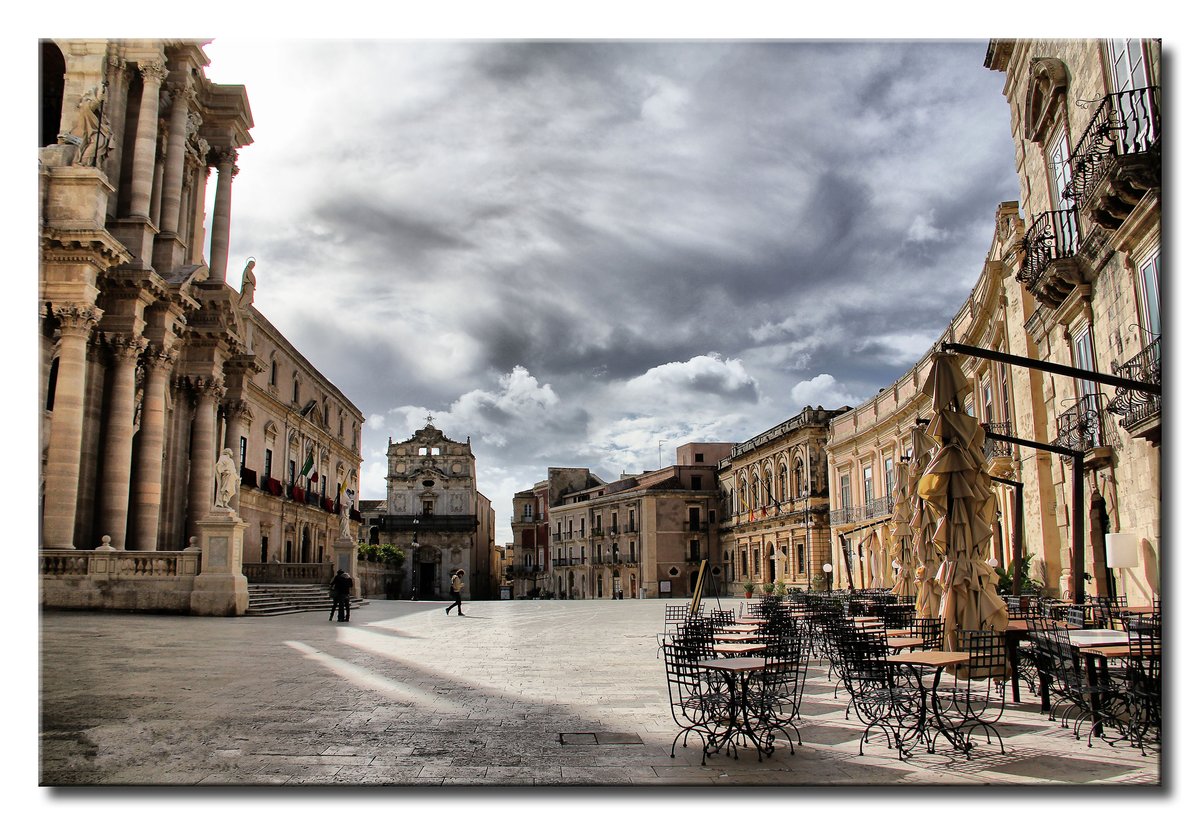 Piazza Duomo is the monumental heart of Ortigia, a gem that tells 2700 years of history. Semi-elliptical and entirely pedestrian, it is dominated by the Cathedral of the Nativity of Mary Most Holy, which incorporates the Doric columns of the Temple of Athena (5th century BC). The Baroque facade, built after the 1693 earthquake, is a masterpiece by Andrea Palma. The square is surrounded by noble palaces such as Palazzo Beneventano del Bosco (which hosted Admiral Nelson) and Palazzo Vermexio, home to the town hall. Don’t miss the Church of Santa Lucia alla Badia, which houses Caravaggio’s famous painting “The Burial of St. Lucy”. Beneath the square lies the hypogeum, a network of tunnels used as an air-raid shelter during World War II. Let yourself be enchanted by the perfect harmony between Sicilian Baroque and Greek vestiges, in a square that served as the set for films like “Malèna”.
- Siracusa (SR)
- Open in Google Maps
- View on Google Images
You should go if…


