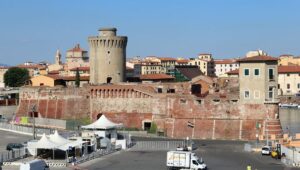
Built in the 16th century, Buranaccio Tower stands on the sandbar between Lake Burano and the sea, within the WWF Oasis. Privately owned, it is open to visitors only on rare occasions, such as the Oasis festival. Its charm lies in its border history and the pristine nature surrounding it.
– Centuries-old history: built as a watchtower, it marked the border between the State of Presidi and the Papal States.
– Military architecture: square base, walls up to 3 meters thick, elevated entrance with drawbridge.
– Protected nature: immersed in the WWF Oasis, among dunes, lagoon, and Mediterranean scrub.
– Trivia: Giacomo Puccini stayed here to hunt.
Introduction
If you find yourself at Capalbio Scalo and turn your gaze toward Lake Burano, you can’t help but notice that massive silhouette emerging from the vegetation. It’s the Torre di Buranaccio, a small sixteenth-century gem that seems to have stepped out of a history book. Immersed in the WWF Oasis, it tells centuries of coastal defenses, contested borders, and protected nature. A visit here is a dive into the past, but also an embrace of the wild beauty of Maremma.
Introduction
If you find yourself at Capalbio Scalo and turn your gaze toward Lake Burano, you can’t help but notice that massive silhouette emerging from the vegetation. It’s the Torre di Buranaccio, a small sixteenth-century gem that seems to have stepped out of a history book. Immersed in the WWF Oasis, it tells centuries of coastal defenses, contested borders, and protected nature. A visit here is a dive into the past, but also an embrace of the wild beauty of Maremma.
Historical Notes
Built in
1563 by order of
Cosimo I de’ Medici, the tower was part of a coastal watch system in Tuscany. It marked the border between the Grand Duchy of Tuscany and the Papal States, later coming under Spanish control within the State of Presidi. Standing about 8 meters tall, it served as a guard post: a plume of smoke by day or a fire by night would alert the Rocca di Capalbio of any attacks. Its history is also linked to a great composer:
Giacomo Puccini, who stayed there in the early 1900s to hunt wild boar.
- 1563 – Construction under Cosimo I de’ Medici
- 16th–17th centuries – Under the Spanish State of Presidi
- Early 1900s – Stays by Giacomo Puccini
- 1922 – Foundation of the SACRA society to protect the area
- Today – Inside the WWF Oasis, access only during special events
Historical Notes
Built in
1563 by order of
Cosimo I de’ Medici, the tower was part of a coastal watch system in Tuscany. It marked the border between the Grand Duchy of Tuscany and the Papal States, later coming under Spanish control within the State of Presidi. Standing about 8 meters tall, it served as a guard post: a plume of smoke by day or a fire by night would alert the Rocca di Capalbio of any attacks. Its history is also linked to a great composer:
Giacomo Puccini, who stayed there in the early 1900s to hunt wild boar.
- 1563 – Construction under Cosimo I de’ Medici
- 16th–17th centuries – Under the Spanish State of Presidi
- Early 1900s – Stays by Giacomo Puccini
- 1922 – Foundation of the SACRA society to protect the area
- Today – Inside the WWF Oasis, access only during special events
Fortress Architecture
The tower is a perfect example of Renaissance military architecture. Square base with a sloping profile, walls up to 3 meters thick: it looks like a stone block rising from the earth. The entrance is elevated, about 5 meters high, and was reached via a wooden ladder and a drawbridge. Every detail is designed for defense: the water cistern on the ground floor, the guardroom on the first floor, and the top terrace for lookout. The resemblance to the Spanish Fortress of Porto Santo Stefano is evident, a nod to the military school of the time.
Fortress Architecture
The tower is a perfect example of Renaissance military architecture. Square base with a sloping profile, walls up to 3 meters thick: it looks like a stone block rising from the earth. The entrance is elevated, about 5 meters high, and was reached via a wooden ladder and a drawbridge. Every detail is designed for defense: the water cistern on the ground floor, the guardroom on the first floor, and the top terrace for lookout. The resemblance to the Spanish Fortress of Porto Santo Stefano is evident, a nod to the military school of the time.
In the Heart of the WWF Oasis
The Tower of Buranaccio is not just a monument: it is the guardian of the WWF Oasis of Burano, the first of its kind in Italy. Here, nature reigns supreme: Lake Burano is a paradise for birdwatching, with flamingos, herons, and cormorants. Walking along the paths, you will feel as if you are in a world suspended between land and water. The tower is not always open to visitors, but during the Oasis Festival you can exceptionally access the terrace and enjoy a breathtaking view of the lake and the sea. An experience that combines history and wilderness.
In the Heart of the WWF Oasis
The Tower of Buranaccio is not just a monument: it is the guardian of the WWF Oasis of Burano, the first of its kind in Italy. Here, nature reigns supreme: Lake Burano is a paradise for birdwatching, with flamingos, herons, and cormorants. Walking along the paths, you will feel as if you are in a world suspended between land and water. The tower is not always open to visitors, but during the Oasis Festival you can exceptionally access the terrace and enjoy a breathtaking view of the lake and the sea. An experience that combines history and wilderness.
Why Visit It
Even if you can’t enter every day, it’s worth visiting for three reasons: first, it’s the only spot from which to admire the entire ecosystem of Lake Burano from above (with a bit of luck during events). Second, the natural setting is extraordinary, with its coastal dune and Mediterranean scrub. Third, its fascinating history will make you feel like an explorer: imagine Puccini hunting in the area! For opening info, follow the WWF calendar.
Why Visit It
Even if you can’t enter every day, it’s worth visiting for three reasons: first, it’s the only spot from which to admire the entire ecosystem of Lake Burano from above (with a bit of luck during events). Second, the natural setting is extraordinary, with its coastal dune and Mediterranean scrub. Third, its fascinating history will make you feel like an explorer: imagine Puccini hunting in the area! For opening info, follow the WWF calendar.
When to Go
The best time? Late afternoon in spring, when the low light paints the tower ochre and the lake fills with birds in flight. Avoid summer if you’re looking for peace and quiet, but if you attend the Oasi Festival (usually in June), the atmosphere is festive. In autumn, the colors of the scrubland are warm and the air is crisp. Remember: the tower is private, so always check the dates of special openings.
When to Go
The best time? Late afternoon in spring, when the low light paints the tower ochre and the lake fills with birds in flight. Avoid summer if you’re looking for peace and quiet, but if you attend the Oasi Festival (usually in June), the atmosphere is festive. In autumn, the colors of the scrubland are warm and the air is crisp. Remember: the tower is private, so always check the dates of special openings.
Nearby
After your visit, don’t miss Capalbio Vecchio, a medieval village perched on a hill with incredible views of the countryside. And if you love nature, Lake Burano itself offers trails and birdwatching spots. Nearby, the Rocca Aldobrandesca di Capalbio is also worth a stop. A perfect itinerary for a day of history and breathtaking landscapes.
Nearby
After your visit, don’t miss Capalbio Vecchio, a medieval village perched on a hill with incredible views of the countryside. And if you love nature, Lake Burano itself offers trails and birdwatching spots. Nearby, the Rocca Aldobrandesca di Capalbio is also worth a stop. A perfect itinerary for a day of history and breathtaking landscapes.