The Fanale of Livorno, Italy’s Oldest Lighthouse
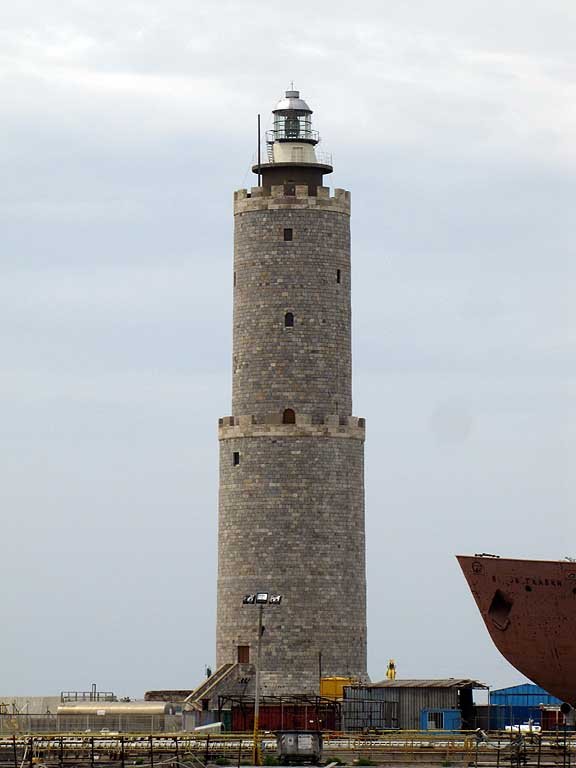
When you arrive in Livorno and look towards the harbor, the first thing to catch your eye is the Fanale. Standing 52 meters tall, with its two superimposed crenellated towers that seem straight out of a medieval tale, it is considered Italy’s oldest lighthouse. Built between 1303 and 1305 by the Republic of Pisa, it has witnessed centuries of history through wars and transformations. Today, after being destroyed and faithfully rebuilt, it is the city’s most authentic symbol. Climbing to the top, when it’s open, rewards you with a breathtaking view: on one side, the busy port; on the other, the open sea stretching to the horizon. It’s not just a lighthouse, but a piece of history that continues to shine.
The Fanale of Livorno, Italy’s Oldest Lighthouse
When you arrive in Livorno and look towards the harbor, the first thing to catch your eye is the Fanale. Standing 52 meters tall, with its two superimposed crenellated towers that seem straight out of a medieval tale, it is considered Italy’s oldest lighthouse. Built between 1303 and 1305 by the Republic of Pisa, it has witnessed centuries of history through wars and transformations. Today, after being destroyed and faithfully rebuilt, it is the city’s most authentic symbol. Climbing to the top, when it’s open, rewards you with a breathtaking view: on one side, the busy port; on the other, the open sea stretching to the horizon. It’s not just a lighthouse, but a piece of history that continues to shine.
Historical Notes
The history of the Fanale begins after the Pisan defeat at Meloria (1284), when the Republic of Pisa decided to build a new lighthouse to demonstrate its power. The design is attributed to Giovanni Pisano, and the tower was completed in 1305. In 1583, under the Medici, the first lazaretto of Livorno was added to its base. During World War II, on July 19, 1944, the retreating Germans mined it and destroyed it almost completely. Immediately after the war, the people of Livorno raised funds to rebuild it, and in 1956, in the presence of President Gronchi, the lighthouse relit its light. Here are the key moments:
- 1303-1305: construction of the Fanale by the Pisans
- 1583: addition of the Medicean lazaretto
- 1944: destruction by the Germans
- 1956: reconstruction and inauguration
Historical Notes
The history of the Fanale begins after the Pisan defeat at Meloria (1284), when the Republic of Pisa decided to build a new lighthouse to demonstrate its power. The design is attributed to Giovanni Pisano, and the tower was completed in 1305. In 1583, under the Medici, the first lazaretto of Livorno was added to its base. During World War II, on July 19, 1944, the retreating Germans mined it and destroyed it almost completely. Immediately after the war, the people of Livorno raised funds to rebuild it, and in 1956, in the presence of President Gronchi, the lighthouse relit its light. Here are the key moments:
- 1303-1305: construction of the Fanale by the Pisans
- 1583: addition of the Medicean lazaretto
- 1944: destruction by the Germans
- 1956: reconstruction and inauguration
Architecture and Materials
The Fanale is not a simple tower: it consists of two superimposed crenellated towers, a polygonal base, and seven cylinders of decreasing diameter that give it a slender conical profile. It is made of Pietra della Verruca, quarried from San Giuliano in Pisa, a durable stone that has withstood the centuries. Inside, a spiral staircase of 297 steps leads to the lantern. At the entrance, the Pisan cross once stood, later replaced by the Florentine lily after the Medici conquest. The original structure was completely surrounded by the sea, but today it is connected to the mainland. Every detail, from the battlements to the conical shape, tells the story of a lighthouse that was not only a beacon but also a defensive fortress.
Architecture and Materials
The Fanale is not a simple tower: it consists of two superimposed crenellated towers, a polygonal base, and seven cylinders of decreasing diameter that give it a slender conical profile. It is made of Pietra della Verruca, quarried from San Giuliano in Pisa, a durable stone that has withstood the centuries. Inside, a spiral staircase of 297 steps leads to the lantern. At the entrance, the Pisan cross once stood, later replaced by the Florentine lily after the Medici conquest. The original structure was completely surrounded by the sea, but today it is connected to the mainland. Every detail, from the battlements to the conical shape, tells the story of a lighthouse that was not only a beacon but also a defensive fortress.
Light That Crosses Time
Today the Lighthouse emits 4 white flashes every 20 seconds, visible up to 24 nautical miles. But it wasn’t always this way: initially they used fire braziers, then oil lamps, Fresnel lenses from 1841, acetylene gas and finally electricity. Since 2006 it has been fully automated and telemonitored. The lantern, with a 4-panel Fresnel lens, is powered by a 1000 W lamp. What strikes you is that, despite modern technology, its soul has remained intact. Climbing to the top (when open) means walking through history, and looking out from the terrace between the two crenellated towers is an experience that makes you feel part of something ancient and majestic. Galileo Galilei himself used the lighthouse for his astronomical experiments.
Light That Crosses Time
Today the Lighthouse emits 4 white flashes every 20 seconds, visible up to 24 nautical miles. But it wasn’t always this way: initially they used fire braziers, then oil lamps, Fresnel lenses from 1841, acetylene gas and finally electricity. Since 2006 it has been fully automated and telemonitored. The lantern, with a 4-panel Fresnel lens, is powered by a 1000 W lamp. What strikes you is that, despite modern technology, its soul has remained intact. Climbing to the top (when open) means walking through history, and looking out from the terrace between the two crenellated towers is an experience that makes you feel part of something ancient and majestic. Galileo Galilei himself used the lighthouse for his astronomical experiments.
Why Visit It
It’s not just a monument; it’s an experience blending history, views, and identity. First: it’s Italy’s oldest lighthouse, and few places have such a layered history. Second: the panoramic view from the top (when you can climb) stretches across the entire port and city, a sight you won’t easily forget. Third: it’s a living symbol for the people of Livorno, who rebuilt it brick by brick after the war. It’s not a cold museum, but a working lighthouse that, on certain occasions, you can explore with passionate guides. If you love authentic places rich with stories, this is a must.
Why Visit It
It’s not just a monument; it’s an experience blending history, views, and identity. First: it’s Italy’s oldest lighthouse, and few places have such a layered history. Second: the panoramic view from the top (when you can climb) stretches across the entire port and city, a sight you won’t easily forget. Third: it’s a living symbol for the people of Livorno, who rebuilt it brick by brick after the war. It’s not a cold museum, but a working lighthouse that, on certain occasions, you can explore with passionate guides. If you love authentic places rich with stories, this is a must.
When to Go
The Fanale is not open every day, but when it is, the best time is late afternoon, just before sunset. The golden light caressing the stone of the Verruca and the sea turning orange create a unique atmosphere. If you catch a clear day, from the top you can see the entire gulf. Even in winter, when the sky is clearer, the view is spectacular. Avoid the midday hours in summer when the sun beats down and heat accumulates on the stone. But in every season, the lighthouse is evocative: in autumn with the fog rising from the sea, or in spring with the scent of salt.
When to Go
The Fanale is not open every day, but when it is, the best time is late afternoon, just before sunset. The golden light caressing the stone of the Verruca and the sea turning orange create a unique atmosphere. If you catch a clear day, from the top you can see the entire gulf. Even in winter, when the sky is clearer, the view is spectacular. Avoid the midday hours in summer when the sun beats down and heat accumulates on the stone. But in every season, the lighthouse is evocative: in autumn with the fog rising from the sea, or in spring with the scent of salt.
Nearby
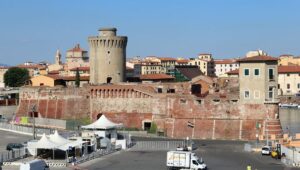
Once you’ve seen the Fanale, don’t miss the Porto Mediceo and the Ponte di Marmo nearby: it’s the beating heart of Livorno, among boats, fishermen, and shipyards. Just a few steps away, Terrazza Mascagni with its iconic black and white checkered floor is the perfect place for a seaside stroll. If you have more time, the Fortezza Vecchia is another symbol of the city, with its ancient walls and views of the port. All these places are connected by a pleasant waterfront walk, letting you breathe in the maritime soul of Livorno.
Nearby
Once you’ve seen the Fanale, don’t miss the Porto Mediceo and the Ponte di Marmo nearby: it’s the beating heart of Livorno, among boats, fishermen, and shipyards. Just a few steps away, Terrazza Mascagni with its iconic black and white checkered floor is the perfect place for a seaside stroll. If you have more time, the Fortezza Vecchia is another symbol of the city, with its ancient walls and views of the port. All these places are connected by a pleasant waterfront walk, letting you breathe in the maritime soul of Livorno.