Cape Santa Maria di Leuca Lighthouse: 360° View of Puglia’s Southernmost Point

The Cape Santa Maria di Leuca Lighthouse marks the southernmost point of Puglia, offering a 360-degree view of the sea and the Salento coast. Built in 1866, it is still active and managed by the Italian Navy. The visit provides unique panoramas, especially at sunset when the sky’s colors reflect on the sea.

  • Unique Location: Southernmost point of Puglia where the Ionian and Adriatic Seas meet
  • Panoramic Terrace: Climb 254 steps for a 360° view of the coast and open sea
  • Spectacular Sunset: Best time to visit with colors tinting the sea and sky
  • Historic Structure: 1866 lighthouse made of Lecce stone, 47 meters high and still functioning


Events nearby


Copertina itinerario Cape Santa Maria di Leuca Lighthouse: 360° View of Puglia's Southernmost Point
Historic 1866 lighthouse with panoramic terrace at 47 meters, meeting point of the Ionian and Adriatic Seas. Guide to visiting, climbing 254 steps, and breathtaking sunset.

Good to know


Introduction

The Capo Santa Maria di Leuca Lighthouse is more than just a lighthouse. It’s the exact point where Puglia ends, where the mainland gives way to the open sea where the Ionian and Adriatic meet. The feeling upon arrival is that of standing at the edge of the world. The white structure, standing 47 meters tall, dominates a rocky spur overlooking a sea of deep blue. On clear days, it’s not uncommon to see the Albanian coast on the horizon. For me, it has always been a place of arrival and departure, a powerful symbol. The wind here is almost always present, brisk, reminding you that you’re in a special, wild, and majestic place.

Historical Overview

The history of the lighthouse is inextricably linked to navigation in one of the most treacherous stretches of sea in Salento. Before its construction, ships rounding the cape relied on fires lit along the coast or, worse, sailed in darkness. Its construction was a significant undertaking for the emerging Kingdom of Italy. The foundation stone was laid in 1864, and two years later, the lantern was lit for the first time. During the Second World War, it was damaged but remained operational, a silent sentinel. Today, it is managed by the Italian Navy and remains a crucial aid to navigation, though its imposing structure now attracts more tourists than ships. Its history can be summarized in a few key milestones:

  • 1864: Construction begins.
  • 1866: Official lighting of the lantern.
  • 1940-45: Damage during the conflict and subsequent repairs.
  • Today: An active lighthouse and iconic tourist destination.

The Climb to the Terrace

One of the most rewarding (and tiring!) experiences is climbing the 254 steps of the internal spiral staircase to reach the panoramic terrace. It’s not always open to the public, so it’s essential to check opening times, but when it is, it’s worth every effort. The ascent is narrow, a bit claustrophobic, but when you emerge at the top, it takes your breath away. The 360-degree view is simply breathtaking: on one side, the Bay of Leuca with its 19th-century villas, and on the other, the endless blue of the sea and the rugged coastline. You can clearly see the Roman column with the statue of the Madonna placed opposite. Be mindful of the wind, which can be very strong at the top. I recommend wearing comfortable shoes and not having issues with vertigo. It’s an experience that makes you feel small in the face of nature’s grandeur.

The Sunset Ritual

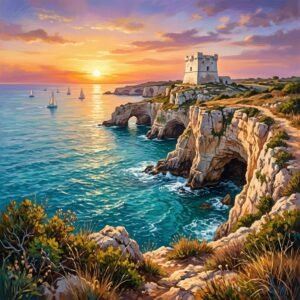
If there’s a magical time to visit the lighthouse, it’s at sunset. This isn’t just a subjective opinion—it’s almost a ritual. The warm light of the sun setting behind the white building paints the sky and sea in shades of orange, pink, and purple. The lantern begins to glow, faintly at first, then more brightly, becoming a beacon in the twilight. The atmosphere turns almost mystical. You’ll often find photographers with tripods, couples, and solitary travelers pausing in silence to admire the view. This is the moment when the lighthouse stops being just a monument and becomes a true beacon in the most poetic sense: a point of light and guidance. I recommend bringing a jacket, because in the evening, even in summer, the sea breeze can be cool. Staying until the first star becomes visible is a memory you’ll carry with you.

Why Visit It

Visiting the Leuca Lighthouse is worthwhile for three very concrete reasons. First, it’s a unique geographical point: you’re literally at the tip of Italy’s heel, with two seas at your feet. Second, it offers views you’ll hardly forget, especially from the terrace or at sunset. Third, it has a historical and functional charm that sets it apart from a mere viewpoint: it’s an engineering work still in use, telling centuries of navigation. It’s not just a postcard; it’s a place with its own voice, made of wind, light, and sea stories.

When to Go

The lighthouse is beautiful in every season, but for a truly enchanting experience, avoid the midday hours on the hottest summer days. The sun beats down intensely, and the place loses some of its magic. I much prefer late spring or early autumn, when the air is clear, the crowds thin out, and the light is perfect for photos. In winter, with the stormy seas, it’s spectacular but also very windy, almost wild. In any case, plan your visit for late afternoon, so you can end with the sunset. That’s when the place truly shines.

In the Surroundings

The lighthouse visit pairs perfectly with exploring the Basilica Sanctuary of Santa Maria de Finibus Terrae, located just steps away in the marina square. It’s an important place of worship, built on an ancient pagan temple, and its name (‘at the ends of the earth’) speaks volumes. Another related experience is a boat trip along the cave coastline. Departing from Leuca’s small harbor, you can admire spectacular sea caves, like the Grotta del Diavolo, which lie right beneath the cliffs dominated by the lighthouse. Two different experiences, land and sea, that complete the picture of this extreme corner of Puglia.

Itineraries nearby


💡 Did You Know…?

Below the lighthouse, carved into the rock, is the Devil’s Cave, accessible from the sea. Legend has it that sinister noises and glows came from the cave, frightening fishermen who attributed the phenomenon to the devil. In reality, it is an important prehistoric archaeological site. Nearby, the monumental staircase of 284 steps connects the basilica to the port, a majestic work commissioned in the 1900s. Looking east from the lighthouse terrace, with a bit of luck on the clearest days, you can glimpse the Albanian coast on the horizon.