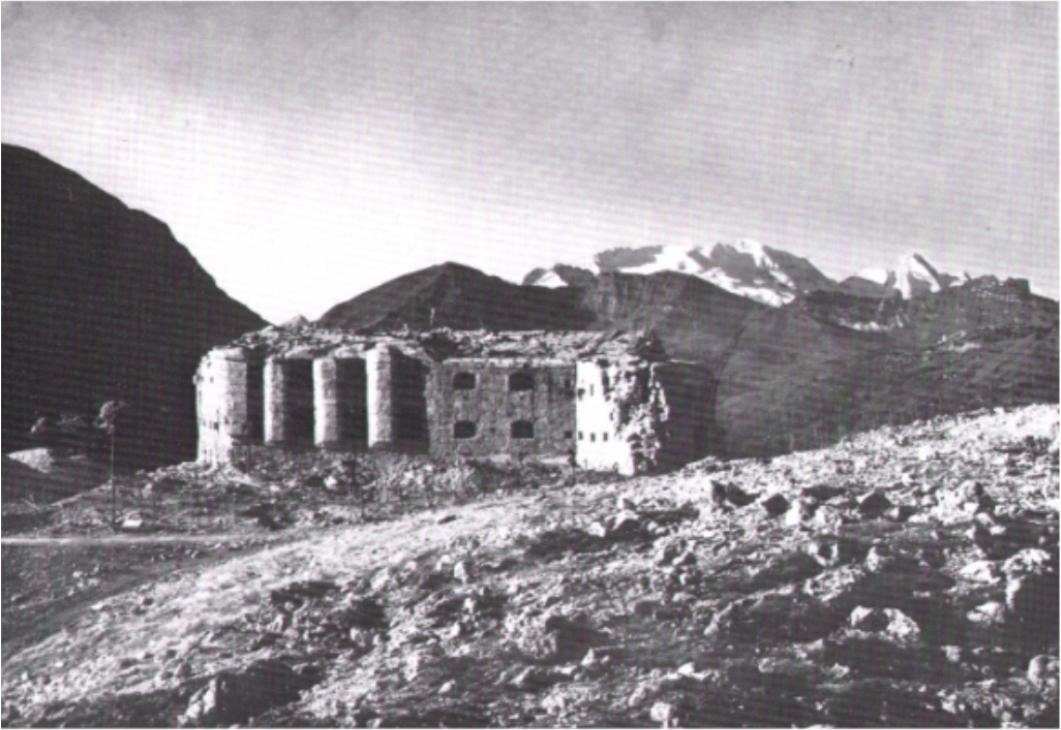
Forte Intra i Sásc, also known as Forte Tre Sassi, is an Austro-Hungarian Great War fortress perched at 2,197 meters on the Passo di Valparola, just a few kilometers from Cortina d’Ampezzo. Preserved as an open-air museum, it offers an accessible historical excursion with well-marked trails suitable for families, combining military history with breathtaking Dolomite landscapes.
- Austro-Hungarian World War I fortress built between 1897 and 1901, featuring cannon embrasures and evocative interior rooms
- Panoramic views of the Tofane and Monte Lagazuoi from its strategic position at 2,197 meters, perfect for photography
- Well-preserved open-air museum with wartime artifacts, soldiers’ graffiti, and original heating system
- Easy access via a non-strenuous trail from Passo Valparola, also reachable by car
Introduction
Arriving at Forte Intra i Sásc, also known as Forte Tre Sassi, is an experience that immediately strikes you. It’s not just an Austro-Hungarian fortress from the Great War, but a piece of history nestled among the Dolomites of Cortina d’Ampezzo. Its strategic position, at 2,187 meters, offers breathtaking views of the Tofane and Monte Lagazuoi. Walking among its stone walls, you breathe an atmosphere suspended between the wartime past and today’s mountain peace. Personally, I was surprised by how well-preserved it is, despite the years and battles. It’s not a sterile museum, but a living place where every corner tells a story. If you love mountains and history, here you’ll find the perfect mix. The feeling is of being in a unique place, far from the crowds of Cortina, yet incredibly close to its most authentic soul.
Historical Overview
Forte Intra i Sásc was constructed between 1897 and 1901 by the Austro-Hungarian Empire as part of the defensive system for the Dolomite front.
During World War I, it was the site of fierce clashes between Italian and Austrian forces, suffering heavy bombardments that damaged its structure. After the war, it fell into disrepair until a restoration in the 2000s transformed it into an open-air museum. Today, it houses wartime artifacts and temporary exhibitions. Its history is linked to figures such as Italian General Luigi Cadorna and the Alpine troops who fought here.
- 1897-1901: Construction by the Austro-Hungarian Empire
- 1915-1918: Use during the Great War, with significant damage
- 2000s: Restoration and opening to the public as a historical site
A Journey Through the Embrasures
Visiting the fort means exploring its interior and exterior spaces with curious eyes. The cannon embrasures offer incredible views of the surrounding mountains, and immediately make you understand why this location was chosen. Inside, the rooms are bare but evocative, with traces of graffiti left by soldiers and explanatory panels that recount daily life during wartime. I noticed details like bullet holes in the walls, which give a concrete sense of the violence of the clashes. It’s not a huge place, but every corner has something to say. I recommend climbing to the upper terrace: from there, the view embraces the entire Cortina basin, and in the distance, you can spot other military outposts. It’s an experience that combines historical and scenic aspects, without needing too many words.
Nature Reclaims Its Space
One of the most fascinating aspects of Forte Tre Sassi is how nature has reclaimed its space. Mosses and lichens cover the stones, creating a striking contrast with the military architecture. In spring, wildflowers sprout from the cracks, and in summer, you can hear the whistle of marmots in the surrounding area. This mix of ruins and natural life makes the place particularly photogenic, almost surreal. During my visit, I saw a falcon soaring above the towers, adding a touch of wilderness. It’s not uncommon to encounter chamois along the access trail. This reclamation by nature gives the fort a melancholic yet positive atmosphere, as if the mountain has healed the wounds of war. For me, it’s a detail that makes the visit even more memorable.
Why Visit It
Visiting Forte Intra i Sásc is worthwhile for at least three practical reasons. First, it’s a historical excursion accessible even to non-hiking experts: the trail from Passo Valparola is well-marked and not too challenging, suitable for families with older children. Second, it offers a unique perspective on mountain warfare during the Great War, away from typical museums, with authentic artifacts that let you touch history firsthand. Third, the views of the Dolomites are among the most beautiful in the area, perfect for unforgettable photos. Plus, it’s a smart alternative to the more crowded destinations around Cortina, ideal for those seeking a more intimate and reflective experience. I found it a way to combine sport, history, and natural beauty in a single outing.
When to Go
The best time to visit the fort depends on what you’re looking for. Personally, I recommend late spring or early autumn, when the days are still long but the summer crowds have thinned. During these periods, the low-angle sunlight enhances the colors of the stones and mountains, creating magical atmospheres. In summer, it’s best to arrive early in the morning to avoid the heat and enjoy the quiet before other hikers arrive. In winter, the fort is often snow-covered and accessible only with proper equipment, but the white landscape offers an almost fairy-tale experience. I’ve heard that at sunset in summer, when the sun paints the Tofane peaks pink, the spectacle is unmissable. In any case, check the weather conditions: at high altitude, conditions change quickly.
In the Surrounding Area
If you want to enrich your day, there are other thematic experiences in the surrounding area that you shouldn’t miss. The Great War Museum at Passo Falzarego is a complementary stop, with more detailed artifacts and interactive paths that complete the history of the fort. Alternatively, you can explore the Lagazuoi galleries, another wartime site carved into the mountain, reachable with an easy hike or by cable car. For a lighter experience, Lake Limides, not far away, offers a peaceful corner with crystal-clear waters and views of the Dolomites, perfect for a picnic after the historical visit. These places allow you to immerse yourself even more in the context of the area, without straying too far from Cortina.