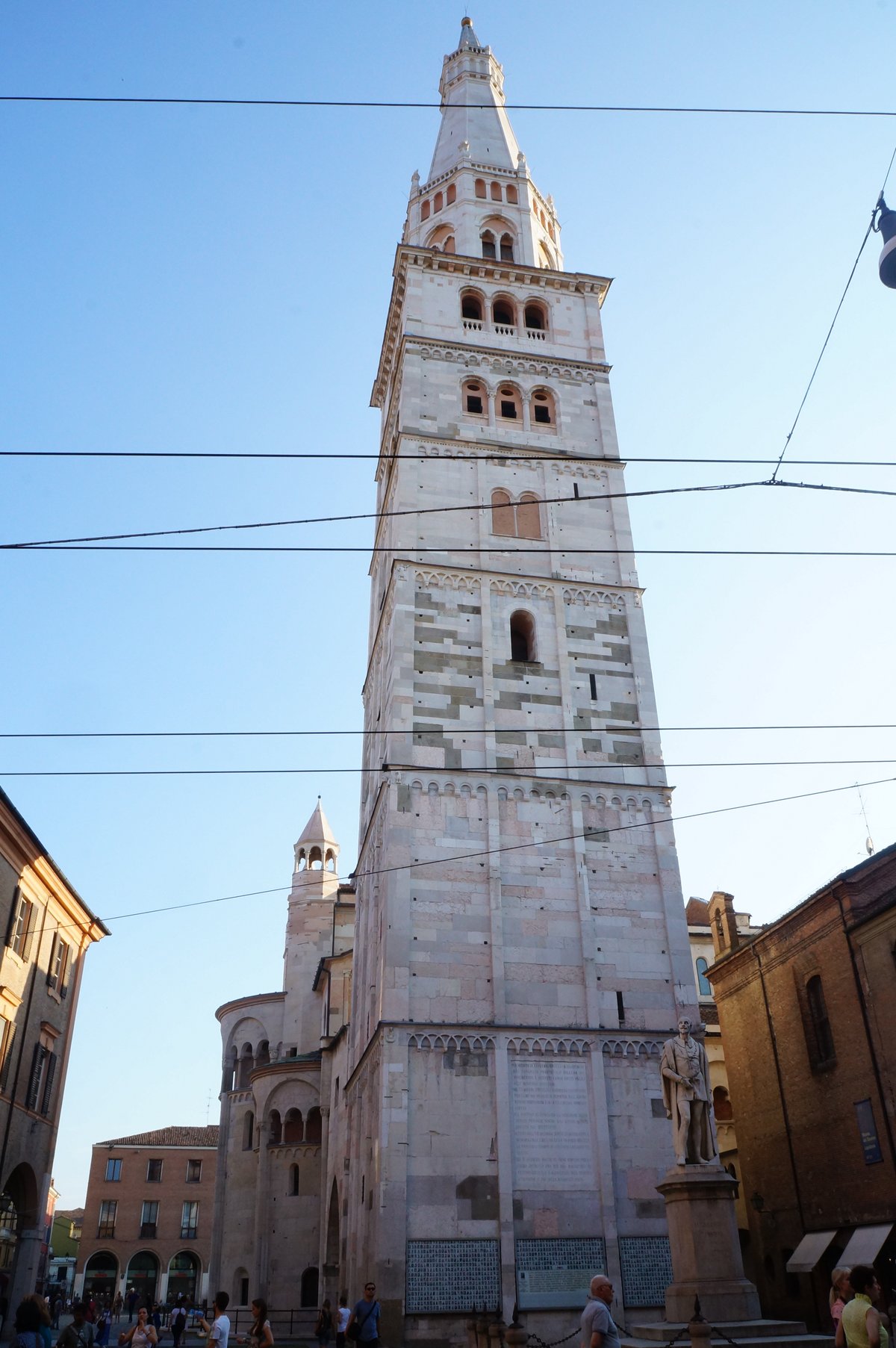
The Ghirlandina is the symbol of Modena, an 89-meter bell tower declared a UNESCO World Heritage Site along with the Cathedral and Piazza Grande. Ascending its 200 steps leads to the panoramic terrace with views of Modena and the Apennines, passing through the Sala dei Torresani with its medieval frescoes. The tower holds curiosities such as the Secchia rapita and the legendary Pietra Ringadora.
- Panoramic view of Modena and the Apennines from the top terrace
- Sala dei Torresani with 14th-century frescoes and Romanesque capitals
- Hidden symbols like the Pietra Ringadora and the bas-relief of King Arthur
- Romanesque architecture with double garland railings and an octagonal spire
Introduction
When you arrive in Modena, the first thing that catches your eye is the Ghirlandina, the majestic bell tower soaring beside the Cathedral. Standing 89 meters tall, it’s not just an architectural symbol but the beating heart of the city, designated a UNESCO World Heritage site along with the cathedral and Piazza Grande. Its slender silhouette, with the distinctive garland-shaped spire (from which it gets its name), dominates the urban skyline and invites you to discover its secrets. Climbing to the top offers a unique view over the red-tiled roofs of the historic center, the medieval towers, and on clear days, all the way to the Apennines. It’s an experience that combines history, art, and emotion, perfect for anyone wanting to capture the essence of Modena in a single glance.
Historical Overview
The construction of the Ghirlandina began in 1099, simultaneously with the Cathedral, commissioned by the Modenese community as a symbol of civic and religious power. Originally shorter, it was heightened between 1261 and 1319 with the addition of the octagonal spire, the work of Arrigo da Campione, which gave it its definitive appearance. In the Middle Ages, the tower served as a watchtower and repository for municipal documents, such as the Statutes of Modena, kept in the
Secchia Rapita (a secure vault). In 1997, along with the Cathedral and Piazza Grande, it was inscribed on the UNESCO World Heritage List as an exceptional example of Romanesque art. Recent restoration works (2008–2011) strengthened the structure and improved accessibility.
- 1099: Construction begins
- 1261–1319: Addition of the spire
- 1997: UNESCO World Heritage inscription
- 2008–2011: Conservation restoration
The Ascent and Architectural Details
Climbing the 200 steps of the Ghirlandina is an adventure that reveals unique details. The stone spiral staircase first leads to the Sala dei Torresani, where the guards once lived, with 14th-century frescoes depicting stories of saints and hunting scenes. Continuing upward, you encounter the five bells, cast in different eras, including the oldest one dating back to 1306. At the top, the panoramic terrace offers a 360-degree view: you can make out Piazza Grande with its checkerboard pavement, the Town Hall, and in the background, the hills where Traditional Balsamic Vinegar of Modena is produced. The external architecture features Romanesque bifora and trifora windows, while the spire is covered in marble slabs that gleam in the sun. Every detail, from the capitals to the corbels, tells centuries of Emilian craftsmanship.
Hidden Curiosities and Symbols
The Ghirlandina conceals symbols that connect it to Modenese culture. On the north facade, look for the ‘Pietra Ringadora’, a marble block used in the Middle Ages as a platform for public speakers, witness to assemblies and proclamations. Inside, at the base of the tower, a bas-relief depicts King Arthur in an episode from the Lancelot legend, a rare example of Arthurian iconography in Italy, possibly linked to pilgrims passing through Modena. Another peculiarity is its tilt of about 1.3 degrees towards the northwest, due to the clay soil, constantly monitored to ensure its stability. These elements, combined with its function as a ‘time tower’ (it once marked the hours with chimes), make the Ghirlandina a living monument, intertwined with the city’s daily life.
Why Visit It
Visiting the Ghirlandina is worthwhile for three concrete reasons. First, the panoramic view from the top is irreplaceable: it embraces the entire historic center of Modena, allowing you to recognize key monuments like the Ducal Palace and the ancient walls. Second, it’s an opportunity to touch history firsthand: walking through its halls means retracing centuries of Modenese life, from the documents preserved in the Secchia Rapita to the bells that still mark events today. Third, access is included in the combined ticket with the Cathedral and the Cathedral Museums, a practical advantage for those who want to optimize time and budget, delving into the entire UNESCO complex in a single tour.
When to Go
The ideal time to climb the Ghirlandina is in the late afternoon, when the warm sunlight enhances the colors of the bricks and marble, creating beautiful shadow plays across the square. In summer, avoid the midday heat, while in autumn and spring visibility is often optimal, with clear skies that allow you to see all the way to the Apennines. If you prefer a more intimate atmosphere, weekdays are less crowded than weekends, allowing you to enjoy the climb and the view in peace. No matter the season, check the weather forecast: a clear day turns the experience into an unforgettable spectacle.
In the Surroundings
After your visit, explore Piazza Grande, the heart of UNESCO-listed Modena, with its Romanesque Cathedral and Town Hall, where you can admire the Secchia Rapita (the city’s symbol). Just a short walk away, immerse yourself in the Cathedral Museums, which house treasures such as the Cathedral Metopes and medieval artifacts. For a themed experience, head to a traditional vinegar cellar in the nearby countryside, where you’ll discover the production of Traditional Balsamic Vinegar of Modena DOP, a product deeply rooted in local culture for centuries. These locations enrich your visit, connecting art, history, and flavors in a cohesive itinerary.