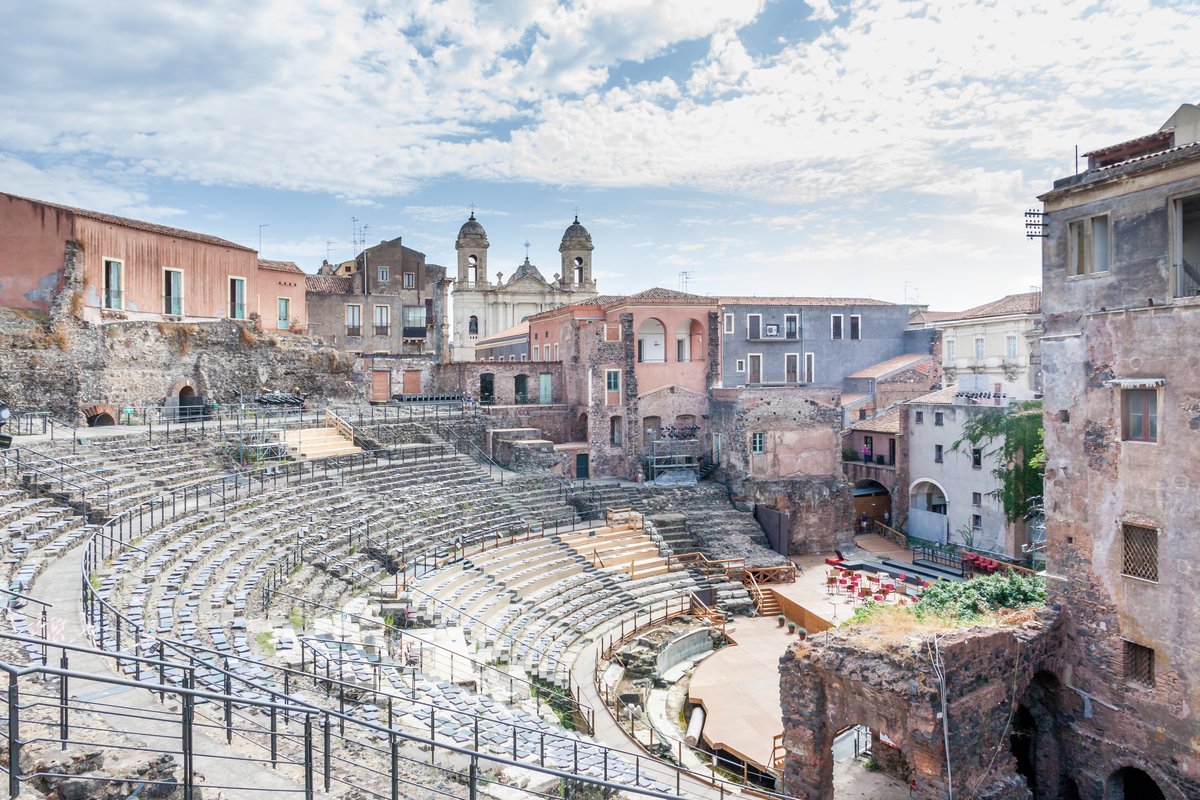
The Greek-Roman Theatre of Catania, hidden among the Baroque buildings of the city centre, is an authentic archaeological site constructed with Etna’s lava stone. It offers a peaceful experience away from the crowds, with panoramic views over Catania’s rooftops and, on clear days, Mount Etna.
- Built by the Greeks in the 3rd century BC and expanded by the Romans, with seating made of lava stone.
- Strategically located in the historic Civita district, near Via Etnea and the Benedictine Monastery.
- ‘Secret’ entrance from Casa Liberti and panoramic views from above over Catania’s rooftops.
- Authenticity of the ruins blending with the modern urban fabric, creating a fascinating contrast.
Introduction
Have you ever walked through a modern city and suddenly found yourself face to face with two thousand years of history? At the Greek-Roman Theatre of Catania, that’s exactly what happens. Tucked away among the Baroque buildings of the city center, this archaeological site surprises you with its grandeur, almost like a secret that Catania jealously guards. It’s not just a theatre; it’s an experience that makes you feel the weight of time. The view from above, with the lava stone steps descending towards the orchestra, is something that stays with you. Personally, I was struck by how palpable, almost tangible, the contrast between ancient and modern is here. It’s not a closed museum; it’s a living place that breathes along with the city.
Historical Overview
The history of this theatre is a true epic. Originally built by the Greeks in the 3rd century BC, it was later
expanded and transformed by the Romans in the 2nd century AD, becoming one of the largest in Sicily. Imagine—it could seat up to 7,000 spectators! It wasn’t just for tragedies: gladiatorial shows and naumachiae, or simulated naval battles, were held here. Over time, it was abandoned and partially buried. Interestingly, some of its stone blocks were reused to build the nearby Benedictine Monastery. Here’s a timeline to put it in order:
- 3rd century BC: First Greek settlements.
- 2nd century AD: Peak under Roman rule.
- Middle Ages: Abandonment and reuse of materials.
- 18th century: Discoveries during post-earthquake works.
- Today: An archaeological site visitable in the heart of the city.
The Lava Stone of Mount Etna
One of the details that makes this theatre unique is the material it’s built with: the lava stone of Mount Etna. This isn’t merely an aesthetic choice, but a practical and ingenious one. The Romans, who knew the territory well, used this black, porous basalt because it was durable, easy to work with, and, I believe, to integrate it with the landscape. Walking among the tiers, touching them, you feel the typical roughness of solidified lava. It’s as if the volcano, which dominates Catania, had directly contributed to the construction. This connection with Mount Etna isn’t just symbolic: during excavations, layers of volcanic ash were found that helped date the various phases of the site. It’s almost as if nature had left its signature.
The Secret Entrance and the View
Not everyone knows that the theater’s access isn’t limited to the main entrance. There’s a sort of secret entrance from Casa Liberti, a modern building overlooking the ruins. From there, you get a different, closer perspective that lets you appreciate the details of the vaults and underground corridors. But the best view, in my opinion, is from above. Climbing to the upper terraces (if accessible—always check first!), your gaze spans the theater in its entirety, with the rooftops of Catania in the background and, on clear days, a silhouette of Mount Etna on the horizon. It’s a sight worth the visit alone. Note: sometimes parts may be under restoration, but this too is part of the character of an ever-evolving site.
Why Visit It
Why dedicate a couple of hours to this theater? First, for its authenticity: it’s not a reconstruction, it’s history emerging from underground, with all its signs of time. Second, for its location: it’s extremely convenient, in the historic center, just steps away from Via Etnea. You can easily combine it with a city tour. Third, for the value for money: admission costs just a few euros and gives you a plunge into antiquity without having to travel kilometers. And let’s face it, it’s a great way to escape the summer heat or the crowds: down here, among the stones, there’s often a pleasant coolness. I’ve returned several times and each time I discover a new detail.
When to go
The best time? Early afternoon, especially in spring or autumn. The sun, not too high, illuminates the steps in a spectacular way, creating plays of shadows that enhance the shapes. In summer, avoid the midday hours: it’s hot and the site is almost completely exposed. In winter, on the other hand, clear days after rain offer a special atmosphere, with the lava stones becoming darker and shinier. Once I was there around closing time, with the sun setting, and it was magical: silent, almost suspended in time. Perhaps a bit melancholic, but beautiful.
In the Surroundings
After leaving the theater, don’t miss two nearby experiences that complete the picture. First, the Benedictine Monastery of San Nicolò l’Arena, one of the largest in Europe, which stands right above part of the ancient cavea. Today it’s a university campus, and the contrast between Baroque cloisters and student life is fascinating. Second stop, a visit to the historic Pescheria market, just a few minutes’ walk away. Not to buy fish (unless you need it), but to immerse yourself in the colors, scents, and sounds of the most authentic Catania. It’s like moving from antiquity to daily vitality in an instant.