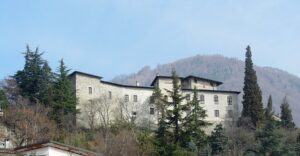
Pontevico Castle: Medieval Tower on the Oglio River and Ancient Walls

Pontevico Castle dominates the Oglio River with its imposing medieval tower and well-preserved brick walls. Accessible free of charge and away from mass tourism, it offers an authentic experience blending history and landscape.

  • Master brick tower built directly overlooking the Oglio River
  • Authentic medieval walls that tell centuries of local history
  • Strategic panoramic location with glimpses of the surrounding countryside
  • Free access to a partially visitable and genuine historical site


Events nearby


Copertina itinerario Pontevico Castle: Medieval Tower on the Oglio River and Ancient Walls
Medieval castle with a master brick tower overlooking the Oglio River, accessible free of charge. Discover Visconti and Venetian history, stroll among authentic remains, and admire panoramic views of the Brescian countryside.

Good to know


Introduction

As you arrive in Pontevico, the Castle suddenly appears before you, an imposing tower that stands out against the sky right where the village overlooks the Oglio River. It’s not one of those perfectly restored and museum-like castles; on the contrary: it has that slightly decadent, authentic charm that makes you feel like you’re truly touching history. The red brick walls, worn by time and water, tell centuries of life along the river. The location is everything: it dominates the valley with an air of control that you can still sense today. I stopped to look at it from the opposite bank and understood why this place, though not among the most famous in Lombardy, has such a strong character. It’s a piece of the Middle Ages that endures, silent, as the river flows slowly at its feet.

Historical Overview

The history of Pontevico Castle is a tapestry woven from threads of power, water, and defense. The first reliable records date back to the 13th century, when it served as a strategic outpost for the Visconti family of Milan to control the border with Venice along the Oglio River. It was not merely a noble residence but a true fortress, fulfilling military and customs functions. In the 15th century, it passed to the Republic of Venice, which further strengthened its defenses. Yet it was water, both ally and adversary, that ultimately shaped its fate: a devastating flood in 1705 destroyed much of the structure, leaving primarily the tower and some sections of the walls standing. What you see today is what has survived wars and floods—a silent witness to distant eras.

  • 13th century: Construction as a Visconti outpost
  • 15th century: Transition to Venetian rule and fortification enhancements
  • 1705: Severe damage from a flood of the Oglio River
  • Today: Accessible medieval remains, with the tower as the dominant feature

The Tower and Its Gaze Over the River

If there’s one element that defines this castle, it’s its main tower of exposed brick. It’s not accessible inside (unfortunately, I would have liked to climb it), but simply walking around it reveals its importance. It’s massive, square, with narrow arrow slits that once served archers. What’s striking is how it was built sheer above the Oglio River, almost challenging its current. From here, lookouts monitored river traffic and the approach of any enemies. Today, the view it offers is more peaceful: cultivated fields, the winding watercourse, and in the distance the first foothills of the Prealps. I recommend taking the small path that runs along the walls towards the river: from there, the perspective on the tower is even more dramatic, and you understand why this point was so strategically vital.

A Lived-In Castle, Not Just Seen

Visiting Pontevico Castle isn’t a stroll through a sterile museum. It’s a tactile experience, almost. You walk on what remains of the ancient courtyards, among wild grass and uneven stones. The walls, in some places, have been incorporated into more recent constructions—houses and warehouses—creating a curious collage of eras. This is what I like: it tells of a place that hasn’t been abandoned but has continued to live, transforming. You’ll notice, for example, how an old entrance arch is now part of a private garden. There aren’t explanatory panels everywhere (sometimes you have to imagine), but perhaps that’s better: it forces you to observe the details, like the bricks worn by rain and wind, or the traces of ancient fires on the stones. Wear comfortable shoes because the ground is uneven.

Why Visit It

For three concrete reasons. First: it’s an authentic example of Lombard river military architecture, not reconstructed but genuine in its incompleteness. Second: the location is unique, with the river seeming to embrace the ruins, creating beautiful photographic views, especially with the slanting light of early afternoon. Third: it’s a dive into a lesser-known but fascinating history, that of the borders and rivalries between Milan and Venice, which were also played out here through control of the waters. Plus, it’s free and not crowded: you can take your time, without queues or mandatory routes.

When to Go

The best time? A late autumn afternoon, when leaves begin to yellow and the light is warm and low. In that season, the river’s humidity mingles with the cool air, and the castle stones take on deeper red hues. In summer it can get very hot and the area offers little shade, while in spring, if the river is high, the atmosphere is more dramatic but some paths might be muddy. Personally, I avoid gray, rainy days because the mood becomes a bit too melancholic, but that’s a subjective preference.

In the Surroundings

The castle visit pairs perfectly with a stroll through the historic center of Pontevico, a peaceful village with some interesting civic architecture and the parish church. For a river-themed experience, a few kilometers away lies the Oglio Nord Park, a protected natural area where you can enjoy easy walks or birdwatching along the banks, following trails that wind through oxbow lakes and riparian woods. It’s a lovely way to continue soaking in the atmosphere of this water-shaped landscape.

Itineraries nearby


💡 Did You Know…?

According to local legend, on full moon nights, the footsteps of the Venetian soldiers who garrisoned the castle can still be heard. A historical anecdote confirmed by documents recounts that in 1438, during the war between Milan and Venice, the condottiero Niccolò Piccinino tried unsuccessfully to capture the fortress, demonstrating its defensive solidity. The main tower, 25 meters high, was also used as a prison until the 19th century, and on its inner walls, graffiti left by prisoners is still visible. During restoration work in the 1990s, a well 15 meters deep was discovered, which ensured water supply during sieges.