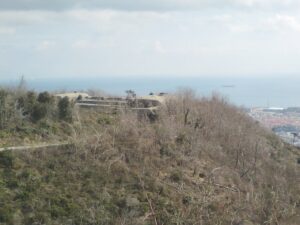
The Roman amphitheatre of Luni in Portonetti, in the province of La Spezia, is a well-preserved archaeological site from the 1st century AD that combines ancient history with an exceptional sea panorama. The remains include stone seating and an ellipse measuring approximately 90 by 70 metres, offering an authentic and accessible experience for all.
- Stone seating with a panoramic view of the Gulf of Poets
- Well-preserved remains dating back to the 1st century AD, with a visible elliptical perimeter
- Free access without a ticket, ideal for families and history enthusiasts
- Tranquil atmosphere away from crowded tourist circuits
A Dive into Ancient Rome with a Sea View
Arriving at the Roman Amphitheatre of Luni in Portonetti is an immediately striking experience. You don’t expect to find such a well-preserved archaeological site just steps from the sea, and yet there it is: the stone steps overlooking the Gulf of Poets create an incredible contrast between history and landscape. You walk among the remains and it almost feels like you can hear the roar of the gladiators, while your gaze sweeps towards Lerici and Tellaro. It’s a place that speaks for itself, without needing too much explanation. The atmosphere is tranquil, far from the crowds of the Cinque Terre, perfect for a moment of reflection. Personally, I was surprised to discover how intact the elliptical perimeter is: the entrances and part of the cavea are clearly distinguishable. A detail I love? The local stone, a grey limestone that turns pink at sunset. It’s not the Colosseum, but it has a more intimate and authentic charm.
History in a Nutshell: From Roman Colony to Archaeological Site
The amphitheatre is not an isolated relic: it is part of the ancient city of Luni, founded as a Roman colony in 177 BC. This structure, likely built in the 1st century AD, was the heart of entertainment for citizens, hosting gladiatorial shows and animal hunts. The city reached its peak as a strategic port for trading marble from the Apuan Alps, then gradually declined. Systematic archaeological excavations began in the 19th century, uncovering not only the amphitheatre but the entire urban area. Today, walking among the ruins, one can clearly understand the importance of this Roman outpost in Liguria.
- 177 BC: Foundation of the Roman colony of Luni.
- 1st century AD: Construction of the amphitheatre.
- Middle Ages: Decline of the city and abandonment of the site.
- 19th century: Beginning of archaeological excavations.
- Today: Visitable site and part of the Luni Archaeological Park.
The Perfect Ellipse and Its Secrets
What immediately strikes you is the shape: an almost perfect ellipse measuring approximately 90 by 70 meters, partially excavated into the ground to take advantage of the natural slope. This engineering technique, typical of Roman amphitheaters, ensured stability and good acoustics. Upon closer inspection, you can still see the squared stone blocks that formed the seating tiers (cavea), divided into sections. Some claim it could accommodate up to 7,000 spectators, an impressive number for a provincial colony. Unfortunately, there are no remains of the actual arena, but imagination fills in the gaps. An interesting detail? The construction materials came from nearby quarries, the same ones that supplied Rome with marble. Walking along the perimeter, you get the feeling of being in a ‘living’ place, where every stone tells a story of labor, leisure, and daily life.
The Dialogue Between Archaeology and Landscape
Location is everything here. The amphitheater isn’t enclosed in a sterile fence, but blends seamlessly with the panorama of the Gulf of Poets, creating a unique dialogue between past and present. On one side, Roman ruins; on the other, the blue sea and green hills of the Ligurian coast. This makes the visit particularly evocative: it’s not just about admiring a monument, but immersing yourself in an extraordinary environmental context. In winter, with the low-angled light, shadows accentuate the volumes of the seating tiers; in summer, the contrast between the pale stone and the blue sky is photogenic. I like to imagine that ancient spectators enjoyed the same view, perhaps between one performance and another. It’s a place that invites you to sit and observe, without haste. Perfect for those seeking a cultural experience but also relaxation, away from the more beaten paths.
Why It’s Worth Visiting
First: it’s one of the few Roman amphitheaters in Liguria so well-preserved and with free access. No need to book or pay for a ticket—you can just arrive and enjoy it at your own pace. Second: the combination of history and landscape is rare. Where else do you find an ancient archaeological site directly overlooking the sea? Third: it’s suitable for everyone. History enthusiasts can delve deeper with the informational panels (few but clear), while families with children appreciate the open, safe space for a stroll. Plus, being less known compared to other attractions in the area, you avoid the crowds. I visited on an autumn afternoon, and there were only two other people: silence, a light breeze, and that sense of discovery that makes a trip special.
The Right Time for Magic
I would avoid the midday hours on summer days when the sun beats down strongly and there’s no shade. The best time is late afternoon, especially in spring or autumn. The light is warm, low-angled, and accentuates the stone reliefs, creating postcard-perfect atmospheres. In winter, with a clear sky, you can enjoy a crisp view of the gulf, though it can be cold. Personally, I prefer the months of May or September: the climate is mild, nature is lush, and you can combine the visit with a walk on the fine sandy beach nearby. If you happen to visit on a day with a southwesterly wind, you’ll smell the sea mingling with the earth: a mix that, for me, captures the essence of this corner of Liguria.
What to see in the surrounding area
A visit to the amphitheatre pairs perfectly with exploring the Archaeological Area of Luni, just a few minutes’ drive away. Here you’ll find the remains of the forum, temple, and domus, along with a museum displaying interesting artefacts such as statues and mosaics. Another thematic pairing is Lerici Castle, reachable with a short detour: it overlooks the gulf from above and houses a geopaleontology museum, ideal for those who love natural history. If you prefer a contrast, after immersing in culture you can relax on Marinella di Sarzana beach, a sandy and family-friendly spot. All these places are connected by the same ancient history and the beauty of the territory, without requiring long journeys.