
The Royal Castle of Racconigi is a Savoy residence set within a 170-hectare historical park, featuring authentic interiors that preserve period furniture, original tapestries, and paintings. Strolling through the royal apartments and English gardens offers an immersive cultural experience away from the crowds.
- Royal apartments with original furnishings, including Charles Albert’s Bedroom and the Hercules Hall
- Historical park designed by Xavier Kurten with ponds, small temples, and rich birdlife
- 19th-century greenhouses among Italy’s oldest, still functioning with exotic plants
- Neo-Gothic Margaria dependency adding a romantic touch to the complex
Events nearby

UNESCO-listed Savoy residence with perfectly preserved royal apartments, a 170-hectare romantic park designed by Xavier Kurten, and functioning 19th-century greenhouses. Visit Charles Albert’s Bedroom and the neo-Gothic Margaria dependency.
Good to know
Introduction
The Royal Castle of Racconigi welcomes you with its majestic neoclassical facade, nestled within a centuries-old park that feels suspended in time. It’s not just a Savoy residence, but a place where history breathes in every detail, from the perfectly preserved royal apartments to the 19th-century greenhouses. Walking here means immersing yourself in a regal atmosphere, among frescoed halls and period furniture that recount centuries of court life. The park, with its tree-lined avenues and fountains, completes the experience, offering quiet corners perfect for a pause. It’s one of those places that impresses with effortless elegance, far from the crowds of more touristy spots.
Historical Overview
The castle’s history begins in the Middle Ages as a fortress, but it was with the Savoy-Carignano family that it became a country residence in the seventeenth century. The architect Guarino Guarini redesigned its Baroque forms, while in the nineteenth century Pelagio Palagi transformed it in Neoclassical style, adding the famous greenhouses. King Charles Albert loved to stay here for hunting and relaxation, and the last King of Italy, Umberto II, was born here. Today it is a UNESCO World Heritage site as part of the Savoy Royal Residences, with interiors preserving original furnishings and artworks.
- 11th century: first records as a medieval castle
- 1670-1676: transformation into a residence for the Savoy-Carignano family
- 1834-1842: Neoclassical renovation by Pelagio Palagi
- 1997: inclusion in the UNESCO list
The Royal Apartments
Visiting the royal apartments is like stepping into the daily life of the Savoy family: the rooms are furnished with period furniture, silk curtains, and crystal chandeliers that illuminate frescoed halls. The Bedroom of Charles Albert stands out, with its four-poster bed and family portraits, and the Hercules Hall, dedicated to court festivities. Each space tells stories of illustrious guests, such as Tsar Nicholas II, and preserves personal items, like the porcelain dinner service. The attention to detail is impressive, from the marble fireplaces to the precious wood floors, making the visit a plunge into 19th-century elegance.
The Park and the Greenhouses
The historic park is a masterpiece of romantic gardening, with winding avenues, ponds populated by swans, and small temples hidden among the vegetation. Designed by Xavier Kurten, it extends for hectares and includes an English garden with centuries-old trees, such as oaks and plane trees. The nineteenth-century greenhouses, among the oldest in Italy, host exotic plants and citrus trees, and are still functional. Walking here offers moments of peace, with glimpses of the castle emerging among the trees, ideal for photos or simply to disconnect from the routine. In spring, the blooming of rhododendrons and magnolias adds a touch of color.
Why Visit It
Three concrete reasons not to miss it: first, the authentic interiors show you how the court actually lived, with original furnishings and stories of figures like Carlo Alberto. Second, the park is a green oasis perfect for a refreshing walk, away from the chaos, with quiet corners and local wildlife. Third, it’s an example of excellent conservation: everything, from the curtains to the gardens, is maintained as it once was, offering an immersive historical experience without artificial reconstructions.
When to Go
The best time is late spring, when the park is in full bloom and the mild climate allows you to enjoy both the interiors and exteriors without oppressive heat or cold. During these weeks, the colors of the magnolias and rhododendrons burst forth, and the long days give you ample time to explore at a leisurely pace. Avoid the summer peaks if you prefer tranquility: in the early morning or at sunset, the slanting light enhances the beauty of the frescoes and gardens.
In the Surroundings
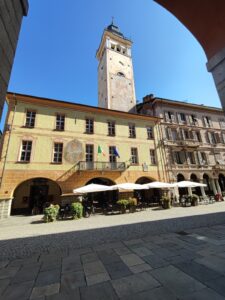
Just a few minutes away, the historic center of Racconigi is worth a stop, with its arcades and the Church of San Giovanni Battista, which houses Baroque artworks. For a themed experience, head to Savigliano to visit the Piedmont Railway Museum, with vintage locomotives that tell the story of transportation in the region, ideal if you love engineering or are traveling with children.
Itineraries nearby


💡 Did You Know…?
The castle hosted the 1900 wedding of Victor Emmanuel III and Elena of Montenegro, an event that transformed Racconigi into a capital for a day. Legend has it that the ghost of a courtier still wanders the halls, while the gardens hide a rare specimen of oriental plane tree planted in 1813. The 19th-century greenhouse, one of the largest in Europe, preserves exotic plants brought back from the Savoy family’s travels.