Introduction
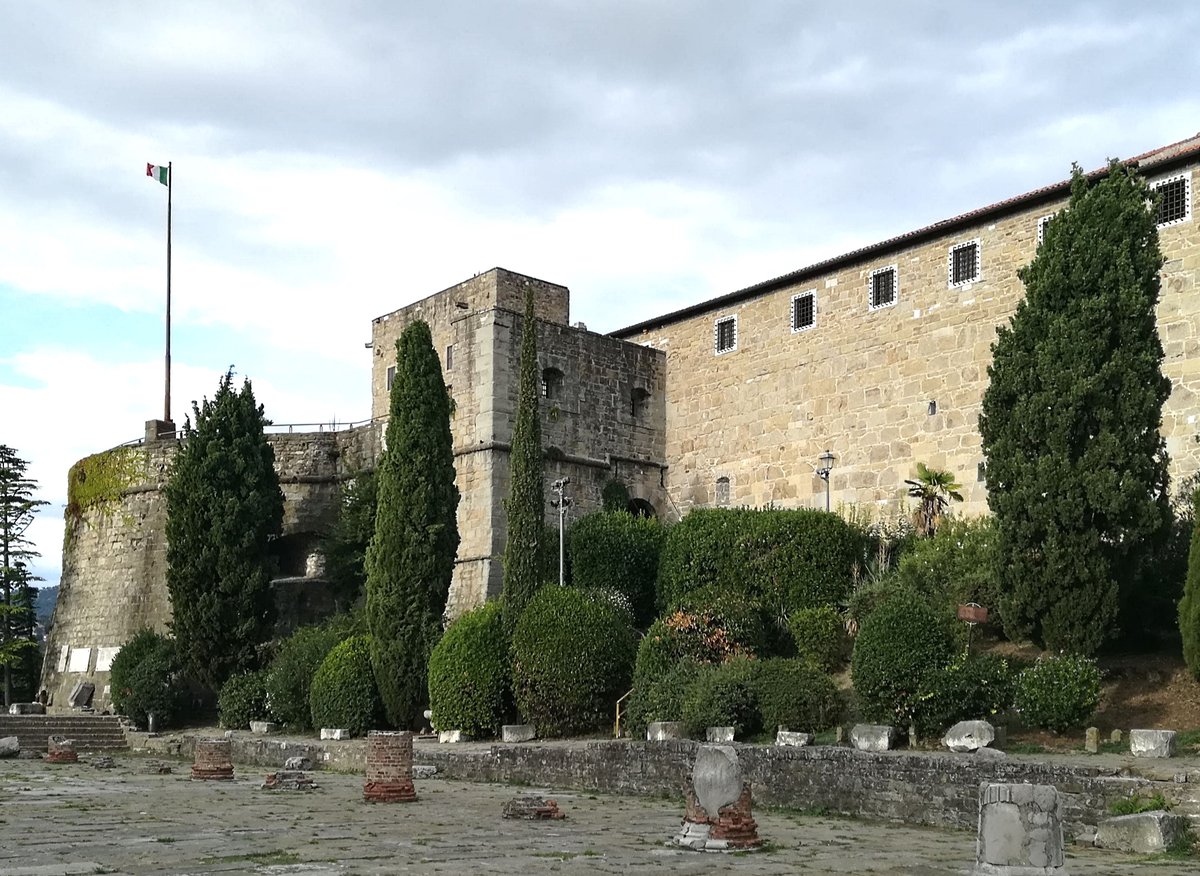
Perched on the hill overlooking Trieste, Castello di San Giusto is much more than a museum: it’s a living fortress that tells centuries of history. As you enter, the smell of ancient stone and the view opening over the gulf immediately capture your gaze. This is no postcard castle, but an authentic place, where the ramparts speak of wars and power. And then, as soon as you cross the drawbridge, two old friends await you: Michez and Jachez, the automata that strike the hours.
Historical Background
Construction of the castle began in 1468 under Emperor Frederick III of Habsburg, on a hill that had been inhabited since Roman times. In 1508-1509, the Venetians – who briefly recaptured Trieste – added the Round Bastion. After the Austrians returned, work continued with the Lalio Bastion (1553-1557) and finally the Fiorito Bastion (1636). Until 1750 it served as the residence of the Imperial Captain, then became a garrison and prison. Purchased by the municipality in 1932, it opened as a museum in 1936.
- 1468: construction began on the Captain’s House
- 1508-1509: Round Bastion (Venetian)
- 1553-1557: Lalio Bastion
- 1636: completion of Fiorito Bastion
- 1936: opened to the public as a museum
A Dive into History: The Automatons and the Courtyard
As soon as you cross the drawbridge, you find yourself in a 16th-century vestibule dominated by two life-sized figures: they are Michez and Jachez, 19th-century striking automata, once on the town hall clock. Next to them, the so-called Melone, an enigmatic stone acroterion from Roman times, symbol of the city. The Courtyard of the Militias, in the center, preserves a well-cistern and ancient tombstones. From here, your gaze sweeps over the three bastions: each with a different shape, testifying to the evolution of defensive techniques.
Museum and Armory: Hidden Treasures
Inside the Captain’s House winds the Castle Museum-Armory. The Chapel of St. George preserves a Gothic vault with the coat of arms of Frederick III and the motto A.E.I.O.U. On the first floor, the Caprin Room recreates the atmosphere of an 18th-century Venetian salon, with original furnishings and the painting “Triumph of Venice” by Andrea Celesti. Along the patrol path, the armory displays halberds, swords, crossbows, and rifles from the Middle Ages to the 19th century. In the underground of the Lalio Bastion, the Lapidarium Tergestinum houses 130 Roman inscriptions and sculptures, including statues of deities and the equestrian monument of Lucius Fabius Severus.
Why Visit It
1) The view from the walls: it offers a unique view of the gulf, the old town, and the Teresiano district – perfect for an unforgettable photo. 2) The Venetian and Habsburg bastions: walking among the fortifications lets you understand how Trieste was contested for centuries. 3) The Tergestino Lapidary: a journey into Roman Tergeste with authentic artifacts, including funerary monuments and maritime mosaics.
When to Go
The most evocative time? Late afternoon, just before closing (at 7 PM in summer). The warm light tints the stone and the sea lights up with golden reflections. To avoid the crowds, choose a weekday in mid-season, like May or September. In winter, the castle feels more intimate, but the chilly view is equally fascinating. And if you’re lucky, you might catch one of the historical reenactments or summer concerts in the courtyard.
In the Surroundings
Just steps from the castle, the Cathedral of San Giusto is worth a visit: a Romanesque gem built on a Roman basilica, with mosaics and the bell tower from 1337. A little further down, the Civic Museum of Antiquities Winckelmann houses Roman sculptures and an Egyptian mummy. If you fancy a walk, the Parco della Rimembranza offers welcome shade in summer.