
🧭 What to Expect
- Ideal for: cultural travelers and families
- Highlights: Buonconsiglio Castle, MUSE, pedestrian historic center
- Must-see: Orrido di Ponte Alto for a nature escape
- Best time: spring and autumn for mild weather
- Tip: taste the typical Trentino products
Events nearby
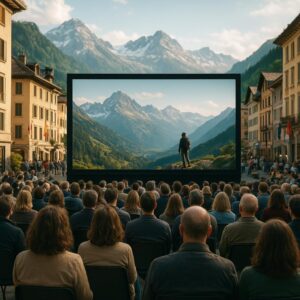


Trento is a city that surprises. What to see in Trento? Buonconsiglio Castle is the ideal starting point: a medieval complex rich in frescoes, including the famous Cycle of the Months. Nearby, St. Vigilius Cathedral dominates Piazza del Duomo with its Gothic facade. For science lovers, MUSE is an interactive museum that appeals to both adults and children. Don't miss Neptune's Fountain and the Civic Tower for a panoramic view. If you're looking for nature, the Orrido di Ponte Alto is a spectacular gorge just a stone's throw from the center. End your visit with a stroll among Renaissance palaces like Palazzo Pretorio and Palazzo Geremia. Trento is easily explored on foot, perfect for a weekend getaway.
Overview
- Castello del Buonconsiglio
- Castello del Buonconsiglio
- Saint Vigilius Cathedral: History and Art in the Heart of Trento
- Saint Vigilius Cathedral: History and Art in the Heart of Trento
- MUSE: An Interactive Journey Between Science and Nature
- MUSE: An Interactive Journey Between Science and Nature
- Piazza del Duomo: The Heartbeat of Trento
- Neptune Fountain: The Baroque Heart of Piazza Duomo
- Civic Tower: history, bells, and breathtaking view over Trento
- Church of Santa Maria Maggiore in Trento
- Palazzo Pretorio: A Dive into History Between Bishops and Courts
- Museo Diocesano Tridentino: A Dive into Sacred Art Among Tapestries and Treasures
- The Orrido di Ponte Alto: Trento's Secret Canyon
- Forte di San Rocco, Trento
Itineraries nearby
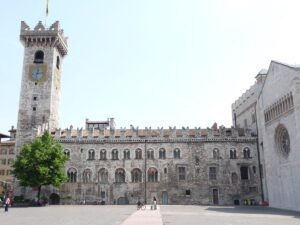


Castello del Buonconsiglio
- Go to the page: Buonconsiglio Castle: History and Art in the Heart of Trento
- Via Torre D'Augusto, Trento (TN)
- https://www.buonconsiglio.it/index.php/Castello-del-Buonconsiglio
- Open in Google Maps
- View on Google Images
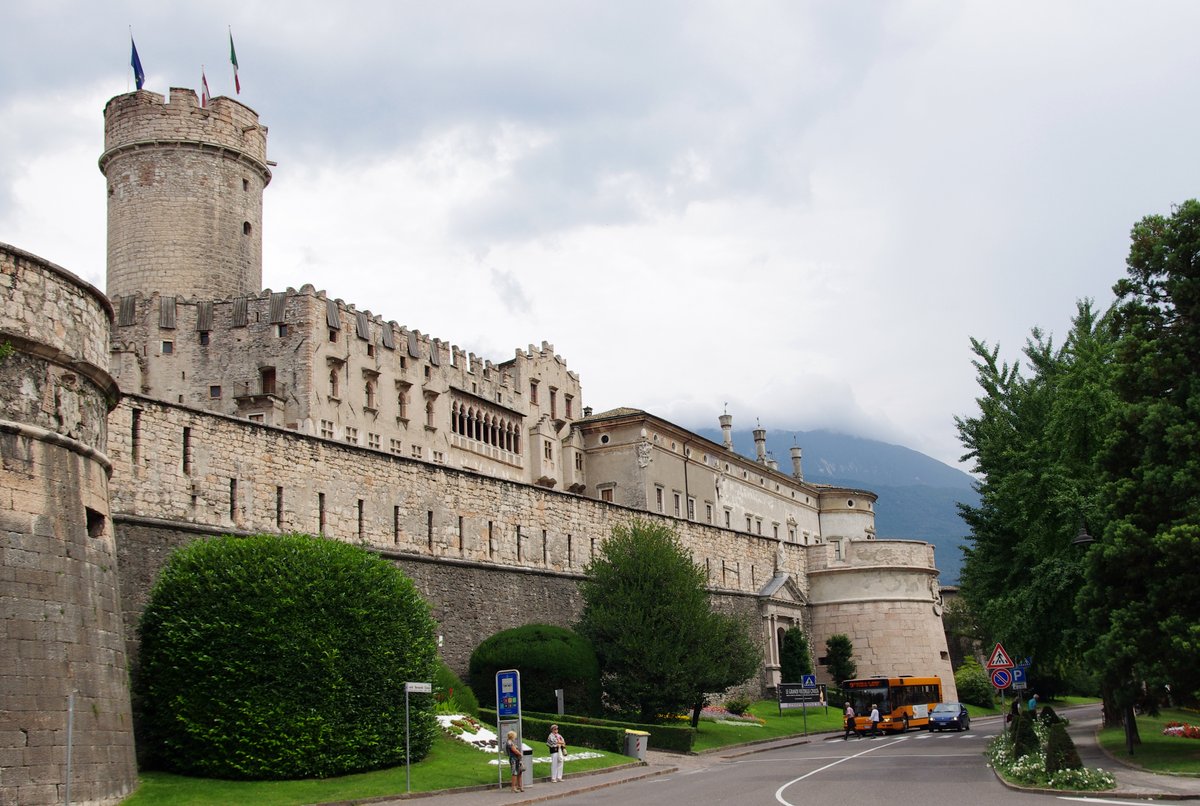 Entering Castello del Buonconsiglio is like flipping through a seven-century-long history book. This imposing complex, perched on a small promontory in the heart of Trento, was for centuries the residence of the prince-bishops. You don't expect it to be so big: as soon as you cross the entrance, you find yourself facing three different souls in one space. On one side, the Castelvecchio, the medieval core with its mighty cylindrical tower (Torre d'Augusto), on the other the Magno Palazzo, a Renaissance jewel commissioned by Cardinal Bernardo Cles, with frescoes by Dosso Dossi and Romanino. And then there's the Giunta Albertiana, a Baroque addition from the 1600s. But the real masterpiece, the one that leaves you speechless, is the Torre Aquila. Hidden here is the Ciclo dei Mesi (Cycle of the Months), a fresco from the early 1400s by a Bohemian master, Wenceslaus. Eleven scenes depicting noble life and agricultural work month by month: a rare example of International Gothic so vivid that you can almost hear the peasants' songs and the horses' hooves. Strolling through the sixteenth-century gardens, among geometric hedges and Lagerstroemia trees, is a relaxing break. And if you love art, don't miss the temporary exhibitions: the castle is a vibrant cultural center. Practical info: the castle is at via Bernardo Clesio 5. Open Tuesday to Sunday (closed Monday), hours 10-18 (winter 9:30-17). Full ticket €10, reduced youth (15-26) €6, supplement for Torre Aquila €2.50. With the Trentino Guest Card you get a 30% discount. Note: there are architectural barriers, but the museum does its best for accessibility.
Castello del Buonconsiglio
- Go to the page: Buonconsiglio Castle: Gothic Frescoes and Council of Trent Chambers
- Via Torre D'Augusto, Trento (TN)
- https://www.buonconsiglio.it/index.php/Castello-del-Buonconsiglio
- Open in Google Maps
- View on Google Images
Entering Castello del Buonconsiglio is like flipping through a seven-century-long history book. This imposing complex, perched on a small promontory in the heart of Trento, was for centuries the residence of the prince-bishops. You don't expect it to be so big: as soon as you cross the entrance, you find yourself facing three different souls in one space. On one side, the Castelvecchio, the medieval core with its mighty cylindrical tower (Torre d'Augusto), on the other the Magno Palazzo, a Renaissance jewel commissioned by Cardinal Bernardo Cles, with frescoes by Dosso Dossi and Romanino. And then there's the Giunta Albertiana, a Baroque addition from the 1600s. But the real masterpiece, the one that leaves you speechless, is the Torre Aquila. Hidden here is the Ciclo dei Mesi (Cycle of the Months), a fresco from the early 1400s by a Bohemian master, Wenceslaus. Eleven scenes depicting noble life and agricultural work month by month: a rare example of International Gothic so vivid that you can almost hear the peasants' songs and the horses' hooves. Strolling through the sixteenth-century gardens, among geometric hedges and Lagerstroemia trees, is a relaxing break. And if you love art, don't miss the temporary exhibitions: the castle is a vibrant cultural center. Practical info: the castle is at via Bernardo Clesio 5. Open Tuesday to Sunday (closed Monday), hours 10-18 (winter 9:30-17). Full ticket €10, reduced youth (15-26) €6, supplement for Torre Aquila €2.50. With the Trentino Guest Card you get a 30% discount. Note: there are architectural barriers, but the museum does its best for accessibility.Saint Vigilius Cathedral: History and Art in the Heart of Trento
- Go to the page: St. Vigilius Cathedral: History, Art, and the Council of Trent
- Piazza Adamo d'Arogno, Trento (TN)
- Open in Google Maps
- View on Google Images
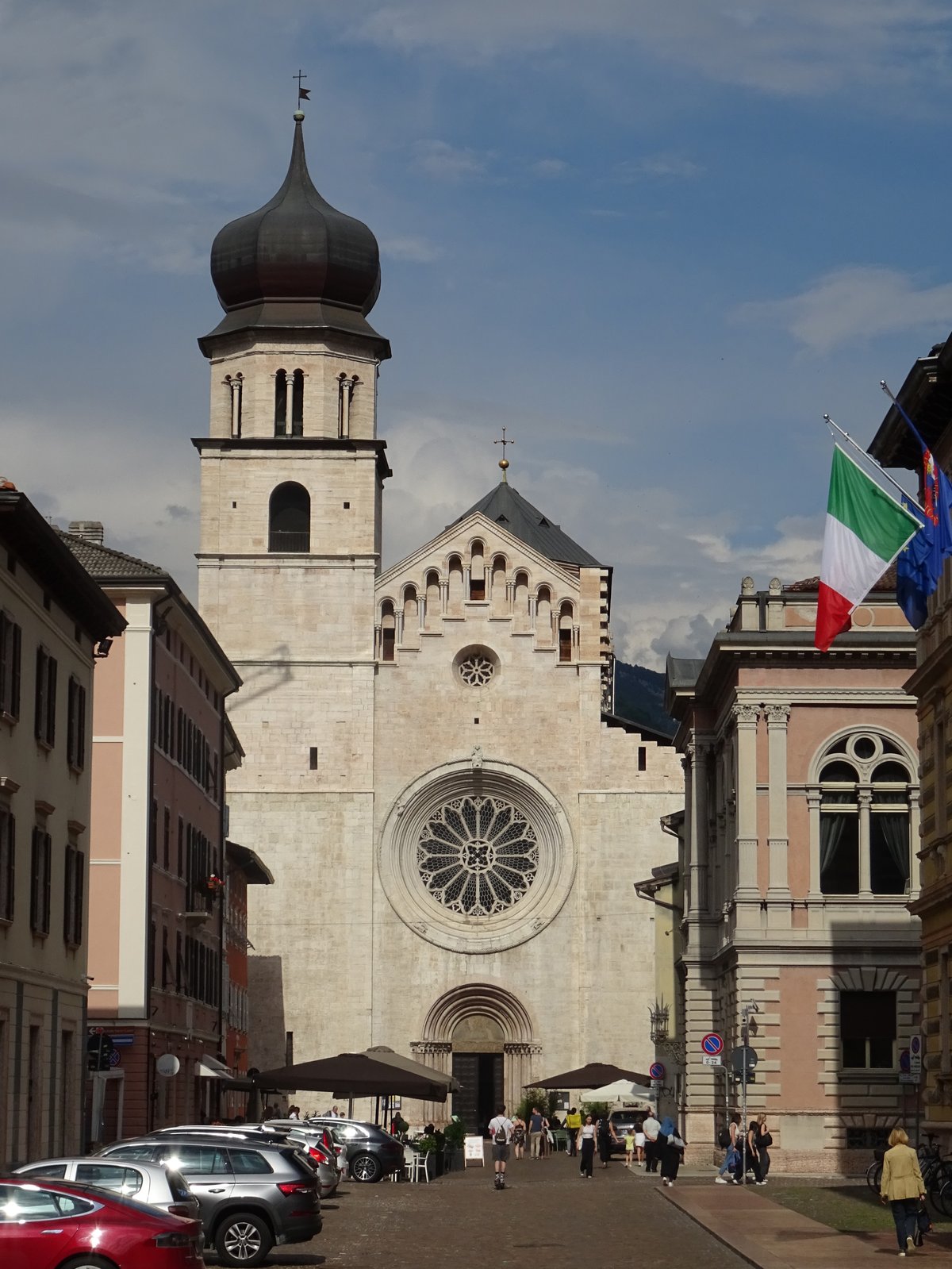 The Saint Vigilius Cathedral (Trento Cathedral) dominates Piazza del Duomo with its imposing structure. Built starting in 1212 at the behest of Bishop Federico Vanga and completed in 1321, it is a masterpiece blending Romanesque, Gothic, and Baroque styles. The asymmetrical façade – one bell tower remains unfinished – offers a unique sight: admire the large rose window depicting Christ the Judge and the northern porch supported by stylophore lions, work of the Comacine masters. Inside, the three naves are striking for the light filtering through the rose windows; not to be missed are the Rose Window of Fortune on the north transept, symbol of the fickleness of human fate, and the Cappella del Crocifisso with the wooden crucifix by Sixtus Frei, known as “of the Council.” Right here, between 1545 and 1563, the sessions of the Council of Trent were held, which marked the history of the Church – a plaque on the high altar commemorates the 217 fathers who signed the decrees. Descending into the underground basilica (accessible with a ticket from the Diocesan Museum), you will discover the remains of the 4th-century paleochristian church and the tombs of Saint Vigilius and the Anaunian martyrs. The cathedral is open daily from 9:45 AM to 6:00 PM, free admission. For deeper exploration, the nearby Museo Diocesano Tridentino houses the cathedral's treasure, including the processional urn of Saint Vigilius and iconographic testimonies of the Council. A place that tells centuries of faith, art, and power, perfect for understanding the soul of Trento.
Saint Vigilius Cathedral: History and Art in the Heart of Trento
- Go to the page: St. Vigilius Cathedral: Council Frescoes and Early Christian Crypt in Trento
- Piazza Adamo d'Arogno, Trento (TN)
- Open in Google Maps
- View on Google Images
The Saint Vigilius Cathedral (Trento Cathedral) dominates Piazza del Duomo with its imposing structure. Built starting in 1212 at the behest of Bishop Federico Vanga and completed in 1321, it is a masterpiece blending Romanesque, Gothic, and Baroque styles. The asymmetrical façade – one bell tower remains unfinished – offers a unique sight: admire the large rose window depicting Christ the Judge and the northern porch supported by stylophore lions, work of the Comacine masters. Inside, the three naves are striking for the light filtering through the rose windows; not to be missed are the Rose Window of Fortune on the north transept, symbol of the fickleness of human fate, and the Cappella del Crocifisso with the wooden crucifix by Sixtus Frei, known as “of the Council.” Right here, between 1545 and 1563, the sessions of the Council of Trent were held, which marked the history of the Church – a plaque on the high altar commemorates the 217 fathers who signed the decrees. Descending into the underground basilica (accessible with a ticket from the Diocesan Museum), you will discover the remains of the 4th-century paleochristian church and the tombs of Saint Vigilius and the Anaunian martyrs. The cathedral is open daily from 9:45 AM to 6:00 PM, free admission. For deeper exploration, the nearby Museo Diocesano Tridentino houses the cathedral's treasure, including the processional urn of Saint Vigilius and iconographic testimonies of the Council. A place that tells centuries of faith, art, and power, perfect for understanding the soul of Trento.MUSE: An Interactive Journey Between Science and Nature
- Go to the page: MUSE in Trento: Science, Nature, and Innovation
- Corso del Lavoro e della Scienza 3, Trento (TN)
- http://www.muse.it/
- Open in Google Maps
- View on Google Images
- museinfo@muse.it
- +39 0461 270311
 If you think a science museum is boring, you've never set foot in MUSE in Trento. Designed by Renzo Piano and opened in 2013, this building that echoes the Trentino mountains is a concentration of experiences. The path winds through seven floors, from top to bottom: you start from the terrace overlooking the Adige Valley and descend to the origins of the Earth. Each floor has a theme: on the fourth, a glacial tunnel where you can touch a tongue of ice; on the third, an interactive forest for children; on the second, the geology of the Dolomites with an earthquake simulator; on the first, human history and the fablab; on the ground floor, the science gym with experiments in physics and mathematics; in the basement, fossils and dinosaurs. The tropical greenhouse is the crown jewel: 600 square meters that recreate the rainforest of the Udzungwa Mountains in Tanzania, with waterfalls and tropical animals. For the little ones, there is Maxi Ooh!, a sensory space for children aged 0-5. MUSE is not just to be seen, but to be experienced: you can try the fakir's bed, draw with your voice, and even sleep at the museum with 'Nanna al Muse'. Sustainability is a core value: LEED GOLD certification, lots of glass and natural light. Tickets cost 11 euros (reduced 9), and admission is free on the first Sunday of the month. In short, a place that combines science, fun, and nature, perfect for adults and children alike.
MUSE: An Interactive Journey Between Science and Nature
- Go to the page: MUSE Trento: Interactive Science with Rooftop Garden and Whale Skeleton
- Corso del Lavoro e della Scienza 3, Trento (TN)
- http://www.muse.it/
- Open in Google Maps
- View on Google Images
- museinfo@muse.it
- +39 0461 270311
If you think a science museum is boring, you've never set foot in MUSE in Trento. Designed by Renzo Piano and opened in 2013, this building that echoes the Trentino mountains is a concentration of experiences. The path winds through seven floors, from top to bottom: you start from the terrace overlooking the Adige Valley and descend to the origins of the Earth. Each floor has a theme: on the fourth, a glacial tunnel where you can touch a tongue of ice; on the third, an interactive forest for children; on the second, the geology of the Dolomites with an earthquake simulator; on the first, human history and the fablab; on the ground floor, the science gym with experiments in physics and mathematics; in the basement, fossils and dinosaurs. The tropical greenhouse is the crown jewel: 600 square meters that recreate the rainforest of the Udzungwa Mountains in Tanzania, with waterfalls and tropical animals. For the little ones, there is Maxi Ooh!, a sensory space for children aged 0-5. MUSE is not just to be seen, but to be experienced: you can try the fakir's bed, draw with your voice, and even sleep at the museum with 'Nanna al Muse'. Sustainability is a core value: LEED GOLD certification, lots of glass and natural light. Tickets cost 11 euros (reduced 9), and admission is free on the first Sunday of the month. In short, a place that combines science, fun, and nature, perfect for adults and children alike.Piazza del Duomo: The Heartbeat of Trento
- Piazza del Duomo, Trento (TN)
- Open in Google Maps
- View on Google Images
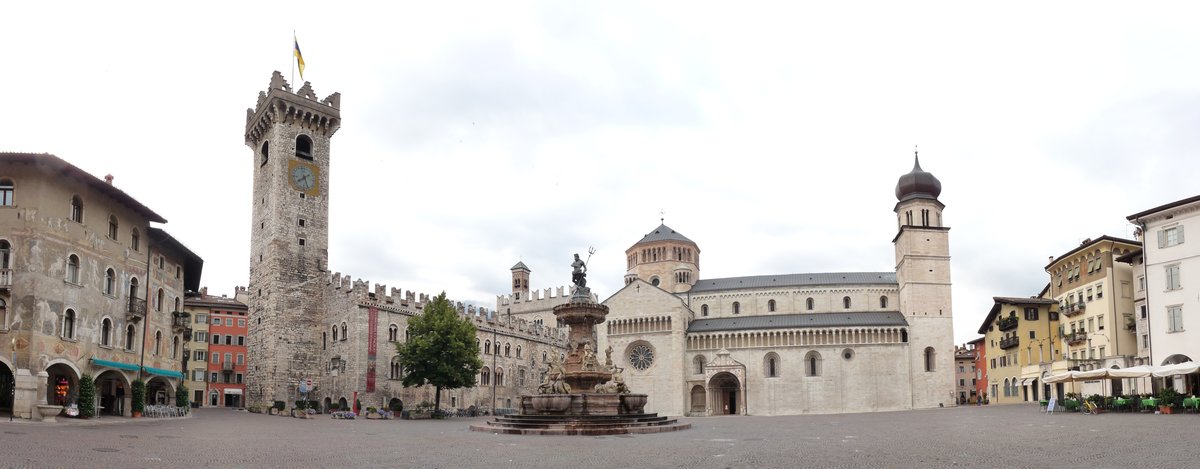 Stepping into Piazza del Duomo is like diving into the Middle Ages, but with a vibrant energy that surprises you. The square is Trento's living room, a porphyry rectangle framed by frescoed palaces, elegant arcades, and, of course, the majestic Cathedral of San Vigilio. At its center stands the 18th-century Neptune Fountain, with the sea god brandishing his trident—a bronze copy of the original housed elsewhere. Beside it, the smaller Eagle Fountain, a city symbol. On the eastern side, Palazzo Pretorio with the Civic Tower—once the bishop's residence and now the Diocesan Museum—tells centuries of religious and political power. Then there are the famous Cazuffi-Rella Houses, with Renaissance frescoes of pagan and legendary figures, a contrast to the usual religious themes. Under the Civic Tower, a linden tree tells a curious story: planted during the Napoleonic era as a liberty tree, today's version is the grandchild of that original. The square has long been a marketplace and meeting place, and it still serves as the nerve center for events, Christmas markets, and simply an outdoor coffee. Don't worry if you come by car: there are disabled parking spots, and the center is well-connected by bus. I recommend visiting early in the morning to catch the light caressing the frescoes, or at sunset when everything turns golden.
Neptune Fountain: The Baroque Heart of Piazza Duomo
- Piazza del Duomo, Trento (TN)
- Open in Google Maps
- View on Google Images
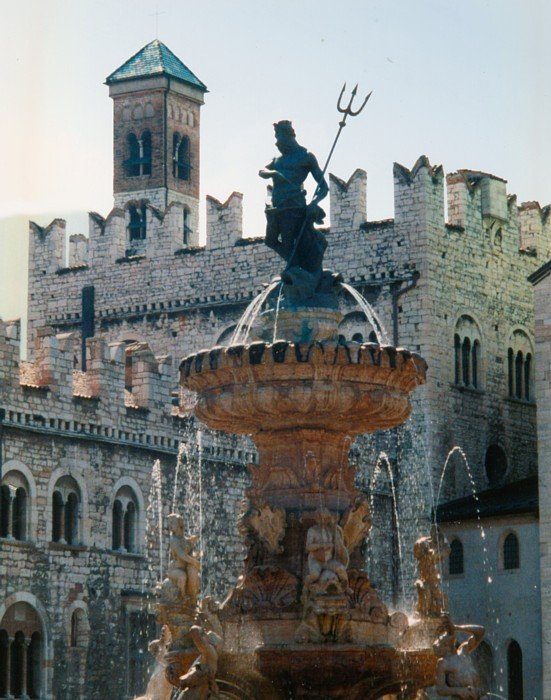 In the middle of Piazza Duomo, the Neptune Fountain is an unmissable landmark. Rising 12 meters, this Baroque fountain was built between 1767 and 1769 based on a design by Francesco Antonio Giongo, with original statues by Como-born sculptor Stefano Salterio. Today, however, the Neptune you see is not the original: the sandstone statue, damaged by time, was removed in 1939 and replaced in 1945 by a bronze copy created by Davide Rigatti. The sculptural groups of tritons and seahorses were also remade in the 19th century by Andrea Malfatti.
Giongo devised an ingenious system to keep water flowing continuously, creating a play of jets that changes constantly. The tritons seem to blow water jets from their mouths, while dolphins spray from their nostrils. The effect is both relaxing and lively. On the sides of the shaft, Latin inscriptions can be read, including the date MDCCLXVIII (1768) and the acronym SPQT (Senatus Populusque Tridenti).
The fountain is surrounded by three steps where locals love to sit, perhaps with an ice cream. Beware: in 2021, during celebrations for Italy's victory at the European Championship, it was damaged (lighting brackets were bent), but the municipality quickly intervened. Fun fact: a copy exists in Wuppertal, Germany, made in 1895. In short, an absolute must when visiting Trento.
Civic Tower: history, bells, and breathtaking view over Trento
- Piazza del Duomo, Trento (TN)
- Open in Google Maps
- View on Google Images
 The Civic Tower is the symbol of Trento, standing tall in Piazza Duomo next to the Cathedral and the Diocesan Museum. Nearly 46 meters high, it was built in the mid-12th century over the ancient Roman Porta Veronensis. For centuries it served as a bishop's residence, later a prison (until the 19th century), and finally a civic tower with a clock and bells. Two bells marked the city's rhythm: the Renga (for announcements and sentences) and the Rason (for fires and judicial functions). In 2015, a fire destroyed the original 1789 Renga; a new bell, cast by Grassmayr of Innsbruck, was installed in 2018. Today it can only be visited with a guide, climbing 156 steel steps over 8 levels (out of 12). The effort is rewarded: from the top, you'll enjoy an incredible view of Piazza Duomo, the Neptune Fountain, and Trento's rooftops. The ticket (€12) also includes entry to the Diocesan Museum and the Early Christian Basilica. Check the hours: the tower is closed on Tuesdays, and access is forbidden to children under 120 cm, people with vertigo, or mobility issues. In short, it's a dive into the medieval past that offers a unique panorama.
Church of Santa Maria Maggiore in Trento
- Piazza Santa Maria Maggiore, Trento (TN)
- Open in Google Maps
- View on Google Images
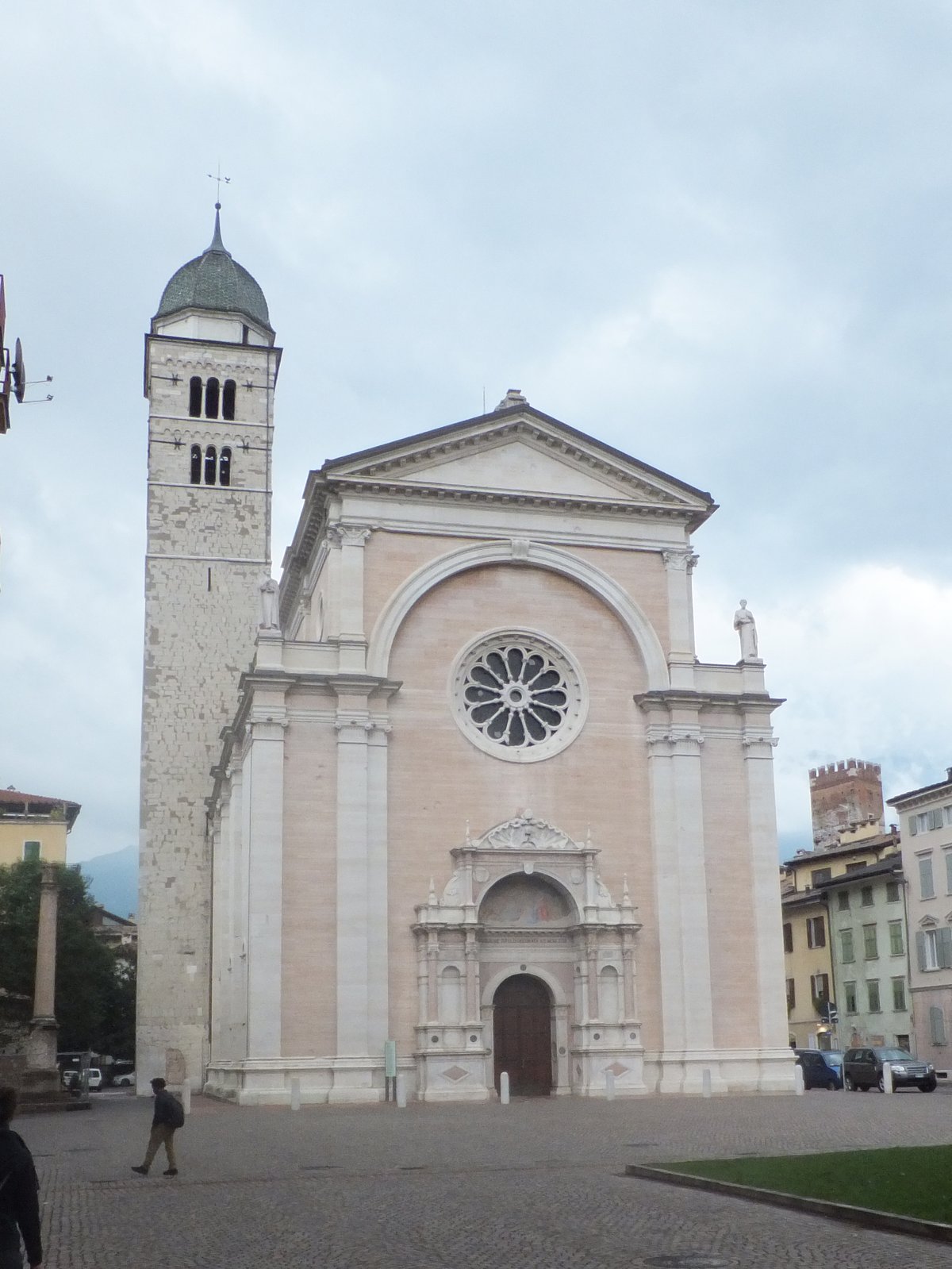 Entering Santa Maria Maggiore means immersing yourself in the history of the Council of Trent. Between 1562 and 1563, the general congregations of the third phase were held here, an event that marked the Counter-Reformation. The church was commissioned by Prince-Bishop Bernardo Clesio and built between 1520 and 1524 under the design of Antonio Medaglia, inspired by the Basilica of Sant'Andrea in Mantua. The façade, reworked in Neo-Renaissance style between 1899 and 1901, is made of white and red stone, with a portal from 1539 and a rose window. Inside, with a single nave, the six side chapels with Baroque marble altars stand out, works by artists such as Oradini and Sartori. The choir loft, created by Vincenzo and Giovan Girolamo Grandi between 1534 and 1542, is a masterpiece of wooden sculpture, and above it is the Mascioni pipe organ from 1928, reusing the case from 1536. The frescoes on the vault, painted by Sigismondo Nardi in 1902, depict scenes from the Council and protagonists of the Counter-Reformation. Don't miss the Baroque sarcophagus with the relics of Saint Clement and the altarpiece by Giovan Battista Moroni. Outside, the 53-meter bell tower is the tallest in Trento, with a set of 7 bells. The church, elevated to minor basilica in 1973, reopened in April 2012 after major restorations. Admission is free, open daily 8:00-12:00 and 14:30-18:00. A must-see stop for anyone wanting to understand the city's history and admire a Renaissance gem.
Palazzo Pretorio: A Dive into History Between Bishops and Courts
- Piazza del Duomo 18, Trento (TN)
- http://museodiocesanotridentino.it
- Open in Google Maps
- View on Google Images
- +39 0461 234419
 If there's one place that tells the story of Trento in just a few hundred square meters, it's Palazzo Pretorio. Overlooking Piazza Duomo with its crenellated façade and mullioned and triple-lancet windows, it seems straight out of a history book. And in a way, it is: bishops lived here from the 9th to the 13th century, then it became the seat of the court (hence the name 'Pretorio'). Today it houses the Museo Diocesano Tridentino, a true treasure chest. Step inside and you'll find Flemish tapestries, wooden sculptures, and an entire room dedicated to the Council of Trent. It's breathtaking. But it doesn't end there: next door stands the Torre Civica, 41 meters high, built around 1150 on the ruins of the Roman Porta Veronensis. Once a prison, now open to visitors with a guide (156 steps, but worth it: from the top, the view of the square is spectacular). Beneath the tower, the remains of the Roman road. And then the Castelletto, a tall defensive structure leaning against the cathedral. In short, in one corner of the square, you have ten centuries of history. What struck me? The prisoners' inscriptions still visible on the tower walls, made with rusty nails. Small marks that bring the past to life.
Museo Diocesano Tridentino: A Dive into Sacred Art Among Tapestries and Treasures
- Piazza del Duomo 18, Trento (TN)
- https://www.museodiocesanotridentino.it/
- Open in Google Maps
- View on Google Images
- +39 0461234419
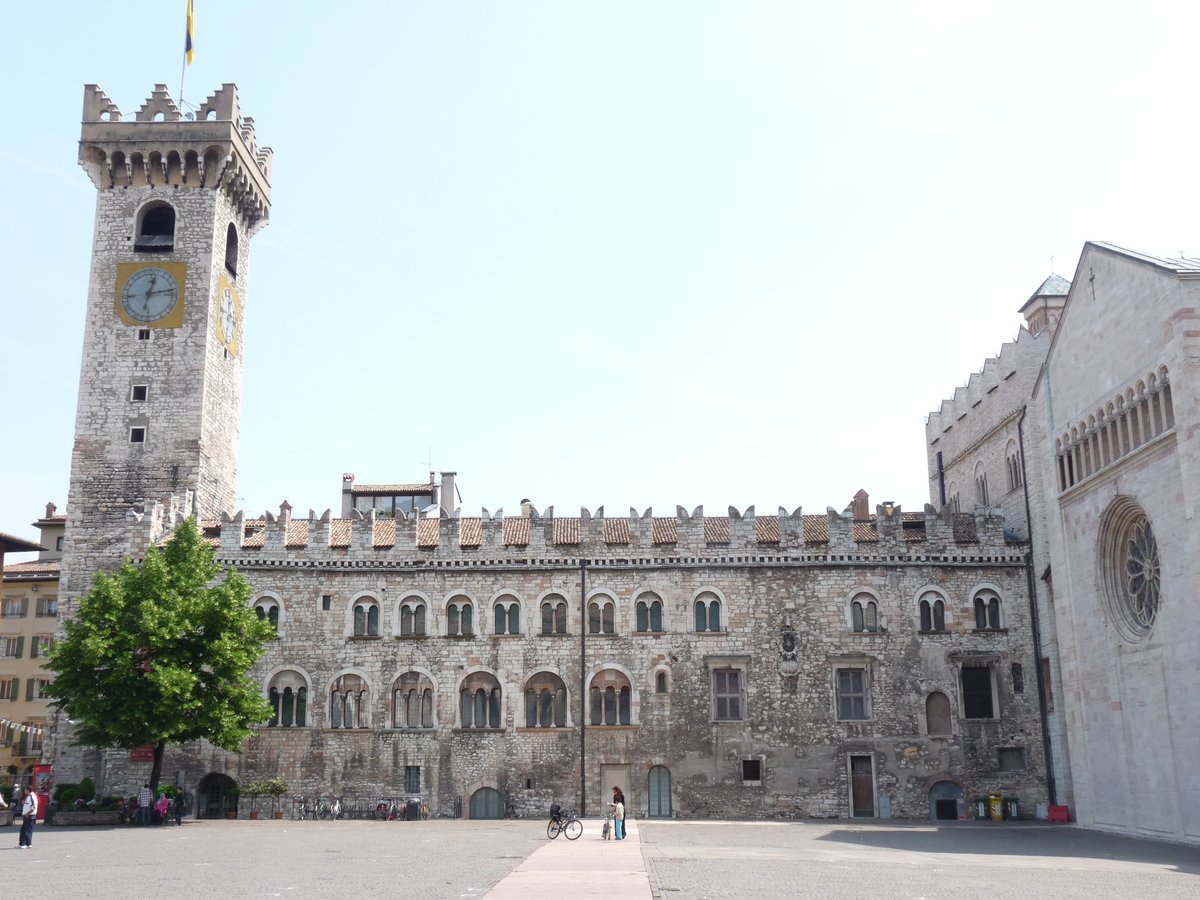 If you find yourself in Piazza Duomo in Trento, don't miss the Museo Diocesano Tridentino, housed in the ancient Palazzo Pretorio, the former residence of the prince-bishops. Founded in 1903, it is one of the first diocesan museums in Italy and tells ten centuries of sacred art (from the 11th to the 19th century). Upon entering, you are immediately struck by the intimate atmosphere: paintings, wooden sculptures, vestments, and illuminated manuscripts take you on a journey through the history of the Trentino Church. The highlight? The Flemish tapestries on the second floor: seven huge panels woven in Brussels between 1511 and 1520, purchased by Prince-Bishop Bernardo Cles, which decorated the cathedral during the Council of Trent (1545-1563). Examine them up close: the details of the Passion Stories are incredible. But that's not all: the museum also houses the Cathedral Treasury, with the processional urn of Saint Vigilius, and the Paleochristian Basilica of San Vigilio beneath the cathedral, with mosaics and artifacts from the 6th century. Among the gems, a section dedicated to the Council of Trent with paintings and documents that make you feel part of that historical moment. Honest prices: €7 for the museum+basilica, or €12 if you want to climb the Civic Tower (45 meters of breathtaking view). Open every day except Tuesday.
The Orrido di Ponte Alto: Trento's Secret Canyon
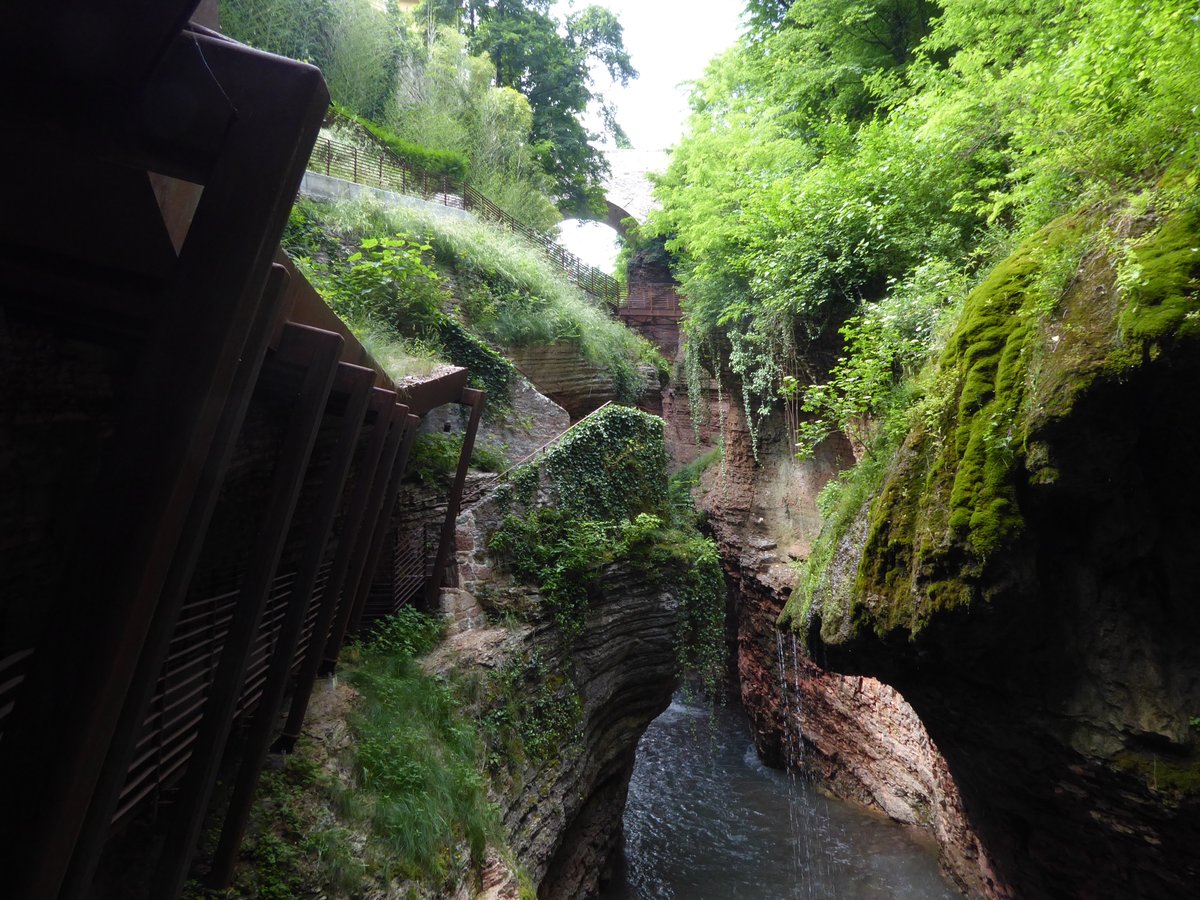 If you think Trento is all about squares and castles, think again. Hidden just a few kilometers from the center, along the Fersina stream, lies the Orrido di Ponte Alto, a canyon about a hundred meters deep carved into limestone. The catch? Here, as early as the 16th century, man built massive hydraulic works to tame the river's floods. Today you can only visit with a guide (mandatory, but worth it). The route takes about 45 minutes and leads you along suspended walkways, staircases, and even behind the waterfall thanks to a spiral staircase carved into the red stone. The effect is spectacular, especially in spring when snowmelt makes the waterfall more powerful. Note: not suitable for those with mobility issues (there are many steps) and the environment is damp, so bring a waterproof jacket and non-slip shoes. The ticket costs €6 (€4 with Trentino Guest Card) and can be combined with the Giardino dei Ciucioi di Lavis for €10. Open Saturday and Sunday from 10 am to 6 pm (daily in August). To get there, take bus 9 or 10 to Cognola and then a ten-minute walk. I recommend arriving early to take photos of the surroundings. A place that uniquely combines nature and engineering.
Forte di San Rocco, Trento
- Sentiero verso Busa dei Castagnari, Trento (TN)
- Open in Google Maps
- View on Google Images
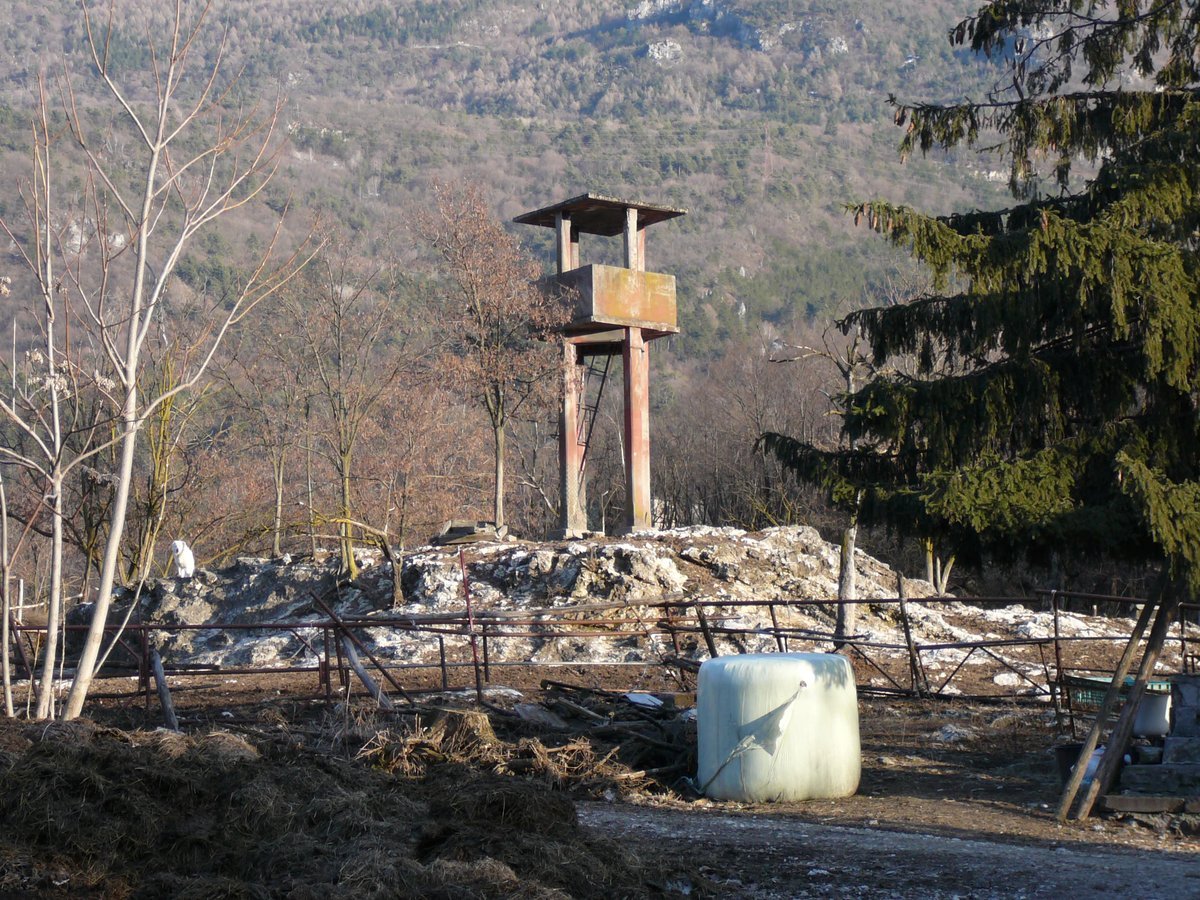 If you find yourself in Trento and want to discover a corner of Habsburg history, the Forte di San Rocco is an unexpected stop. Located on the Dosso di San Rocco, south of the city, this Austro-Hungarian fort was built between 1880 and 1882 (some sources say 1881-1883) to protect the entrance to the Adige valley and Valsorda. It was part of the Fortezza di Trento, an imposing defensive system. Today, however, the fort is in a state of abandonment: privately owned, fenced off, and overgrown with vegetation. The interior is not open to visitors, but it's worth coming here for the natural surroundings. The Dosso is located within the Bosco della Città park, a green area with marked trails and breathtaking viewpoints over the Adige Valley. Here you'll also find the LIPU Wild Bird Rescue Center, a bonus for nature lovers. The hike is short and suitable for everyone: from the parking area at San Rocco, follow the old unpaved military road, with an elevation gain of about 100 meters and a duration of roughly an hour and a half. At the top, a meadow with benches offers a spectacular view to the north. It's a shame the fort is so degraded: it would be a piece of history worth restoring. The structure, hexagonal in plan with limestone and concrete, consisted of an upper work with a revolving armored dome for two 12 cm cannons and a lower work with barbette positions. The garrison numbered up to 134 men. Today, what remains is a ghost of iron and concrete hidden among the trees, but the place is worth a visit to immerse yourself in a distant past, between nature and history.