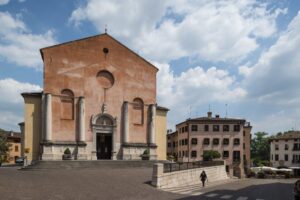
Palazzo del Capitano in Gradisca: 15th-century Venetian fortress with a porticoed courtyard

The Palazzo del Capitano in Gradisca d’Isonzo is an imposing 15th-century Venetian fortress, built between 1479 and 1483 as the seat of the garrison captain. Today it houses the Town Hall and preserves intact Renaissance military architecture with Venetian elements.

  • Facade in Istrian stone with biforate windows and a historic portal
  • Inner porticoed courtyard with a central well and an intimate atmosphere
  • Border architecture blending military function and Venetian elegance
  • Strategic location in the historic center, steps away from the Isonzo River
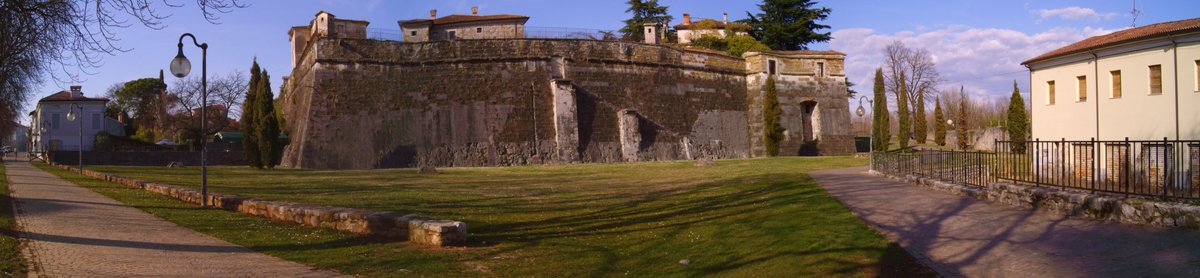
Copertina itinerario Palazzo del Capitano in Gradisca: 15th-century Venetian fortress with a porticoed courtyard
Palazzo del Capitano in Gradisca d’Isonzo, Venetian seat from 1479 now the Town Hall. Admire the Istrian stone facade, the inner courtyard, and Renaissance architecture in the heart of Friuli.

Good to know


Introduction

As you pass through the entrance arch, the Captain’s Palace welcomes you with its imposing Renaissance grandeur. It’s not just a historic building in Gradisca d’Isonzo, but the symbol of Venetian power that shaped this fortified town. Walking through the inner courtyard, surrounded by elegant loggias, you feel the weight of centuries and the pride of a community that has preserved this jewel. Its façade of Isonzo stone, with arched windows and coats of arms, immediately tells a story of borderlands and beauty, perfect for those seeking authenticity in Friuli Venezia Giulia.

Historical Overview

The palace was built in 1479 at the behest of the Republic of Venice, serving as the seat of the Captain who governed the fortress of Gradisca, a strategic point against Ottoman incursions. In the 16th century, it passed to the Habsburgs, becoming the residence of the Counts of Gradisca, and in the 18th century, it was expanded with Baroque elements. Today, after careful restoration, it houses municipal offices and cultural spaces, preserving its commanding aura intact.

  • 1479: Construction for Venice
  • 16th century: Transfer to the Habsburgs
  • 18th century: Baroque expansions
  • Today: Municipal and cultural seat

Venetian Architecture in the Heart of Friuli

What strikes you is the perfect balance between military function and civil elegance. The thick walls and arrow slits recall its defensive origins, while the courtyard loggias, with stone columns and round arches, reveal the Venetian influence of the Renaissance. Ascending the main staircase, you’ll notice the vaulted ceilings and original floors, transporting you to an era of lords and captains. It’s a rare example of border architecture, where Friulian sobriety meets Venetian taste, made even more precious by recent restorations that have enhanced its details.

The Courtyard: The Palace’s Beating Heart

The inner courtyard is not just a passageway, but a living space that once hosted the daily activities of the garrison. Today, with its central well and regular arches, it offers an intimate atmosphere, ideal for a break during the visit. In summer, concerts and readings are held here, transforming it into an open-air cultural salon. Looking up, the windows of the noble floor give you an idea of court life, while the echo of footsteps on the stone adds a touch of mystery. It’s the perfect place to imagine the stories these walls have witnessed.

Why Visit It

Visit to experience Venetian history firsthand in Friuli, away from the crowds of more famous sites. It’s a unique opportunity to see a perfectly preserved captain’s palace, where every architectural detail tells centuries of ruling influences. Moreover, its location in Gradisca’s historic center allows you to combine the visit with a stroll along cobblestone streets and walls, fully immersing yourself in the atmosphere of this fortified town.

When to Go

The best time is at autumn sunset, when the warm light enhances the color of the Isonzo stone and the courtyard fills with evocative shadows. In that season, with the cool air and falling leaves, the palace seems suspended in time, far from the summer noise. A spring morning, with the sun filtering through the arches, also offers a serene and photogenic atmosphere.

In the Surroundings

Just a short walk away, don’t miss the Gradisca Cathedral, with its Baroque facade and interiors rich in artworks, which completes the journey through the city’s history. For a thematic experience, take a trip to the Fortress Museum, where you’ll discover how Venetian soldiers lived and the defensive strategies of this border area.

💡 Did You Know…?

An ultra-realistic curiosity: look closely at the palace walls. On some stones, especially around the main portal, you might notice circular engraved marks, similar to targets. According to a local legend, unconfirmed but very suggestive, they would be marks left by arquebus bullets fired during the 16th-century sieges. In reality, more recent studies hypothesize that they are quarry marks or apotropaic symbols, but the idea that they are ‘battle scars’ makes the visit even more vivid. Another detail: the palace housed the municipal archive for centuries, and it’s said that in its cellars, now inaccessible, some of the ancient chains that closed the river port on the Isonzo are still preserved.