Ursino Castle is the medieval fortress commissioned by Frederick II of Swabia in the 13th century, now home to the Civic Museum of Catania. Located in the heart of the historic center just steps from Piazza Duomo, it offers a journey through history with its massive lava stone walls, internal courtyards, and restored halls. The museum houses collections ranging from Greco-Roman archaeology to medieval and modern artworks, featuring artifacts from ancient Catania and 17th-century Sicilian paintings.
- Medieval fortress built by Frederick II of Swabia in the 13th century
- Civic Museum with Greco-Roman archaeological collections and medieval art
- Etna lava stone walls and well-preserved original architecture
- Central location in the heart of Catania’s historic center
Introduction
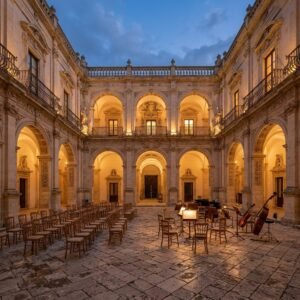
You expect a castle perched on a hill, yet Castello Ursino greets you in the heart of Catania, almost at sea level, surrounded by Baroque palaces. It’s a striking contrast that immediately catches your eye: this massive medieval fortress, with its thick walls and square towers, seems almost out of place in such a Baroque city. Yet, that’s precisely what makes it fascinating. Walking from Piazza Duomo, with its eighteenth-century elegance, and turning onto Via dei Crociferi, the visual impact is strong. You see it emerge at the end of the street, a block of dark, compact lava stone that tells a different story from everything else. It’s not just a monument; it’s a piece of the city that has withstood earthquakes and lava flows, becoming a tenacious symbol. Entering its inner courtyard, now a paved square, instantly gives you the feeling of being in another era, far from the chaos of the Piazza Carlo Alberto market that buzzes beside it.
Historical Overview
Its history is deeply intertwined with Frederick II of Swabia, the emperor who commissioned its construction in the 13th century as a symbol of royal power in Sicily. It was not merely a residence but a true defensive stronghold. Interestingly, it originally stood on a promontory overlooking the sea, but the 1669 lava flows from Mount Etna forever altered the geography, burying its foundations and distancing it from the coast. It has served many purposes: from an Aragonese royal residence to a barracks, and even a prison. Today, following a major restoration, it houses the
Civic Museum of Catania, with a collection ranging from archaeology to a picture gallery. The timeline of its key moments is as follows:
- 1239-1250: Construction commissioned by Frederick II of Swabia.
- 1669: The lava flow from Mount Etna radically changes its appearance and position relative to the sea.
- 1693: It miraculously withstands the devastating earthquake that destroyed much of Catania.
- 1934: It is restored and designated to become the civic museum.
The Museum Inside the Fortress
Visiting the museum here is a unique experience. It’s not the usual sterile tour: you walk among medieval armor and ceramics in the very halls where Aragonese rulers once lived. The feeling is one of exploration, rather than simply observing. The collection is varied: you might move from a room with Greek vases unearthed in the city to another with 17th-century Sicilian paintings. Personally, I was struck by the artifacts from Roman Catania, as they help you understand the layers of history beneath your feet. The ground-floor rooms, the most massive ones, often host temporary exhibitions. A tip? Don’t miss the view from the tower arrow slits: they frame glimpses of Catania in a unique way, like natural photographs of the urban fabric. The atmosphere is intimate, sometimes a bit damp and cool, typical of ancient stone, but that’s part of the charm.
The Details That Tell the Story
Beyond the grand halls, it’s in the details that you grasp the soul of the place. Notice the quarry marks on the lava stone walls of the exterior: signs left by medieval stonemasons, a human signature on a material as powerful and natural as lava. Then there are the heraldic coats of arms above some portals, faded by time but still recognizable, which speak of the families who lived here. In the courtyard, look for the rainwater collection cistern: a practical detail of daily life in a fortress. And the spiral staircases in the towers? They’re narrow, dark, and climbing them is a small journey through time. You feel a bit like the sentries must have felt centuries ago. It’s these elements, often overlooked, that for me transform the visit from a history lesson into a tactile, almost intimate experience with the past.
Why Visit It
For at least three concrete reasons. First, it’s the most immediate way to experience medieval Catania firsthand in a city dominated by Baroque architecture. Second, the civic museum inside is compact yet rich: in an hour or so, you get an excellent overview of the city’s history, from antiquity to modern art, without having to rush to multiple scattered locations. Third, its central location makes it perfect for fitting into any daily itinerary: you can easily combine it with a visit to the Duomo, a stop at the fish market, or a stroll along Via Etnea. It’s a concentrated dose of accessible history and culture, without frills, that adds substance to your visit to Catania.
When to Go
The best time? Definitely early afternoon, especially during the warmer months. The castle’s thick walls provide natural relief from Catania’s scorching sun. The interior rooms are cool, almost muffled, and the light filtering through the high windows is beautiful. In winter, on the other hand, a clear morning can offer a grazing light that enhances the volumes of the lava stone. Avoid peak weekend hours if you prefer a bit of tranquility. I visited in the mid-afternoon on a Tuesday in September, and it was perfect: few people, silence broken only by footsteps on the stones, and that suspended atmosphere that only ancient places can provide.
In the Surroundings
After leaving the castle, you have two nearby thematic options that enrich the context. Just steps away, in Piazza Duomo, you’ll find the Elephant Fountain (u Liotru), the city’s symbol, carved from lava stone with a legendary history behind it. It’s the perfect link between the castle’s medieval era and Catania’s baroque period. Alternatively, if you want to continue along the thread of ancient history, head towards the Roman Theatre and the Odeon, a few minutes’ walk away on Via Vittorio Emanuele. These are well-preserved Roman remains, nestled among buildings, showcasing another fundamental layer of the city. Two different experiences, but both help you understand how Catania is a living palimpsest of eras.