
San Nicolò l’Arena Monastery is a baroque monastic complex rebuilt after the 1693 earthquake, now serving as a university campus. It offers an immersion into Sicilian history through majestic architecture and a peaceful atmosphere in the heart of Catania.
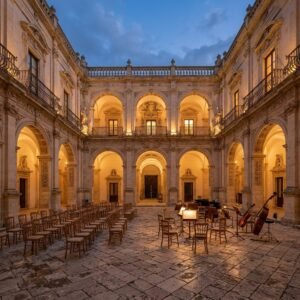
- Baroque cloisters with elegant arches and an internal hanging garden
- Monumental staircase with polychrome marbles and gilded stuccoes
- History linked to Mount Etna: destroyed and rebuilt after eruptions and earthquakes
- Atmosphere of silence and tranquility in the city’s historic center
Events nearby

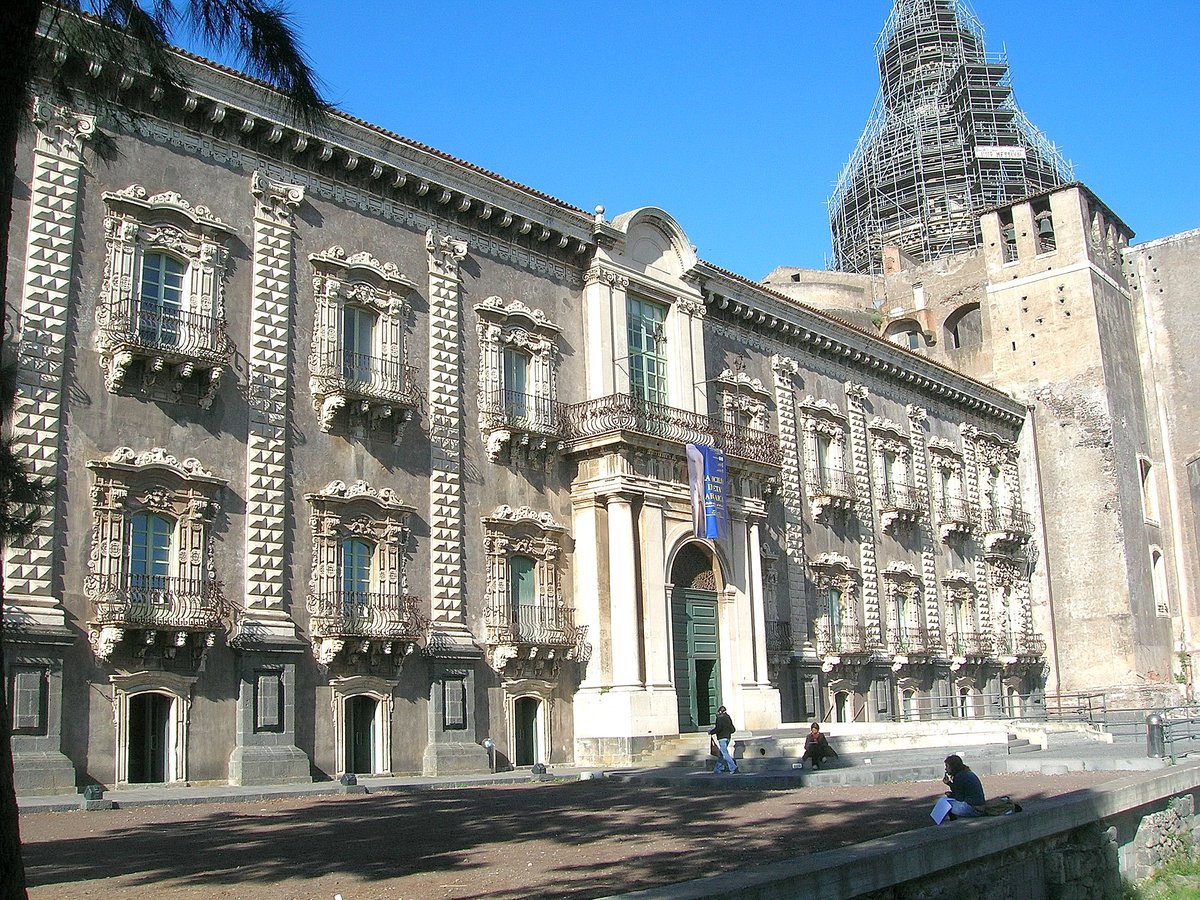
One of Europe’s largest Benedictine monasteries featuring baroque cloisters, a monumental staircase, and a hanging garden. Discover its reconstruction after earthquakes and volcanic eruptions in Catania’s historic center.
- Via Biblioteca, Catania (CT)
- Open in Google Maps
- View on Google Images Monastero di San Nicolò l’Arena a Catania
Good to know
Introduction
As soon as you pass through the gate of the Monastery of San Nicolò l’Arena, you feel like entering another world. The vastness of the complex takes your breath away: cloisters stretching as far as the eye can see, majestic staircases, a silence that envelops everything. It’s not just a monument; it’s an experience. You feel small in front of this Baroque architecture dominating the center of Catania, yet protected by its grandeur. What struck me immediately? That contrast between the chaotic vitality of the city outside and the absolute peace inside. It almost seems as if time has stood still.
Historical Overview
The history of this place is deeply intertwined with Mount Etna and the perseverance of the Benedictine monks. Founded in the 1500s, it was destroyed twice by lava flows—in 1669 and then by the earthquake of 1693—but each time rebuilt larger and more beautiful. The monks never gave up. In the 18th century, it became one of Sicily’s most important cultural centers, with an extensive library and highly active scriptorium. Then came the unification of Italy and the suppression of religious orders. Today, it houses part of the University of Catania, but the sacred atmosphere endures.
- 1558: Foundation of the first monastery
- 1669: Destroyed by the eruption of Mount Etna
- 1693: Leveled by the earthquake
- 1703-1866: Reconstruction in Sicilian Baroque style and period of greatest splendor
- Today: University and museum site
The Cloisters That Speak
You absolutely must lose yourself among the cloisters. Not just one, but several, each with its own distinct personality. The Levante Cloister is my favorite: ancient trees, a central well, and that sense of peace that makes you forget you’re in the city. Then there’s the Ponente Cloister, more austere, with its white stone arches. But the real surprise? The hanging garden, a green corner suspended between sky and history where monks once cultivated medicinal plants. Even today, you can catch the scent of citrus and aromatic herbs. As you walk, you’ll notice signs of Mount Etna everywhere: lava stones embedded in the walls, like a permanent reminder of nature’s power.
Monumental Staircase and Hidden Details
The grand staircase is one of those things you see in photos, but in person, it truly moves you. Polychrome marbles, gilded stuccoes, a staircase that seems to climb toward the sky. But the beauty of this monastery lies in the details you discover by wandering calmly: the 18th-century majolica floor tiles, the Baroque masks watching you from the corners, the wrought-iron grates of the ancient cells. In the Church of San Nicolò, adjacent to the monastery, there is a monumental organ that is a masterpiece in itself. I like to sit on one of the wooden benches and watch the light filtering through the high windows, creating plays of shadow on the walls. It seems as if every stone has a story to tell.
Why Visit It
Three concrete reasons? First: it’s a total immersion in Sicilian Baroque without the crowds of other Catania monuments. You can enjoy it peacefully. Second: the view of Catania’s rooftops from the upper terrace is priceless – you see the Cathedral, Mount Etna in the background, the sea in the distance. Third: here you truly understand the relationship between Catania and its volcano. The architecture itself is a response to Etna’s destructive force, a demonstration of resilience that’s in the DNA of Catania’s people. And let’s face it: it’s free (or almost), which is rare for such a gem.
When to Visit
I visited on a warm autumn morning, and I’ll always remember it. The early afternoon light is magical: it streams through the large windows and illuminates the cloisters with a golden warmth that enhances every Baroque detail. In summer, aim for the hottest hours: outside it’s scorching, but inside the monastery there’s a natural coolness, thanks to the thick lava stone walls. In spring, when the trees in the cloisters are in bloom, the atmosphere is particularly enchanting. Avoid days of heavy rain: some courtyards are uncovered, and you’d miss part of the experience.
In the Surroundings
After leaving the monastery, take a short stroll to Piazza Dante, right across the street. Here you’ll find the Porta Garibaldi, a triumphal arch made of white stone and black lava, another symbol of Catania’s rebirth after the earthquake. Not far away, in the heart of the Pescheria market, discover the Amenano Fountain, where water from the underground river flows amidst stalls of fresh fish—a quintessentially Catanese contrast. If you enjoyed the monastic atmosphere, just a few blocks away is the Monastery of the Benedictines with its mysterious grated parlor.
Itineraries nearby


💡 Did You Know…?
Look closely at the floor of the San Nicolò l’Arena Church, attached to the monastery. You’ll notice perfectly polished black lava stone slabs. This isn’t an aesthetic choice: during the 1669 eruption of Mount Etna, the lava flow stopped right in front of the monastery, miraculously sparing it. In gratitude, the monks used that same lava to pave part of the church. A powerful detail that forever links this place to the fiery mountain that dominates Catania.