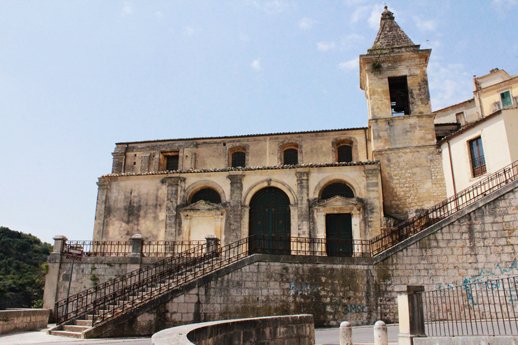
The Church of Santa Maria delle Scale is one of the oldest monuments in Ragusa, located along the staircase connecting Ragusa Superiore to Ibla. Founded in the 13th century by Cistercian monks, it preserves a fascinating mix of Catalan Gothic and Baroque styles. Don’t miss the chance to admire the Dormitio Virginis, a terracotta high relief from 1538, and the view over Ibla from the churchyard.
Catalan Gothic Architecture: admire the four pointed-arch portals with carved decorations.
Dormitio Virginis: polychrome terracotta high relief from 1538, a Renaissance masterpiece.
Baptismal font in pitch stone: carved in 1552 from a single block of stone.
View of Ragusa Ibla: from the churchyard you enjoy one of the most beautiful panoramas of the city.
Introduction
The Church of Santa Maria delle Scale is a gem that surprises you as you descend from Ragusa Superiore towards Ibla. Perched on a rocky ridge, it feels like a bridge between two eras and two styles. From outside, the view of Ibla is breathtaking. Inside, you’ll find Catalan Gothic arches and a terracotta high relief from 1538 that seems to speak. It’s the oldest church in Ragusa, and you can feel it: every stone tells centuries of history, earthquakes, and reconstructions. An unexpected place, but once discovered, unforgettable.
Historical Notes
Tradition holds that it was founded by the Cistercian monks of Lentini in the 13th century, but the first certain mention dates to 1300. The 1693 earthquake damaged it, but it was quickly repaired. The real transformation came in the 18th century: population growth spurred an expansion, and the church was rotated 90 degrees. The ancient apses became side portals, and its orientation changed forever. Nevertheless, the right nave still preserves the original Gothic-Catalan structures, with carvings of celestial and monstrous creatures symbolizing Christ’s dominion over all.
Gothic-Catalan Architecture and Terracotta
Upon entering, the first thing you notice are the four Gothic portals on the right wall: pointed arches, carved columns, a profusion of details. The third portal is the highlight: above a Renaissance altar is the Dormitio Virginis, a polychrome terracotta high relief from 1538 depicting the Virgin Mary giving up her soul to God, surrounded by the apostles. You can almost see them moving. A little further on, a baptismal font from 1552 carved from a single block of pece stone, and an octagonal pulpit built into the exterior. Every corner is a piece of history.
View and Location
The beauty of Santa Maria delle Scale is also what you see from outside. The churchyard is a natural overlook onto Ragusa Ibla: rooftops, domes, green valleys. It’s the perfect spot for a quiet break, perhaps while waiting for sunset. The church is literally a bridge between the new Ragusa and the old one: you arrive from above and descend via the Discesa Santa Maria, a narrow street that takes you in minutes to the heart of Ibla. A passage point worth stopping for, even just for the scenery.
Why Visit
First off, it’s the oldest church in Ragusa and one of the few that still has pre-earthquake structures. Second, the high relief of the Dormition of the Virgin is a rare masterpiece, hard to find anywhere else in Sicily. Third, its strategic spot between the two Ragusas makes it a natural stop, and the view from up there is one of the best of Ibla. In short, you can see it in ten minutes, but you’ll carry it with you forever.
When to Go
If you can, choose the late afternoon. The golden light filters through the Gothic arches and magically illuminates the terracotta. Then step outside to see the sun setting over Ibla. In spring or autumn, when the air is crisp and the sky clear, it’s even better. In summer the heat can be felt, but the church stays cool. Avoid the peak hours of mass tourism if you can: the peace of this place deserves silence.
Nearby
A few steps away, down in Ibla, don’t miss the Duomo di San Giorgio, a masterpiece of Sicilian Baroque. If you have time, climb up to the Giardino Ibleo, a peaceful park with panoramic views and archaeological remains. Between one church and another, stop at a bar for a cannolo or gelato. Ragusa Ibla is a labyrinth of alleys and stairways, perfect for getting lost. And Santa Maria delle Scale is the ideal starting point.