Introduction
The Elephant Tower dominates the historic center of Cagliari with a presence that seems straight out of a medieval tale. Built from white limestone, it towers over Castello, the city’s oldest district, offering a breathtaking view that makes you feel catapulted back in time. It’s not just a monument: it’s a symbol of power, a visual landmark that guides anyone lost among the narrow alleys. The first time I saw it, I was struck by how it almost seems to guard the city’s secrets, with its massive form and the carved elephant that gives it its name. Climbing it means not only admiring a breathtaking panorama but also touching centuries of Sardinian history.
Historical Notes
The Elephant Tower was built in 1307, during Pisan rule over Cagliari, by order of Governor Giovanni Capula. It was part of the defensive system of the Castle walls, along with the nearby Tower of San Pancrazio. Over the centuries, it has served various purposes: from a military stronghold to a prison, and today it is a visitable site. One detail that has always fascinated me: the elephant carved at the top is not merely decorative but may represent a symbol of strength or an exotic reference from that era. The tower has withstood wars and sieges, becoming a silent witness to the city’s history.
- 1307: Construction during Pisan rule
- 14th-16th centuries: Used as a defensive structure and prison
- Today: Historical monument open to the public
The Climb and the View
Climbing the Elephant Tower is an experience I recommend to everyone, even though it requires a bit of stamina. The internal staircase is narrow and steep, typical of medieval structures, and as you ascend, you can almost imagine the soldiers who once kept watch from here. Once at the top, the view makes every effort worthwhile: you can take in the entire Gulf of Cagliari with your gaze, from the port all the way to the Molentargius salt pans. To the north, you can make out the rooftops of Castello and the Cathedral, while looking toward the sea, you understand why this spot was strategic. I visited at sunset, and the golden light over the old town was simply magical. Note: the terrace is protected by grates, but this doesn’t diminish the excitement.
The Elephant and Its Mysteries
That elephant sculpted in white marble on the facade is what makes this tower unique compared to other medieval Sardinian towers. It’s not large, but it has a particular charm: some say it represents the strength of the Pisan Republic, others that it’s a tribute to an exotic animal seen as a symbol of wisdom. Personally, I like to think it’s an encrypted message from the past, a detail that still intrigues today. The sculpture is positioned quite high up, so to see it well you need to look up—a small gesture that makes you appreciate art even in architectural details. It’s one of those elements that transform a monument into a story, something that goes beyond historical dates.
Why Visit It
Visiting the Elephant Tower is worthwhile for at least three concrete reasons. First: it offers the most comprehensive view of Cagliari’s historic center, allowing you to orient yourself and understand the geometry of the medieval city. Second: it’s a tactile experience where you can touch the same stones that have witnessed centuries of Sardinian history. Third: compared to other monuments, here there’s a perfect balance between accessibility (it’s located right in the center) and authenticity—it’s not overly restored, maintaining that ancient character. Plus, there are often fewer tourists than at other sites, so you can enjoy it more leisurely.
When to go
The best time to visit the Elephant Tower? I suggest the early morning hours, when the light is clear and the summer heat isn’t yet oppressive. In winter, on the other hand, a sunny afternoon offers a special atmosphere, with long shadows sketching the alleys of Castello. I’d avoid very windy days, because you feel it more at the top. Once I went after a spring downpour, and the clean air allowed me to see all the way to Serpentara Island—a lucky break that doesn’t happen often. Each season has its charm, but the morning tranquility is unbeatable.
In the Surroundings
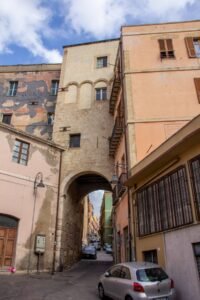
After visiting the tower, I recommend exploring the Castello neighborhood on foot, getting lost in its cobblestone alleys. Just a few steps away is the Cathedral of Santa Maria, with its neo-Romanesque facade and historically rich internal chapels. Another related experience is the National Archaeological Museum, which houses Nuragic and Phoenician artifacts—perfect for understanding Sardinia’s most ancient roots. If you’re in the mood for a snack, in the surrounding narrow streets you’ll find small shops selling pane carasau and traditional Sardinian sweets.