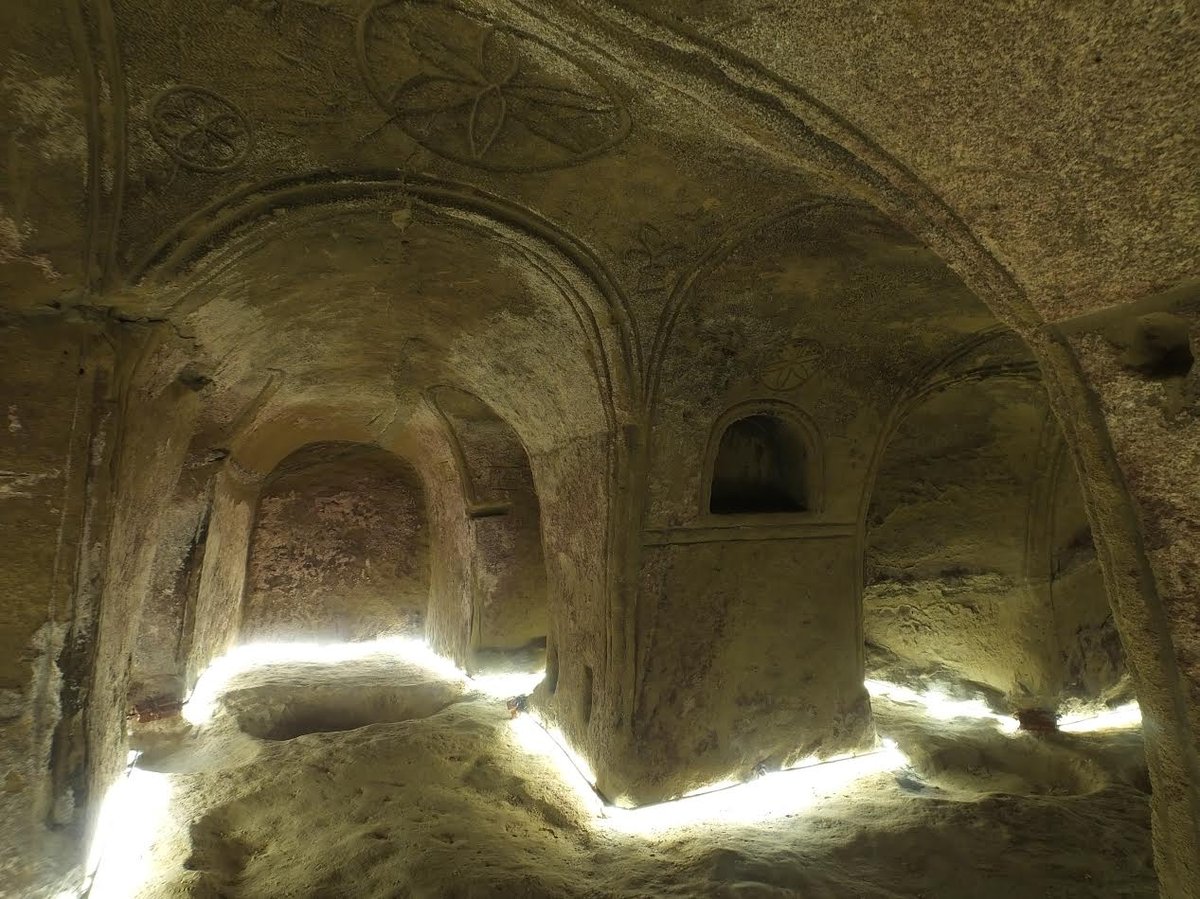
The Piagge Hypogeum is an underground cave carved into tuff, discovered in 1996 and opened to the public on September 2, 2016 after a long restoration. It lies about seven meters deep, with a Latin cross layout and geometric decorations such as the flower of life and the lily. Visiting this place means diving into the Middle Ages, amid hypotheses of Templar rites and mysterious atmospheres.
• Discovered in 1996 by architect Gabriele Polverari.
• Symbols: five-pointed rosette, six-petal flower, lily.
• Theories: early Christian worship site or knightly initiation site.
• Guided tours by reservation with seasonal hours.
Introduction: An Underground Secret
Beneath the streets of Piagge, seven meters deep, lies a place that seems straight out of a medieval novel: the Hypogeum of Piagge, also known as the Secret Tomb. Carved into the tuff, it is a twelve-meter-long, two-meter-wide cross-shaped tunnel, perfectly symmetrical. As soon as you descend the worn steps, the air changes: you breathe in humidity, silence, and an ancient spirituality. Walls and ceilings are decorated with enigmatic symbols – rosettes, six‑petaled flowers, lilies – that speak of a past between early Christianity and Templar rituals. It was once a butcher’s storage, then forgotten, and today it is an archaeological gem open to those seeking something different, off the beaten path.
Historical Background
Discovered in 1996 by architect Gabriele Polverari, the Hypogeum of Piagge remained a mystery for centuries. It is believed to have been excavated around 1200 AD, possibly by Christian communities during times of persecution or by the Knights Templar. Used as a cold storage and warehouse by a butcher shop until the 1990s, it was later restored (work from 2012 to 2016) and opened to the public on September 2, 2016. The decorations – flower of life, lilies, rosettes – have been interpreted as religious symbols associated with Jesus, Mary, and the apostles. Although no written records survive, the basilica plan and symmetry suggest it was intentionally designed as a place of worship. Here are the key milestones:
Symbols and Mysteries
Walking in the hypogeum, your eyes fall on precise engravings: a six-petaled flower (the “flower of life”), a five-pointed rosette, a lily. They are not random: according to scholars, the six-petaled flower represents Jesus, while the two lilies on the sides symbolize Mary and another saint. On the ceiling, near the apse, the pattern repeats: a central flower with four flowers around it, like Christ and the apostles. The marks of a cross remain at the crossing of the nave. Everything is arranged with an almost obsessive symmetry, suggesting initiation rites or secret ceremonies. The hypogeum is a stone book still waiting to be read in full.
How to Visit the Hypogeum
Access is by reservation only, with guided tours (limited groups). Contacts are Morena (328/8711938) and Alessandra (320/4159700). Hours: May to October Saturday and Sunday 5-8 PM; November to April Saturday 4-7 PM and Sunday 4-6 PM. Full ticket €4, reduced €2 (over65, under14, disabled companion). Free for residents of Terre Roveresche, under4, and disabled. The ticket also includes entry to the Museo della Corda e Antichi Mestieri (Orciano) and the MUSA (San Giorgio di Pesaro). Wear comfortable shoes: the tuff steps are slippery due to humidity. The internal temperature is constant around 15°C.
Why Visit It
1. A dive into hidden medieval: it’s not a simple hypogeum, but a rare testimony of underground sacred architecture, with intact decorations. 2. Symbols that defy time: the flower of life and the lilies are details that few sites can boast. 3. Cultural package: with the same ticket you visit two nearby museums, the Museo della Corda and the MUSA, perfect for a day among history and local traditions. And then the atmosphere is unique: darkness, humidity, silence – almost a spiritual experience.
When to Go
The best time? Spring and autumn, when temperatures are mild and the village of Piagge is quieter. But a winter Saturday afternoon has its own charm: leaving the hypogeum after sunset, with crisp air and the sky already dark, makes the experience even more evocative. Visits are only on weekends, so plan ahead. If you can, choose a Sunday afternoon: the village seems frozen in time, and the golden light of late afternoon filters through the castle walls.
Nearby
After your visit, don’t miss the “Terre di Lubacaria” Open-Air Museum: an artistic trail featuring murals and wooden sculptures that tell the story and traditions of the area. A short walk away, the Church of Santa Lucia (1882) houses works by Giovanni Francesco Guerrieri and Carlo Magini. And if you’re passionate about crafts, the Museum of Rope and Ancient Crafts in Orciano di Pesaro (already included in the ticket) is a fascinating stop: you’ll discover the ancient art of rope-making, a trade that shaped the Cesano Valley.