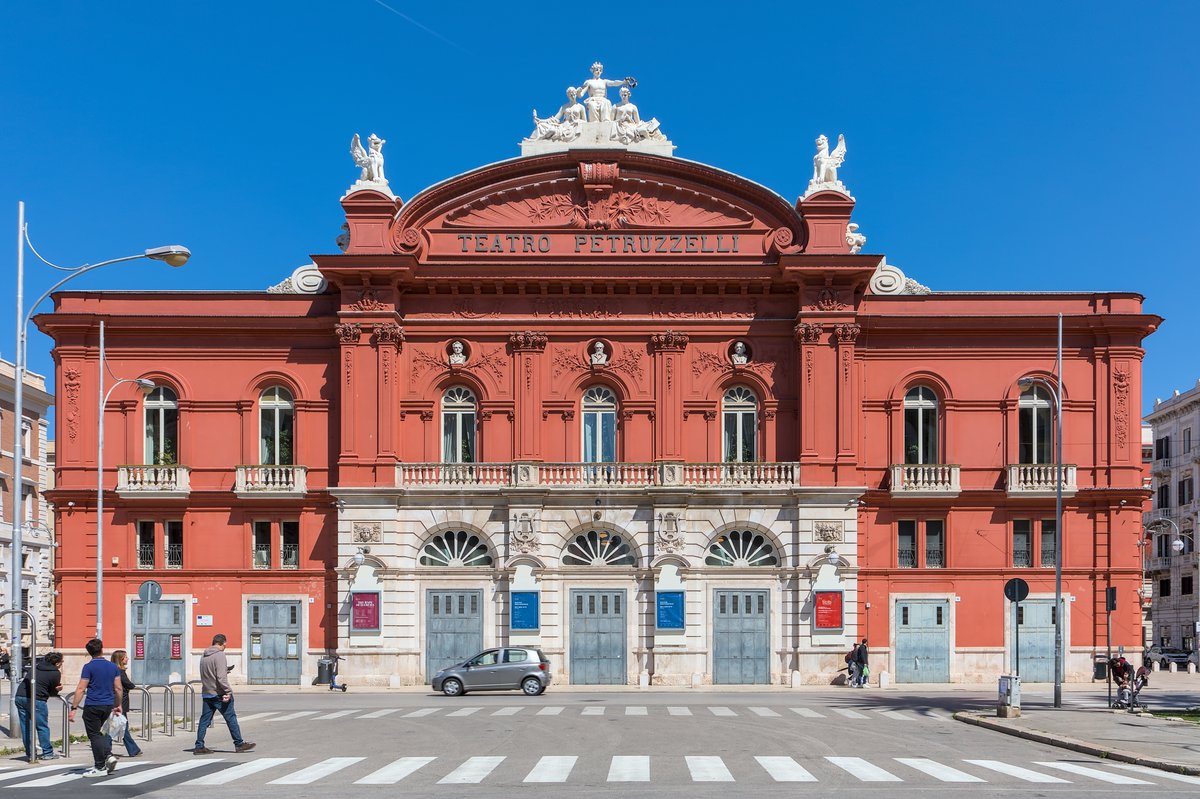
Teatro Petruzzelli is one of the largest and most prestigious theaters in Italy, located in the heart of Bari. Inaugurated in 1903, its history is marked by a tragic fire in 1991 and a rebirth in 2009. Today it hosts an opera and symphony season from October to May, as well as ballets, concerts, and the Bari International Film Festival. Its neoclassical lines, horseshoe-shaped auditorium with four tiers of boxes, and frescoes by Raffaele Armenise enchant visitors. Here’s what not to miss:
– Attending an opera or concert in the magnificent 1,482-seat hall.
– Admiring the mythological frescoes on the ceiling and original architectural details.
– Discovering the reconstruction story after the 1991 fire through guided tours.
– Participating in educational programs and Family Concerts, perfect for adults and children.
Introduction
Stepping into the Teatro Petruzzelli in Bari is like diving into history and culture. With its 1,482 seats and imposing neoclassical façade, it is one of the largest theaters in Italy. But it’s not just about size: here you can feel the emotion of a place that has seen Pavarotti, Callas, and Nureyev grace the stage. The horseshoe-shaped auditorium, with four tiers of boxes and a gallery, is an architectural gem. After the 1991 fire and its reopening in 2009, the Petruzzelli was reborn, more modern yet faithful to the original. A must-see for anyone who loves opera, ballet, or simply beauty.
Historical Notes
The history of the Petruzzelli began in 1898, when brothers Onofrio and Antonio Petruzzelli laid the first stone. Architect Angelo Cicciomessere designed a state-of-the-art theater, with central heating and electric lighting. On February 14, 1903 it was inaugurated with Meyerbeer’s opera Les Huguenots. In 1973 it was recognized as a Theater of Tradition. Then tragedy struck: on October 27, 1991 an arson fire destroyed it almost completely, causing six deaths. The community was devastated. After a long restoration, on December 6, 2009 it reopened, returning the city’s temple of opera. Today it is a vibrant cultural hub, with a season running from October to May.
An Architectural Masterpiece
You can’t help but be awestruck by the frescoes by Raffaele Armenise that adorn the ceiling, with mythological scenes that seem to come to life. The horseshoe-shaped hall is a concentration of elegance: four tiers of boxes, a gallery, and golden details make you feel transported to another era. During guided tours, you can discover anecdotes and curiosities, such as the presence of royal boxes and the ancient gas lighting system, later replaced by electric lighting as early as 1903. Every corner tells a story, and the feeling is that of being part of something grand.
A Program to Experience
The Petruzzelli is not just a monument: it is a living theater. The opera and symphony season runs from October to May, but throughout the year there are also ballets, concerts, and the Bari International Film Festival (Bifest). Events like La Traviata directed by Sofia Coppola with costumes by Valentino Garavani sell out. And then there are the ‘Conversations on Opera’ in the foyer, an informal way to get closer to the music. There are also initiatives for families and young people, such as the Family Concert. The choir and orchestra of the Petruzzelli are of the highest caliber, and conductor Marco Medved has been called to the Deutsche Oper in Berlin – a point of pride for Bari.
Why You Should Visit
If you’re in Bari, the Petruzzelli is worth a stop for at least three reasons. First: guided tours take you behind the scenes, among stages and dressing rooms, revealing stories you won’t find in books. Second: if you love music, attending an opera or ballet in this theater is a unique experience, with excellent acoustics and an enveloping atmosphere. Third: even without a show, the building itself is a work of art. The entrance fee for tours is affordable, and there are often discounted initiatives, like conversations for 2 euros. In short, a dive into culture that doesn’t weigh on your wallet.
When to Go
The best time to visit the Petruzzelli? It depends on what you’re looking for. If you want to experience the thrill of a show, choose autumn or spring, when the programming is richest. Opera evenings have a special charm, with the city lighting up and elegant crowds filling the entrance. If instead you prefer a quiet visit, the afternoon is ideal: fewer people and more time to admire the details. In any case, check the calendar on the official website, because the program changes often and you might get a surprise, like a classical music concert or a Bifest screening.
Nearby
After the theater, two nearby stops are worth a visit. A few steps away, on via Palazzo di Città, there is Palazzo San Michele, managed by the same Petruzzelli Foundation: here they hold costume exhibitions and historical tours related to the theater. Another interesting place is the Libreria Laterza on via Dante, a historic Bari bookstore that collaborates with Petruzzelli for conferences and presentations. Perfect to extend the evening with a book or an aperitif. In the surroundings you also find the basilica of San Nicola and the lungomare, but these two are a natural extension of the cultural itinerary.