Perched at 800 meters above sea level, Mistretta Castle offers an authentic experience blending Norman and Aragonese history with breathtaking panoramas. The fortress is easily accessible from the town center with a short walk and overlooks the entire settlement.
- 360-degree panoramic views over the Nebrodi mountains and Tyrrhenian coast
- Imposing Norman towers and well-preserved quiet courtyards
- Free access to walkways through authentic, non-museumified ruins
- Medieval village with cobblestone alleys and arches at the foot of the castle
Introduction
The Castle of Mistretta is not just a fortress; it’s a privileged vantage point over the Nebrodi Mountains. Upon arrival, the first thing that strikes you is its position: perched on a rocky spur, it dominates the medieval village and the valley with an authority that seems to defy the centuries. The Norman towers, massive and square, stand out against the blue Sicilian sky, promising tales of knights and battles. But the real magic lies in the view: from up there, your gaze sweeps across the Nebrodi woods all the way to the sea, in a breathtaking panorama. This is not a place to rush through; you come here to savor the silence, the wind through the ancient stones, and that sense of history that still feels alive. Personally, I lingered for a long time on the terrace, almost forgetting to take photos—sometimes emotions are worth more than a perfect shot.
Historical Overview
The history of Mistretta Castle is a tapestry of power and strategy. Founded in the Norman era, likely in the 11th century, it served to control communication routes between the inland areas and the Tyrrhenian coast. It later passed to the Swabians, with Frederick II strengthening it as a military outpost, and subsequently to the Aragonese, who modified its structure to adapt to new warfare techniques. It was never an opulent princely residence but a practical fortress designed for defense. Over the centuries, it lost military significance and fell into disrepair until recent restoration efforts stabilized its ruins. Today, walking among the remains of the walls and towers, one can still perceive the different construction phases: the Norman foundation, the Swabian modifications, and the Aragonese expansions. It is a stone book, though some pages have been lost.
- 11th century: Likely Norman foundation.
- 13th century: Strengthening under Frederick II of Swabia.
- 14th-15th centuries: Aragonese modifications and expansions.
- Decline: Progressive abandonment after the Middle Ages.
- Today: Restoration and promotion as a visitable site.
The Charm of the Ruins
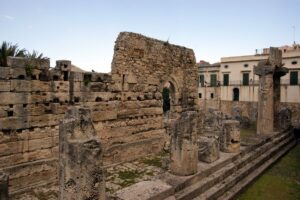
Unlike perfectly restored castles, the atmosphere here is more authentic, more ‘lived-in’. There are no furnished interiors or ballrooms, but open spaces where imagination can run free. You enter through an arched portal leading to the main courtyard, where soldiers and horses once gathered. Today it’s a grassy meadow dotted with wildflowers, with the remains of a water cistern at its center. The walls, made of warm gray local stone, clearly show signs of modifications: here a narrow arrow slit for archers, there an older base incorporated into a later structure. Climbing the towers (accessible with caution), you can appreciate construction details like the stone corbels that supported the machicolations. The wind whistles through the arrow slits, and you understand why this place was so strategic: you can see everything, and you’re visible from afar. It may not be as spectacular as other sites, but it has a straightforward character that I really liked.
The Village at Its Feet
Visiting the castle without exploring Mistretta would be a shame. The medieval village, clinging to the slopes of the fortress, is a maze of cobbled alleys, stairways, and arches that seem straight out of a painting. Descending from the castle, you immediately immerse yourself in the atmosphere: stone houses with flower-filled balconies, ancient portals topped by faded coats of arms, small squares where time seems to have stood still. The Mother Church, dedicated to Saint John the Baptist, houses interesting artworks, but it’s the urban fabric itself that tells the story. You walk under arches that once connected houses to create covered passages, glimpse inner courtyards with wells and lemon trees. The locals are friendly, and you might hear the Mistrettese dialect spoken—a variant of Sicilian with unique influences. I recommend getting lost without haste: every corner hides a detail, like a stone fountain or a votive shrine. It’s a place that still breathes with daily life, not just tourism.
Why Visit It
Three concrete reasons to put it on your itinerary. First: the unique panoramic view over the Nebrodi mountains and the Tyrrhenian Sea, which alone makes the trip worthwhile – rarely do you find such a high point so free of obstructions. Second: the non-‘museumified’ atmosphere; there are no barriers or set paths here, you explore freely among the ruins, making the experience more personal and adventurous. Third: the perfect pairing with the village; in half an hour you go from the solitude of the fortress to the vitality of the medieval alleyways, offering two sides of the same historical coin. Plus, it’s still a relatively uncrowded site where you can enjoy tranquility without the rush – a rarity in Sicily. I’d return for an autumn sunset, when the light is warmer and shadows stretch across the stones.
When to go
I would avoid the midday hours during summer days, when the sun beats down strongly and the reflection off the stone can be blinding. The best time, in my experience, is late afternoon, especially in spring or early autumn. The low-angle light enhances the volumes of the towers and walls, creating spectacular shadow play, and the temperature is more pleasant. During those hours, the landscape takes on golden tones and the silence is almost total, broken only by the wind or the flight of a bird of prey. In winter, if the sky is clear, you can enjoy exceptional visibility, but beware of the cold and wind, which at altitude can be biting. In any case, always check the weather conditions before setting out: here, clouds arrive quickly from the mountains, and fog can obscure the view in minutes.
In the Surroundings
To complete the experience, here are two thematic suggestions. A few kilometers away, in the heart of the Nebrodi mountains, you’ll find the Sanctuary of Maria Santissima dei Miracoli in Tusa, a place of worship nestled in the woods with a history tied to miraculous events – the atmosphere is intimate and evocative, perfect for a peaceful break. Alternatively, if you’re interested in local craftsmanship, seek out the traditional ceramic workshops in nearby villages like San Fratello or Capizzi, where artisans still produce items decorated with motifs inspired by Siculo-Norman culture. Both options enrich your visit with a dive into the spirituality or handcraft traditions of the Messina hinterland, revealing a lesser-known yet authentic side of Sicily.