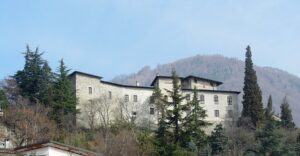
Perched on a panoramic cliff, the Rocca di Angera dominates Lake Maggiore with its imposing medieval bulk. Owned by the Borromeo family since 1449, it preserves 13th-century frescoes in the Hall of Justice and houses the Doll Museum, with over a thousand specimens from the 18th century to today. The faithfully reconstructed medieval gardens and the Scaligera Wing dedicated to contemporary art complete the offering.
– Hall of Justice: fresco cycle by the Master of Angera celebrating the victory of Ottone Visconti.
– Doll Museum: the most important European collection with period dolls and automata.
– Medieval Garden: 2000 sqm of medicinal and ornamental plants with lake views.
– Scaligera Wing: contemporary art exhibitions in a historical context.
Introduction
Perched on a rocky spur overlooking Lake Maggiore, the Rocca di Angera welcomes you with a mix of history and charm that takes your breath away. It’s not just a medieval castle: it’s a journey through time among 13th-century frescoes, Europe’s largest doll museum, and a garden rebuilt like a dream. As you climb towards the entrance, the view alone is worth the ticket.
Introduction
Perched on a rocky spur overlooking Lake Maggiore, the Rocca di Angera welcomes you with a mix of history and charm that takes your breath away. It’s not just a medieval castle: it’s a journey through time among 13th-century frescoes, Europe’s largest doll museum, and a garden rebuilt like a dream. As you climb towards the entrance, the view alone is worth the ticket.
Historical Notes
The earliest traces of the Rocca date back to 1066, when it belonged to the archbishops of Milan. After the Battle of Desio (1277) it passed to the Visconti, who turned it into a stronghold. In 1449 Vitaliano I Borromeo purchased it for 12,800 imperial lire, and it has remained in the family ever since. Between the 17th and 18th centuries it was restored, and in the 20th century it became a center for medieval interpretation.
- 1066: first recorded as archiepiscopal property
- 1277: victory of Ottone Visconti and transfer to the Visconti
- 1449: purchase by the Borromeo family
- 1623: title of marquis granted to Federico Borromeo
- 1988: founding of the Doll Museum
- 2008: creation of the Medieval Garden
Historical Notes
The earliest traces of the Rocca date back to 1066, when it belonged to the archbishops of Milan. After the Battle of Desio (1277) it passed to the Visconti, who turned it into a stronghold. In 1449 Vitaliano I Borromeo purchased it for 12,800 imperial lire, and it has remained in the family ever since. Between the 17th and 18th centuries it was restored, and in the 20th century it became a center for medieval interpretation.
- 1066: first recorded as archiepiscopal property
- 1277: victory of Ottone Visconti and transfer to the Visconti
- 1449: purchase by the Borromeo family
- 1623: title of marquis granted to Federico Borromeo
- 1988: founding of the Doll Museum
- 2008: creation of the Medieval Garden
Frescoes and Historic Halls
The heart of the Rocca is the Sala di Giustizia (Hall of Justice), with a cycle of frescoes by the Master of Angera (late 1200s) depicting the Visconti victory at the Battle of Desio. It is among the best-preserved medieval cycles in Lombardy. Don’t miss the Sala dei Fasti Borromeo (Hall of the Borromeo Glories), with detached frescoes from the early 1400s by Michelino da Besozzo, and the Sala della Mitologia (Hall of Mythology) featuring over 300 majolica pieces from around the world. Each hall has period furnishings and large canvases that make you feel immersed in history.
Frescoes and Historic Halls
The heart of the Rocca is the Sala di Giustizia (Hall of Justice), with a cycle of frescoes by the Master of Angera (late 1200s) depicting the Visconti victory at the Battle of Desio. It is among the best-preserved medieval cycles in Lombardy. Don’t miss the Sala dei Fasti Borromeo (Hall of the Borromeo Glories), with detached frescoes from the early 1400s by Michelino da Besozzo, and the Sala della Mitologia (Hall of Mythology) featuring over 300 majolica pieces from around the world. Each hall has period furnishings and large canvases that make you feel immersed in history.
Museum of Dolls and Toys
Founded in 1988 by Princess Bona Borromeo Arese, it is the largest European museum of its kind, with over a thousand dolls from the 18th century to today. You’ll find them made of wood, wax, porcelain, and papier-mâché, with French and German automata from the 19th century standing out. Twelve rooms take you into a world of antique toys, complete with original accessories and trousseaus. One section is dedicated to non-European toys. It seems like something out of a book, but it’s all real.
Museum of Dolls and Toys
Founded in 1988 by Princess Bona Borromeo Arese, it is the largest European museum of its kind, with over a thousand dolls from the 18th century to today. You’ll find them made of wood, wax, porcelain, and papier-mâché, with French and German automata from the 19th century standing out. Twelve rooms take you into a world of antique toys, complete with original accessories and trousseaus. One section is dedicated to non-European toys. It seems like something out of a book, but it’s all real.
Why Visit It
1. A plunge into the living Middle Ages: the frescoes in the Sala di Giustizia are exceptional, and the Medieval Garden (2000 m², recreated with medicinal plants based on ancient recipes) lets you breathe in the atmosphere. 2. The largest doll museum in Europe: unique in its collection and layout, with rare pieces. 3. The view from the belvedere: from the Castellana Tower or the terrace, Lake Maggiore shows itself in all its splendor, from the Prealps to the islands.
Why Visit It
1. A plunge into the living Middle Ages: the frescoes in the Sala di Giustizia are exceptional, and the Medieval Garden (2000 m², recreated with medicinal plants based on ancient recipes) lets you breathe in the atmosphere. 2. The largest doll museum in Europe: unique in its collection and layout, with rare pieces. 3. The view from the belvedere: from the Castellana Tower or the terrace, Lake Maggiore shows itself in all its splendor, from the Prealps to the islands.
When to Visit
The most magical time is late afternoon in spring or autumn, when the raking light brings out the frescoes and turns the lake into warm hues. The Rocca is open from March to November, but avoid August weekends if you can: with fewer crowds, the magic is more intense. If you love colors, autumn offers a panorama of leaves turning red and gold.
When to Visit
The most magical time is late afternoon in spring or autumn, when the raking light brings out the frescoes and turns the lake into warm hues. The Rocca is open from March to November, but avoid August weekends if you can: with fewer crowds, the magic is more intense. If you love colors, autumn offers a panorama of leaves turning red and gold.
Nearby
If you’re in the area, don’t miss Isola Bella and Isola Madre (reachable by boat from Angera), with their Baroque gardens and period furnishings. A combined ticket with the Rocca saves you money. Or take a trip to Parco Pallavicino in Stresa, an English-style garden with free-roaming animals. Two perfect destinations to enrich your day on Lake Maggiore.
Nearby
If you’re in the area, don’t miss Isola Bella and Isola Madre (reachable by boat from Angera), with their Baroque gardens and period furnishings. A combined ticket with the Rocca saves you money. Or take a trip to Parco Pallavicino in Stresa, an English-style garden with free-roaming animals. Two perfect destinations to enrich your day on Lake Maggiore.