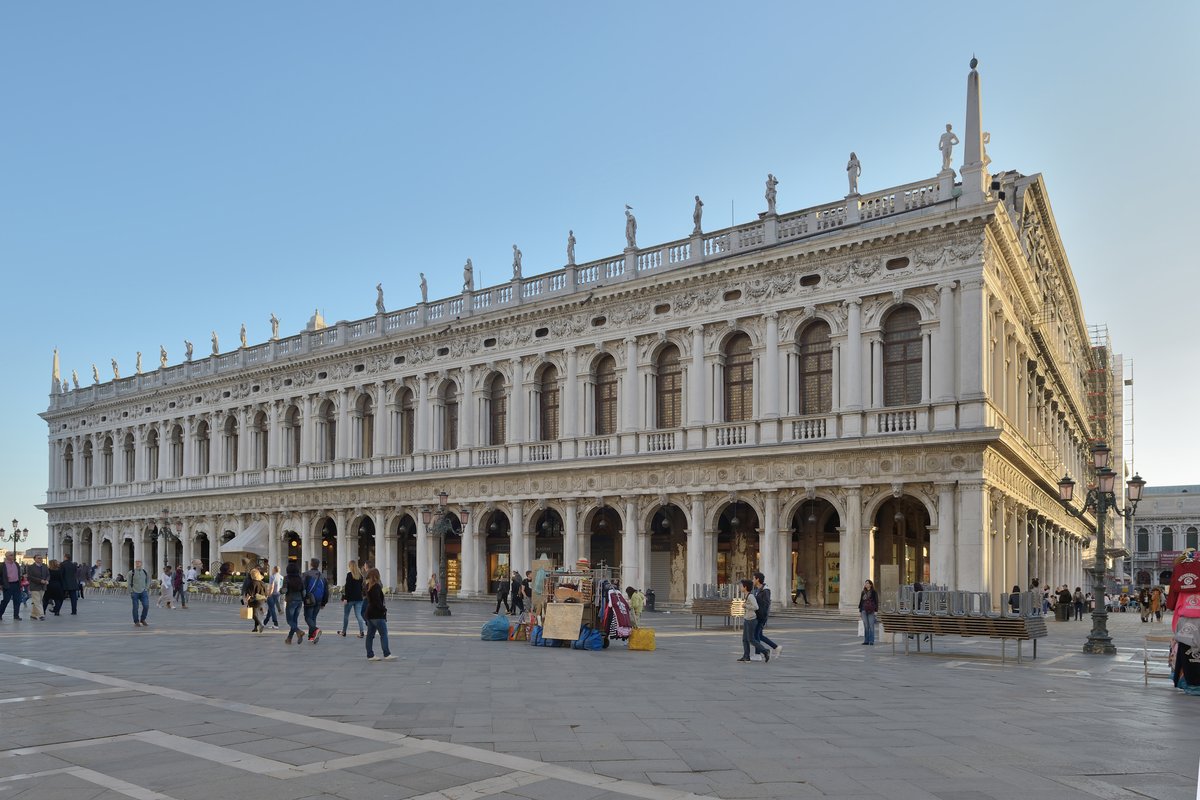
Founded in 1468, the National Marciana Library is one of Italy’s oldest public libraries. Located in Piazzetta San Marco, it is a Renaissance masterpiece by Jacopo Sansovino. Inside, it holds over 13,000 manuscripts and artworks by Titian and Veronese.
– Over 13,000 manuscripts and 2,800 incunabula
– Monumental Rooms with decorations by Veronese and Tintoretto
– Fra’ Mauro’s world map, an important 15th-century cartographic work
– Free admission every first Sunday of the month (Sunday at the Museum)
Introduction
Stepping into the Biblioteca Nazionale Marciana is like diving into the Venetian Renaissance. Overlooking Piazzetta San Marco, with its elegant facade designed by Sansovino, it houses a breathtaking collection of manuscripts and prints. But it’s not just an archive: the Monumental Rooms are a masterpiece of art, with ceilings frescoed by Titian, Veronese, and Tintoretto. The atmosphere is solemn yet welcoming: here you can breathe in history that smells of ancient paper.
Introduction
Stepping into the Biblioteca Nazionale Marciana is like diving into the Venetian Renaissance. Overlooking Piazzetta San Marco, with its elegant facade designed by Sansovino, it houses a breathtaking collection of manuscripts and prints. But it’s not just an archive: the Monumental Rooms are a masterpiece of art, with ceilings frescoed by Titian, Veronese, and Tintoretto. The atmosphere is solemn yet welcoming: here you can breathe in history that smells of ancient paper.
Historical Notes
The library was founded in 1468 when Cardinal Bessarion donated his precious collection of Greek and Latin manuscripts (about 1000 volumes) to the Republic of Venice. The building, designed by Jacopo Sansovino, was begun in 1537 and completed after his death. In 1545 the ceiling collapsed, and Sansovino was imprisoned but later released. From 1603, printers were required to deposit a copy of every book (the first law of its kind in Italy). Today it holds over 13,000 manuscripts, including the 10th-century Homer Venetus A and Fra Mauro’s world map.
Historical Notes
The library was founded in 1468 when Cardinal Bessarion donated his precious collection of Greek and Latin manuscripts (about 1000 volumes) to the Republic of Venice. The building, designed by Jacopo Sansovino, was begun in 1537 and completed after his death. In 1545 the ceiling collapsed, and Sansovino was imprisoned but later released. From 1603, printers were required to deposit a copy of every book (the first law of its kind in Italy). Today it holds over 13,000 manuscripts, including the 10th-century Homer Venetus A and Fra Mauro’s world map.
The Monumental Rooms
The museum tour begins with the monumental staircase and leads to the Vestibule and the Sansovino Hall, where the ceiling is decorated with allegories by seven painters, including Paolo Veronese (who was awarded best for his Music). Here you can also admire the Procurators’ Chambers, with cartographic relics such as Fra’ Mauro’s map (15th century). Entry is free on the first Sunday of the month. To visit the rooms, you enter from the Correr Museum.
The Monumental Rooms
The museum tour begins with the monumental staircase and leads to the Vestibule and the Sansovino Hall, where the ceiling is decorated with allegories by seven painters, including Paolo Veronese (who was awarded best for his Music). Here you can also admire the Procurators’ Chambers, with cartographic relics such as Fra’ Mauro’s map (15th century). Entry is free on the first Sunday of the month. To visit the rooms, you enter from the Correr Museum.
Hidden Treasures
In addition to the famous Homeric manuscripts, the Marciana houses Aldo Manuzio’s Hypnerotomachia Poliphili (1499) and a rich collection of incunabula (2,800) and cinquecentine (24,000). Among the highlights are Fra’ Mauro’s planisphere, a masterpiece of medieval cartography, and a 10th-century copy of the Iliad. The library also possesses illuminated manuscripts such as the French codex Z 6, containing the Chanson d’Aspremont.
Hidden Treasures
In addition to the famous Homeric manuscripts, the Marciana houses Aldo Manuzio’s Hypnerotomachia Poliphili (1499) and a rich collection of incunabula (2,800) and cinquecentine (24,000). Among the highlights are Fra’ Mauro’s planisphere, a masterpiece of medieval cartography, and a 10th-century copy of the Iliad. The library also possesses illuminated manuscripts such as the French codex Z 6, containing the Chanson d’Aspremont.
Why Visit It
Three reasons: first, it’s one of Italy’s oldest public libraries, with a truly unique atmosphere. Second, the Monumental Rooms are a complete work of art, featuring frescoes by Titian and Veronese. Third, Fra’ Mauro’s planisphere is an extraordinary document. Plus, temporary exhibitions (like ‘Audaci e sportive’ until February 28, 2025) add even more to the experience.
Why Visit It
Three reasons: first, it’s one of Italy’s oldest public libraries, with a truly unique atmosphere. Second, the Monumental Rooms are a complete work of art, featuring frescoes by Titian and Veronese. Third, Fra’ Mauro’s planisphere is an extraordinary document. Plus, temporary exhibitions (like ‘Audaci e sportive’ until February 28, 2025) add even more to the experience.
When to Go
The best time? Early in the morning, right when it opens (at 8:30 AM), when the light illuminates the golden ceilings and there are few people. Avoid the weekend if you can. In autumn, there are interesting events, such as the book presentation on October 9, 2025. Winter is evocative for its calm, while in summer the library is a cool oasis.
When to Go
The best time? Early in the morning, right when it opens (at 8:30 AM), when the light illuminates the golden ceilings and there are few people. Avoid the weekend if you can. In autumn, there are interesting events, such as the book presentation on October 9, 2025. Winter is evocative for its calm, while in summer the library is a cool oasis.
Nearby
Just a few steps away, the Correr Museum offers an overview of Venice’s history. Not to be missed is St. Mark’s Basilica with its Byzantine mosaics. If you have time, take a ride on the Grand Canal or visit the nearby Doge’s Palace.
Nearby
Just a few steps away, the Correr Museum offers an overview of Venice’s history. Not to be missed is St. Mark’s Basilica with its Byzantine mosaics. If you have time, take a ride on the Grand Canal or visit the nearby Doge’s Palace.