Introduction
If there is a place that leaves you breathless, it’s the Redipuglia War Memorial. It’s not just a monument: it’s an experience that hits you in the gut. Imagine a staircase of 22 steps rising towards the sky, with over 100,000 names engraved in bronze. The majesty of this place makes you feel small, yet part of something greater. And then there is the silence, broken only by the wind blowing over the Karst. Here, history is not a book, but a punch to the stomach. Prepare to experience an emotion you will never forget.
Introduction
If there is a place that leaves you breathless, it’s the Redipuglia War Memorial. It’s not just a monument: it’s an experience that hits you in the gut. Imagine a staircase of 22 steps rising towards the sky, with over 100,000 names engraved in bronze. The majesty of this place makes you feel small, yet part of something greater. And then there is the silence, broken only by the wind blowing over the Karst. Here, history is not a book, but a punch to the stomach. Prepare to experience an emotion you will never forget.
Historical Notes
Inaugurated on September 18, 1938 in the presence of Mussolini and 50,000 veterans, the shrine replaced the old Cemetery of the Invicti on Colle Sant’Elia. Designed by architect Giovanni Greppi and sculptor Giannino Castiglioni, work began in 1935. Here rest the remains of over 100,000 soldiers, of whom about 40,000 are known and 60,000 unknown, who fell in the battles of the Isonzo. Every November 4th, an official ceremony commemorates all the fallen of World War I. A story of sacrifice and memory, carved into the stone of the Karst.
Historical Notes
Inaugurated on September 18, 1938 in the presence of Mussolini and 50,000 veterans, the shrine replaced the old Cemetery of the Invicti on Colle Sant’Elia. Designed by architect Giovanni Greppi and sculptor Giannino Castiglioni, work began in 1935. Here rest the remains of over 100,000 soldiers, of whom about 40,000 are known and 60,000 unknown, who fell in the battles of the Isonzo. Every November 4th, an official ceremony commemorates all the fallen of World War I. A story of sacrifice and memory, carved into the stone of the Karst.
The Heroic Way and the Steps
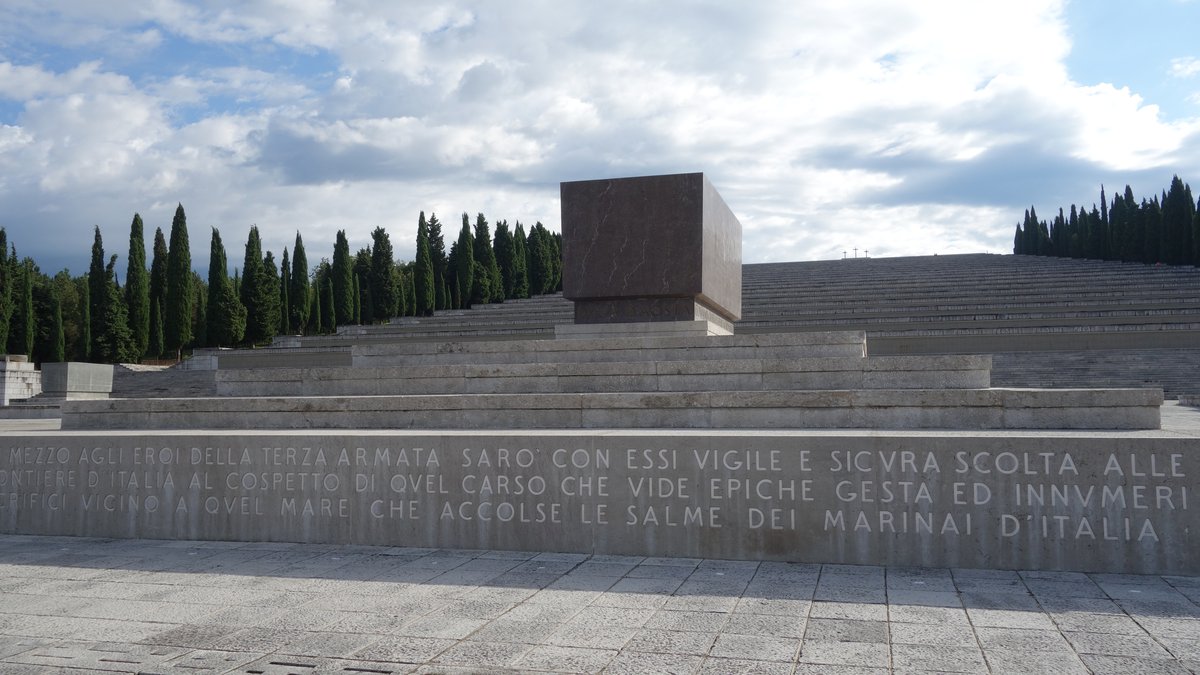
The entrance is marked by an anchor chain from the torpedo boat Grado. Immediately after, you find yourself on the Heroic Way, a cobbled path flanked by 38 bronze plaques bearing the names of the bloodiest locations on the Karst. At the end, the tomb of the Duke of Aosta, a 75-ton monolith, flanked by five blocks for his generals. Then begin the 22 steps, 12 meters wide and 2.5 meters high, which hold the known fallen in alphabetical order. On each step, the inscription “Present” is repeated hundreds of times. As you climb, the emotion grows. At the top, two large common tombs for the unknown and the votive chapel with three crosses.
The Heroic Way and the Steps
The entrance is marked by an anchor chain from the torpedo boat Grado. Immediately after, you find yourself on the Heroic Way, a cobbled path flanked by 38 bronze plaques bearing the names of the bloodiest locations on the Karst. At the end, the tomb of the Duke of Aosta, a 75-ton monolith, flanked by five blocks for his generals. Then begin the 22 steps, 12 meters wide and 2.5 meters high, which hold the known fallen in alphabetical order. On each step, the inscription “Present” is repeated hundreds of times. As you climb, the emotion grows. At the top, two large common tombs for the unknown and the votive chapel with three crosses.
The Remembrance Park on Colle Sant’Elia
Facing the war memorial, Colle Sant’Elia is now a 100-hectare Remembrance Park. Once a war cemetery, it is now a path through cypresses, meadows, and commemorative works. Along the pathways you’ll find 35 stone markers made of Karst limestone with reproductions of relics and original inscriptions. At the top, a Roman column from Aquileia honors the fallen of all wars. The park also houses an Austro-Hungarian tunnel, restored trenches, and over 30 pieces of vintage artillery, some very rare. It is a place where nature embraces history, perfect for reflection away from the crowds.
The Remembrance Park on Colle Sant’Elia
Facing the war memorial, Colle Sant’Elia is now a 100-hectare Remembrance Park. Once a war cemetery, it is now a path through cypresses, meadows, and commemorative works. Along the pathways you’ll find 35 stone markers made of Karst limestone with reproductions of relics and original inscriptions. At the top, a Roman column from Aquileia honors the fallen of all wars. The park also houses an Austro-Hungarian tunnel, restored trenches, and over 30 pieces of vintage artillery, some very rare. It is a place where nature embraces history, perfect for reflection away from the crowds.
Why You Should Visit
There are at least three good reasons. First: it is the largest war memorial in Italy, a masterpiece of architecture and symbolism that makes you understand the scale of the Great War. Second: the Remembrance Park with its original trenches and artillery allows you to touch history. Third: the Piazza delle Pietre d’Italia (Square of the Stones of Italy), created for the centenary with stone materials from all regions, is a moving contemporary artwork. Plus, admission is free and so is parking: an unmissable opportunity to dive into memory.
Why You Should Visit
There are at least three good reasons. First: it is the largest war memorial in Italy, a masterpiece of architecture and symbolism that makes you understand the scale of the Great War. Second: the Remembrance Park with its original trenches and artillery allows you to touch history. Third: the Piazza delle Pietre d’Italia (Square of the Stones of Italy), created for the centenary with stone materials from all regions, is a moving contemporary artwork. Plus, admission is free and so is parking: an unmissable opportunity to dive into memory.
When to Go
The most evocative moment? Late afternoon on an autumn day, when the low sun illuminates the bronze slabs and shadows stretch across the steps. The atmosphere becomes almost mystical. In summer, it’s best to avoid the midday hours: the sun beats down and there’s little shade. If you can, choose a weekday to enjoy the silence. On November 4, with the official ceremony, it’s emotional but crowded. In spring, the green of the Karst makes everything more vibrant.
When to Go
The most evocative moment? Late afternoon on an autumn day, when the low sun illuminates the bronze slabs and shadows stretch across the steps. The atmosphere becomes almost mystical. In summer, it’s best to avoid the midday hours: the sun beats down and there’s little shade. If you can, choose a weekday to enjoy the silence. On November 4, with the official ceremony, it’s emotional but crowded. In spring, the green of the Karst makes everything more vibrant.
Nearby
A stone’s throw from the memorial, don’t miss the Open-Air Museum of the Dolina del XV Bersaglieri. Follow the signs from the top of the memorial: a path leads you to a karst sinkhole turned into a museum, with trenches, positions, and artifacts. Another unmissable stop is Aquileia, about 20 km away: its early Christian basilica with stunning mosaics is a UNESCO World Heritage site. The connection to the memorial is strong: it was from here that the Unknown Soldier departed. An itinerary that combines military history and ancient art.
Nearby
A stone’s throw from the memorial, don’t miss the Open-Air Museum of the Dolina del XV Bersaglieri. Follow the signs from the top of the memorial: a path leads you to a karst sinkhole turned into a museum, with trenches, positions, and artifacts. Another unmissable stop is Aquileia, about 20 km away: its early Christian basilica with stunning mosaics is a UNESCO World Heritage site. The connection to the memorial is strong: it was from here that the Unknown Soldier departed. An itinerary that combines military history and ancient art.