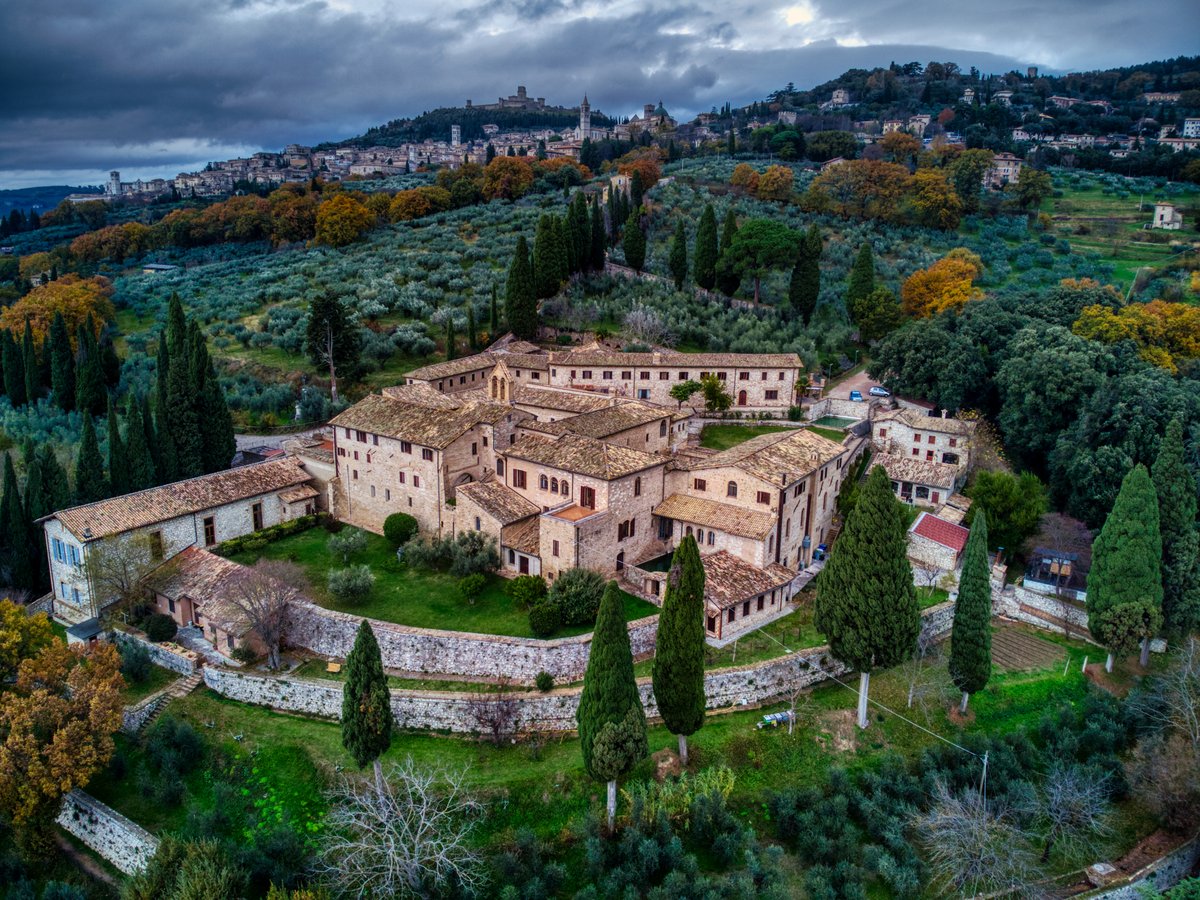
The Church of San Damiano, just a 10-minute walk from the center of Assisi, is one of the most significant sites of Franciscan spirituality. It all began here: the crucifix spoke to St. Francis, and here St. Clare founded her order. Visiting this church means diving into history and faith.
– The San Damiano Crucifix: the original is in the Basilica of Santa Chiara, but a copy is displayed above the altar.
– St. Clare’s Spaces: the choir, the oratory, the dormitory, and the garden tell the story of her life.
– The Canticle of the Creatures: Francis composed it right here in 1225.
– A UNESCO Site: part of the World Heritage since 2000.
The Crucifix That Spoke to Francis
If there is a place that gets under your skin, it is San Damiano. Just a stone’s throw from Assisi, this seemingly modest little church holds a special energy. Here, in 1205, a young Francis heard the crucifix speak to him: «Go and repair my house». From that moment, everything changed. Entering today is like diving into the Middle Ages: the smell of stone, the dim light, the silence broken only by the song of birds. It is not just a UNESCO site; it is a living place. The copy of the crucifix on the apse arch looks at you, and for a moment it really seems as if it could speak.
The Crucifix That Spoke to Francis
If there is a place that gets under your skin, it is San Damiano. Just a stone’s throw from Assisi, this seemingly modest little church holds a special energy. Here, in 1205, a young Francis heard the crucifix speak to him: «Go and repair my house». From that moment, everything changed. Entering today is like diving into the Middle Ages: the smell of stone, the dim light, the silence broken only by the song of birds. It is not just a UNESCO site; it is a living place. The copy of the crucifix on the apse arch looks at you, and for a moment it really seems as if it could speak.
From the Speaking Crucifix to Chiara’s Death
The history of San Damiano begins long before Francis: already in 1030 it was a Benedictine priory. But the key moment is
1205, when Francis, before the crucifix, receives his calling. He restores the church with his own hands, then welcomes Saint Clare and her companions in
1211-1212. Here Francis composes the
Canticle of the Creatures in 1225, and here Clare dies in
1253. The Poor Clares remain until 1260. Here are the highlights:
- 1030: Benedictine priory
- 1205: Francis hears the crucifix
- 1211-1212: Saint Clare founds the monastery
- 1225: The Canticle of the Creatures composed
- 1253: Death of Saint Clare
- 1260: The Poor Clares leave San Damiano
From the Speaking Crucifix to Chiara’s Death
The history of San Damiano begins long before Francis: already in 1030 it was a Benedictine priory. But the key moment is
1205, when Francis, before the crucifix, receives his calling. He restores the church with his own hands, then welcomes Saint Clare and her companions in
1211-1212. Here Francis composes the
Canticle of the Creatures in 1225, and here Clare dies in
1253. The Poor Clares remain until 1260. Here are the highlights:
- 1030: Benedictine priory
- 1205: Francis hears the crucifix
- 1211-1212: Saint Clare founds the monastery
- 1225: The Canticle of the Creatures composed
- 1253: Death of Saint Clare
- 1260: The Poor Clares leave San Damiano
The Interior and the Crucifix by Innocenzo da Palermo
The interior is a single nave with an ogival barrel vault, simple yet striking. Immediately catching the eye is the copy of the San Damiano Crucifix on the apse arch, recalling the miraculous event. But the surprise lies in the side chapel: a wooden crucifix from 1637 by Brother Innocenzo da Palermo. Depending on the angle, Jesus’ expression changes—pain, abandonment, serenity—an effect that leaves you breathless. A little further on, the small window from which Francis threw the rejected coins. Fourteenth-century frescoes and a 1957 Tamburini organ complete the atmosphere of contemplation.
The Interior and the Crucifix by Innocenzo da Palermo
The interior is a single nave with an ogival barrel vault, simple yet striking. Immediately catching the eye is the copy of the San Damiano Crucifix on the apse arch, recalling the miraculous event. But the surprise lies in the side chapel: a wooden crucifix from 1637 by Brother Innocenzo da Palermo. Depending on the angle, Jesus’ expression changes—pain, abandonment, serenity—an effect that leaves you breathless. A little further on, the small window from which Francis threw the rejected coins. Fourteenth-century frescoes and a 1957 Tamburini organ complete the atmosphere of contemplation.
The Convent: Miracles and Spirituality
Beyond the church, the convent is a path of faith. In the little choir of Saint Clare the nuns prayed; in the dormitory you can see the spot where Clare passed away. The cloister is a haven of peace – from here, in 1240, Clare repelled the Saracens by showing the monstrance. In the refectory the multiplication of the loaves and the pope’s visit are remembered. Each room tells a miracle. Strolling through the garden, where Clare grew flowers, you breathe the same simplicity as Francis, who wrote the Canticle of the Creatures here in 1225.
The Convent: Miracles and Spirituality
Beyond the church, the convent is a path of faith. In the little choir of Saint Clare the nuns prayed; in the dormitory you can see the spot where Clare passed away. The cloister is a haven of peace – from here, in 1240, Clare repelled the Saracens by showing the monstrance. In the refectory the multiplication of the loaves and the pope’s visit are remembered. Each room tells a miracle. Strolling through the garden, where Clare grew flowers, you breathe the same simplicity as Francis, who wrote the Canticle of the Creatures here in 1225.
Why Visit It
Three good reasons not to skip San Damiano. First: it is the source of Franciscan spirituality, where it all began. Second: the atmosphere is unique – here silence speaks, and even non-believers are moved. Third: you can admire a copy of the crucifix that spoke to Francis and see with your own eyes the places of Clare’s miracles. Plus, it is away from the tourist chaos of the center, offering an authentic pause.
Why Visit It
Three good reasons not to skip San Damiano. First: it is the source of Franciscan spirituality, where it all began. Second: the atmosphere is unique – here silence speaks, and even non-believers are moved. Third: you can admire a copy of the crucifix that spoke to Francis and see with your own eyes the places of Clare’s miracles. Plus, it is away from the tourist chaos of the center, offering an authentic pause.
When to Go
The best time? Early morning, when the first rays filter through the windows and the cloister is still wrapped in silence. Late afternoon light is also beautiful, especially in spring and autumn. Avoid the central hours of summer, when the heat is felt and groups arrive. But any day, if you have an hour to spare, San Damiano gives you an experience that stays with you.
When to Go
The best time? Early morning, when the first rays filter through the windows and the cloister is still wrapped in silence. Late afternoon light is also beautiful, especially in spring and autumn. Avoid the central hours of summer, when the heat is felt and groups arrive. But any day, if you have an hour to spare, San Damiano gives you an experience that stays with you.
Nearby
Once you step outside, don’t miss the Basilica of Saint Clare (where the original crucifix is kept) and the Porziuncola in the Basilica of Saint Mary of the Angels, another key site of Francis. If you have time, hike up to the Eremo delle Carceri, a corner of nature and prayer in the mountains. All reachable on foot or with short drives, in the heart of Franciscan Umbria.
Nearby
Once you step outside, don’t miss the Basilica of Saint Clare (where the original crucifix is kept) and the Porziuncola in the Basilica of Saint Mary of the Angels, another key site of Francis. If you have time, hike up to the Eremo delle Carceri, a corner of nature and prayer in the mountains. All reachable on foot or with short drives, in the heart of Franciscan Umbria.