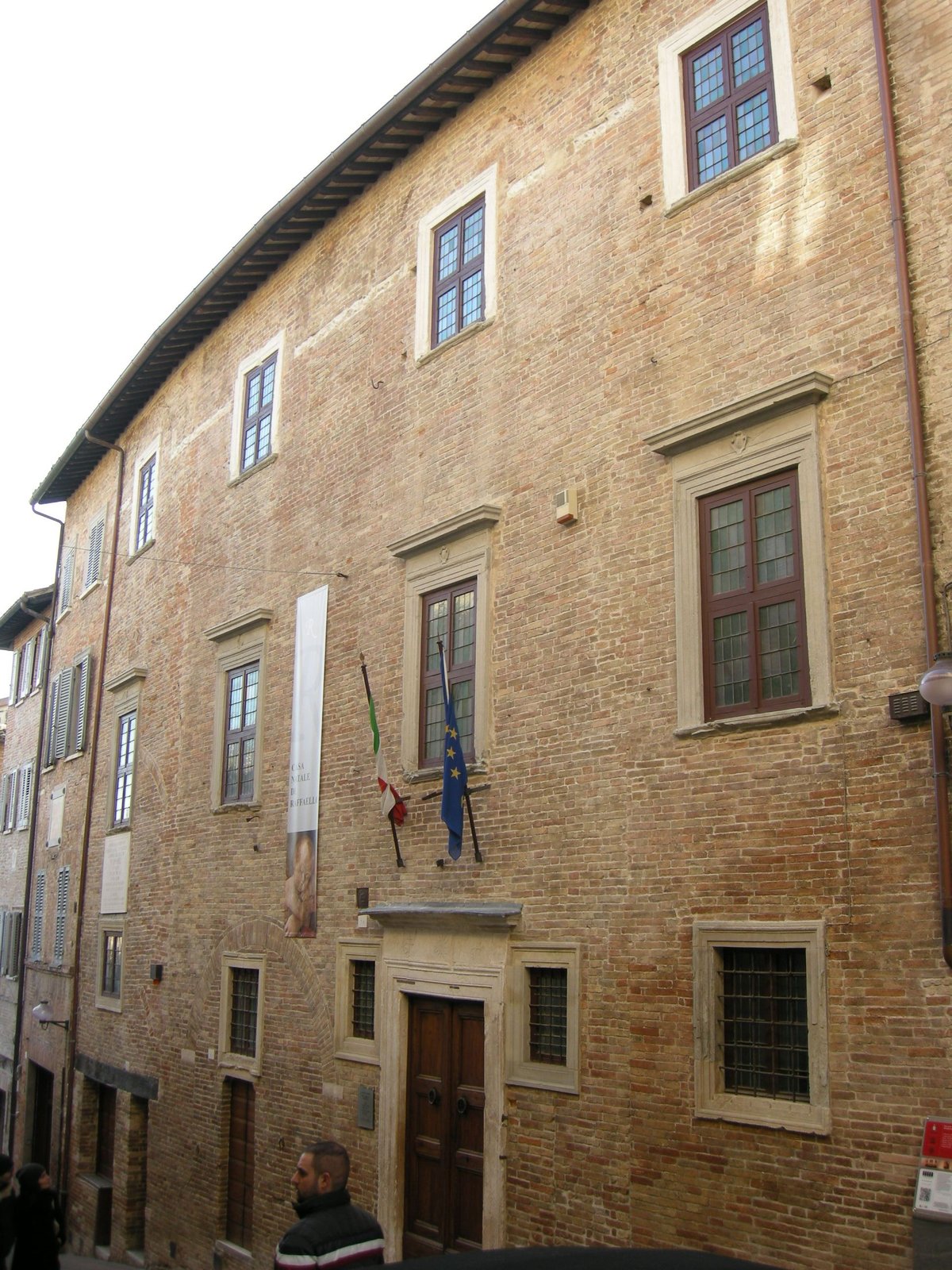
The birthplace of Raphael in Urbino is a small museum that preserves the origins of the Renaissance genius. Here, among the 15th-century rooms, you can see the fresco of the Madonna and Child painted by a very young Raphael and the tools from the workshop of his father, Giovanni Santi. An intimate place full of history, run by the Accademia Raffaello.
– Original fresco: in Raphael’s bedroom, the fresco of the Madonna and Child is one of his earliest works.
– Giovanni Santi’s workshop: discover the tools and environment where Raphael learned his art.
– Skull cast: in the memorabilia room, a plaster cast of Raphael’s skull is displayed, used for the 3D reconstruction.
– Practical information: full ticket €4, free for under 15; hours vary, closed December 25 and January 1.
Introduction
Stepping into Casa Santi is like traveling back five centuries. Tucked away in one of Urbino’s most picturesque alleyways, among exposed brick and stone portals, lies the house where Raphael was born in 1483. Here, between his father’s workshop and the fresco of the Madonna, you can still breathe the atmosphere of a childhood immersed in art. You don’t need to be an expert to be moved—just look around.
Introduction
Stepping into Casa Santi is like traveling back five centuries. Tucked away in one of Urbino’s most picturesque alleyways, among exposed brick and stone portals, lies the house where Raphael was born in 1483. Here, between his father’s workshop and the fresco of the Madonna, you can still breathe the atmosphere of a childhood immersed in art. You don’t need to be an expert to be moved—just look around.
Historical Notes
The building, dating back to the mid-15th century, was purchased in 1460 by
Giovanni Santi, a painter and father of Raphael, who set up his workshop here. On March 28, 1483, Raphael was born and began painting under his father’s guidance. After the artist’s death in Rome in 1520, the house changed hands until 1635, when architect
Muzio Oddi bought a part and restored it. In 1873, the building was bought by the
Accademia Raffaello, which still cares for it today.
- 1460 – Giovanni Santi buys the house and opens his workshop.
- 1483 – Raphael’s birth (March 28).
- 1520 – Raphael’s death in Rome.
- 1635 – Muzio Oddi buys and restores part of the house.
- 1873 – The Accademia Raffaello becomes owner.
Historical Notes
The building, dating back to the mid-15th century, was purchased in 1460 by
Giovanni Santi, a painter and father of Raphael, who set up his workshop here. On March 28, 1483, Raphael was born and began painting under his father’s guidance. After the artist’s death in Rome in 1520, the house changed hands until 1635, when architect
Muzio Oddi bought a part and restored it. In 1873, the building was bought by the
Accademia Raffaello, which still cares for it today.
- 1460 – Giovanni Santi buys the house and opens his workshop.
- 1483 – Raphael’s birth (March 28).
- 1520 – Raphael’s death in Rome.
- 1635 – Muzio Oddi buys and restores part of the house.
- 1873 – The Accademia Raffaello becomes owner.
The Madonna Fresco and the Workshop
The jewel of the house is undoubtedly the fresco of the Madonna and Child, known as the Madonna di Casa Santi, painted by a very young Raphael around the age of fifteen. It is located in the painter’s bedroom, a bare room full of meaning. The Madonna is depicted in profile, with the sleeping Child on a lectern, already showing that sweetness that would become Raphael’s trademark. A few steps away, the father’s workshop – now used as a gallery – preserves tools and furnishings that tell the story of the daily work of a fifteenth-century atelier.
The Madonna Fresco and the Workshop
The jewel of the house is undoubtedly the fresco of the Madonna and Child, known as the Madonna di Casa Santi, painted by a very young Raphael around the age of fifteen. It is located in the painter’s bedroom, a bare room full of meaning. The Madonna is depicted in profile, with the sleeping Child on a lectern, already showing that sweetness that would become Raphael’s trademark. A few steps away, the father’s workshop – now used as a gallery – preserves tools and furnishings that tell the story of the daily work of a fifteenth-century atelier.
Rooms and Collections
Beyond Raphael’s room, the museum route winds through the Sala Grande with its coffered ceiling and 16th-century fireplace, and the upper floor housing the Accademia Raffaello. Here you’ll find paintings by Giovanni Santi (such as the Annunciation), copies of famous Raphael works, a drawing attributed to Bramante, and a collection of Renaissance ceramics. Don’t miss the pigment grinding stone in the courtyard, used by father and son: a simple detail that makes the heart beat faster.
Rooms and Collections
Beyond Raphael’s room, the museum route winds through the Sala Grande with its coffered ceiling and 16th-century fireplace, and the upper floor housing the Accademia Raffaello. Here you’ll find paintings by Giovanni Santi (such as the Annunciation), copies of famous Raphael works, a drawing attributed to Bramante, and a collection of Renaissance ceramics. Don’t miss the pigment grinding stone in the courtyard, used by father and son: a simple detail that makes the heart beat faster.
Why Visit It
First reason: it’s the only place in the world where you can soak in Raphael’s childhood, in an authentic setting not overrun with tourists. Second: the fresco of the Madonna is an early masterpiece that leaves you breathless. Third: the ticket costs only 4 euros (free for under 15), and you can pair it with a stroll through the historic center of Urbino, a UNESCO World Heritage site.
Why Visit It
First reason: it’s the only place in the world where you can soak in Raphael’s childhood, in an authentic setting not overrun with tourists. Second: the fresco of the Madonna is an early masterpiece that leaves you breathless. Third: the ticket costs only 4 euros (free for under 15), and you can pair it with a stroll through the historic center of Urbino, a UNESCO World Heritage site.
When to go
If possible, choose a weekday afternoon in autumn or spring: the low sunlight magically illuminates the fresco, and the house is almost empty. In winter, the atmosphere is more intimate, while in summer, early mornings offer coolness and silence. Avoid weekends if you seek tranquility.
When to go
If possible, choose a weekday afternoon in autumn or spring: the low sunlight magically illuminates the fresco, and the house is almost empty. In winter, the atmosphere is more intimate, while in summer, early mornings offer coolness and silence. Avoid weekends if you seek tranquility.
In the Surroundings
Just a stone’s throw away, the Ducal Palace houses the National Gallery of the Marche, featuring the renowned Flagellation of Christ by Piero della Francesca. If you have time, climb up to Forte Albornoz for a breathtaking view of the Marche hills: the contrast between the silence of the birthplace and the open vista across the landscape makes for a perfect finale.
In the Surroundings
Just a stone’s throw away, the Ducal Palace houses the National Gallery of the Marche, featuring the renowned Flagellation of Christ by Piero della Francesca. If you have time, climb up to Forte Albornoz for a breathtaking view of the Marche hills: the contrast between the silence of the birthplace and the open vista across the landscape makes for a perfect finale.