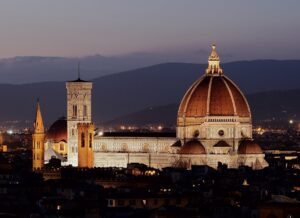
Are you ready to discover Florence in 1 day? This 8-stop walking itinerary will guide you through the Duomo, the most iconic squares, and the historic churches of the city. A route designed for those who love art and history, perfect for a cultural city break. Starting from Piazza del Duomo, you’ll admire the majestic Santa Maria del Fiore Cathedral and the Baptistery with its bronze doors, then continue to Piazza della Signoria, the political heart of Renaissance Florence. Visit the Basilica of Santa Croce, burial place of great Italians like Michelangelo and Galileo, and admire the facade of Santa Maria Novella. Each stop is a short walk away, allowing you to experience the unique atmosphere of this city without stress. Don’t miss the details: Giotto’s Campanile, Ponte Vecchio, and the artisan shops along the way. With this itinerary, you’ll get a complete taste of Florence’s cultural heritage.
🗺️ Your trip at a glance
An 8-stop walking itinerary to discover Florence in 1 day. Here are the key points:
What you do: Walk between the Duomo, historic squares, and Renaissance churches. Why it’s different: A route designed for cultural city breaks, away from the usual tours. Who it’s for: Perfect for explorers who want the essence of Florence in a few hours.
Itinerary stops
Stop no. 1
Basilica of Santa Maria Novella
 I begin my Florentine day right here, in front of the façade of Santa Maria Novella. It is the first great basilica of Florence, built by the Dominicans starting in 1279, but Leon Battista Alberti’s genius touch made it unique: the upper completion in white and green marble, with that tympanum and lateral volutes, is a masterpiece of Renaissance harmony. Entering, the Gothic interior surprises you: the white-green cross vaults, the light filtering through the stained glass, and immediately you find yourself before works that leave you breathless. Giotto’s Crucifix from 1290, Masaccio’s Trinity with its revolutionary perspective, and then the Tornabuoni Chapel with Ghirlandaio’s frescoes. Don’t miss the Green Cloister, where Paolo Uccello painted the Flood. Practical tip: arrive early to enjoy the silence before the crowds. The ticket costs €5, but for €7.50 you can also visit the museum. A perfect start for a walking tour.
- Go to the page: Basilica of Santa Maria Novella: A Gothic and Renaissance Masterpiece
- Piazza di Santa Maria Novella 18, Firenze (FI)
- http://www.chiesasantamarianovella.it/
- Open in Google Maps
- View on Google Images

You should go if…
Stop no. 1
Basilica of Santa Maria Novella
I begin my Florentine day right here, in front of the façade of Santa Maria Novella. It is the first great basilica of Florence, built by the Dominicans starting in 1279, but Leon Battista Alberti’s genius touch made it unique: the upper completion in white and green marble, with that tympanum and lateral volutes, is a masterpiece of Renaissance harmony. Entering, the Gothic interior surprises you: the white-green cross vaults, the light filtering through the stained glass, and immediately you find yourself before works that leave you breathless. Giotto’s Crucifix from 1290, Masaccio’s Trinity with its revolutionary perspective, and then the Tornabuoni Chapel with Ghirlandaio’s frescoes. Don’t miss the Green Cloister, where Paolo Uccello painted the Flood. Practical tip: arrive early to enjoy the silence before the crowds. The ticket costs €5, but for €7.50 you can also visit the museum. A perfect start for a walking tour.- Go to the page: Basilica of Santa Maria Novella: Masaccio’s Trinity and Ghirlandaio’s Frescoes
- Piazza di Santa Maria Novella 18, Firenze (FI)
- http://www.chiesasantamarianovella.it/
- Open in Google Maps
- View on Google Images
You should go if…
Stop no. 2
Basilica of San Lorenzo: the Medici Mausoleum
 Continuing your itinerary on foot, you will find yourself in front of the Basilica of San Lorenzo, one of the oldest churches in Florence, consecrated as early as 393. Its rough stone façade is deliberately unfinished – a project by Michelangelo never realized – but the interior is a Renaissance masterpiece by Filippo Brunelleschi. Step inside and let yourself be amazed by the harmony of Corinthian columns and rounded arches in pietra serena, contrasting with the white plaster. Don’t miss the bronze pulpits by Donatello, his last unconventional work, and Rosso Fiorentino’s Marriage of the Virgin. The Old Sacristy, also by Brunelleschi, houses frescoes showing the star positions of 1442 and the tombs of Giovanni and Piero de’ Medici by Verrocchio. Note: the ticket (€9) includes the basilica, sacristy, cloisters, and crypt, but not Michelangelo’s Medici Chapels, which have a separate entrance. Open Monday to Saturday 10:00 am – 5:30 pm. An unmissable stop to understand the link between art and power in Florence.
- Go to the page: Basilica of San Lorenzo in Florence: Brunelleschi’s Renaissance Architecture and the Medici Chapels
- Via della Stufa, Firenze (FI)
- Open in Google Maps
- View on Google Images
You should go if…
Stop no. 2
Basilica of San Lorenzo: the Medici Mausoleum
Continuing your itinerary on foot, you will find yourself in front of the Basilica of San Lorenzo, one of the oldest churches in Florence, consecrated as early as 393. Its rough stone façade is deliberately unfinished – a project by Michelangelo never realized – but the interior is a Renaissance masterpiece by Filippo Brunelleschi. Step inside and let yourself be amazed by the harmony of Corinthian columns and rounded arches in pietra serena, contrasting with the white plaster. Don’t miss the bronze pulpits by Donatello, his last unconventional work, and Rosso Fiorentino’s Marriage of the Virgin. The Old Sacristy, also by Brunelleschi, houses frescoes showing the star positions of 1442 and the tombs of Giovanni and Piero de’ Medici by Verrocchio. Note: the ticket (€9) includes the basilica, sacristy, cloisters, and crypt, but not Michelangelo’s Medici Chapels, which have a separate entrance. Open Monday to Saturday 10:00 am – 5:30 pm. An unmissable stop to understand the link between art and power in Florence.- Go to the page: Basilica of San Lorenzo: The Medici Mausoleum
- Via della Stufa, Firenze (FI)
- Open in Google Maps
- View on Google Images
You should go if…
Stop no. 3
Piazza San Lorenzo: The Beating Heart of the Medici
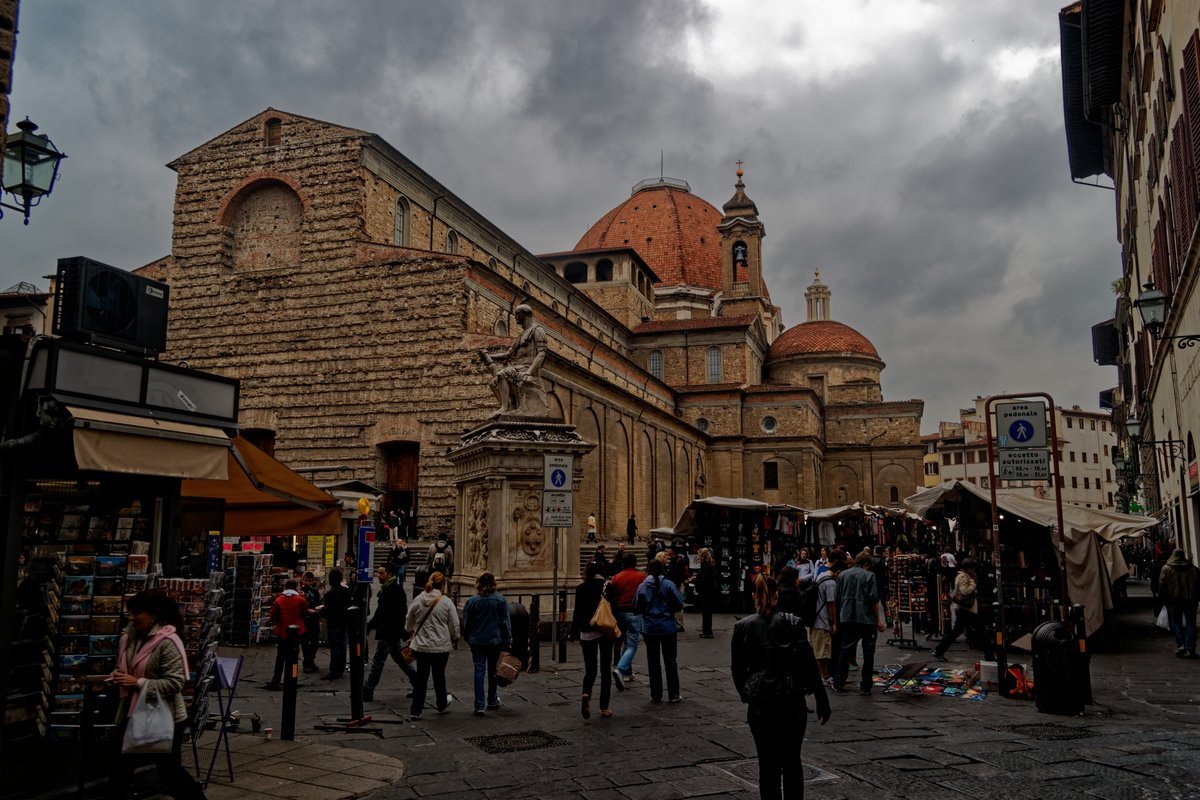 Stepping out of the Basilica of San Lorenzo, you find yourself immersed in the lively bustle of Piazza San Lorenzo. Here, history blends with everyday life: in front of the church’s unfinished façade, a dense souvenir market once stretched out. Since 2014, the city has begun clearing the square to restore breathing space to the architecture, but the atmosphere remains authentic. On the left, the monument to Giovanni delle Bande Nere by Baccio Bandinelli stands out: the condottiero is portrayed seated, an unusual pose that tells the story of a statue moved several times. Around it, noble palaces like Palazzo Lotteringhi della Stufa and Palazzo Inghirlami recount centuries of power. Don’t miss the Laurentian Medicean Library, a masterpiece by Michelangelo, and the Ximenian Observatory, a little-known scientific gem. The square is the perfect place to breathe in the energy of Florence: sit on a step, watch the flow between leather goods stalls and tourists, and imagine the Medici leaving their church. Tip: if you’re hungry, the Central Market is just a step away, with its food shops open until late evening.
- Piazza San Lorenzo, Firenze (FI)
- Open in Google Maps
- View on Google Images
You should go if…
Stop no. 4
Basilica of San Marco: Art, Faith, and Dominican History
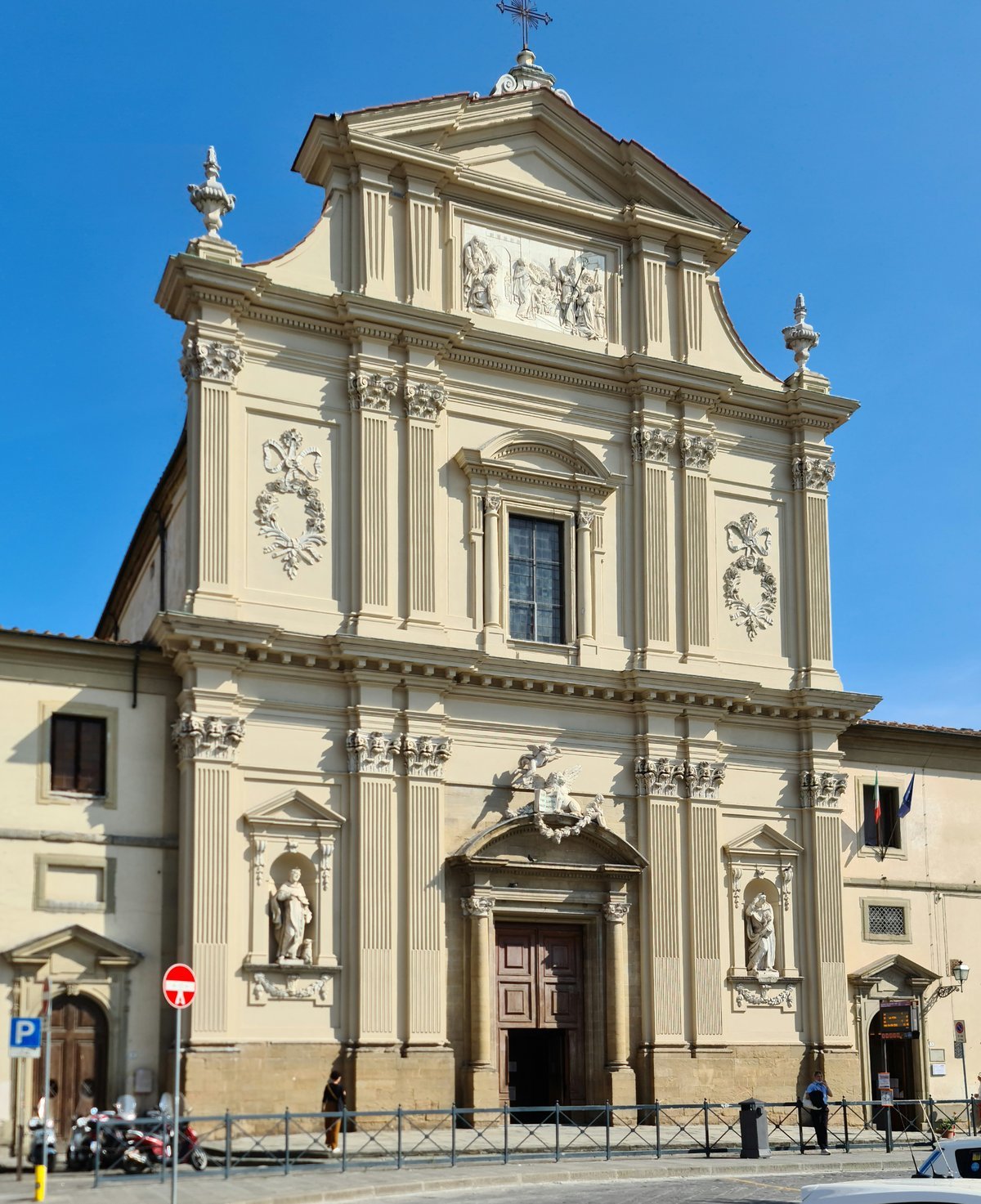 After the chaos of the San Lorenzo market, a stop at the Basilica of San Marco is a true relief. The neoclassical facade, by Fra Giovan Battista Paladini (1777-78), is elegant and discreet, but the single-nave interior houses authentic masterpieces. Here Cosimo the Elder prayed, who commissioned the renovation of the convent in 1437, entrusting it to Michelozzo. Among the side chapels, designed by Giambologna at the end of the 16th century, the altarpiece by Santi di Tito (1593) and the Madonna and Child with Saints by Fra Bartolomeo stand out. Not to be missed is the Crucifix by Fra Angelico on the high altar (1425-28). But the church is also linked to Savonarola: here the Dominican friar preached, and his portrait is preserved. To the side, admire the funerary monuments of Pico della Mirandola and Poliziano, two giants of Humanism. The atmosphere is intimate, far from the tourist crowds: perfect for a moment of silence. Pay attention to opening hours: Mon-Fri 8:15-13:15, Sat 8:15-16:15, Sunday closed (but better to check).
- Piazza San Marco, Firenze (FI)
- Open in Google Maps
- View on Google Images
You should go if…
Stop no. 5
Accademia Gallery: Michelangelo’s David and Masterpieces
 Leaving the quiet of San Marco, you step into one of the world’s most famous museums: the Accademia Gallery. Here, on Via Ricolasi, the centerpiece is undoubtedly Michelangelo’s David, moved here in 1873 to protect it from the elements. The Tribune designed by Emilio De Fabris houses it majestically. But there’s more than just the David: along the way, the unfinished Prigioni (Slaves) reveal Michelangelo’s genius in the ‘non-finito’ technique, and the San Matteo (St. Matthew) adds intensity. The museum also boasts a rich collection of Tuscan painting from the 13th to the 16th century, with works by Giotto, Botticelli, Ghirlandaio, and many others. Don’t miss the Gipsoteca Bartolini (Bartolini Plaster Cast Gallery) and the Museum of Musical Instruments, which features rare pieces like a Stradivari viola. Reservation required to avoid queues; entry is free on the first Sunday of the month. Recommended time: about 1 hour and 30 minutes.
- Go to the page: Accademia Gallery: Michelangelo’s David and Unfinished Prisoners
- Via Ricasoli 58/60, Firenze (FI)
- http://www.galleriaaccademiafirenze.beniculturali.it
- Open in Google Maps
- View on Google Images
You should go if…
Stop no. 6
Palazzo Medici Riccardi: The first Medici palace
 Continuing your itinerary, you find yourself before another gem: Palazzo Medici Riccardi. Commissioned in 1444 by Cosimo the Elder to Michelozzo, it was the Medici residence for almost a century. Here Lorenzo the Magnificent welcomed artists and intellectuals. Leaving the Galleria dell’Accademia, the contrast is sharp: you go from sculpture to historical residence. The inner courtyard, with its columns and garden, is a peaceful corner. But the real masterpiece is the Cappella dei Magi, frescoed by Benozzo Gozzoli in 1459: a cavalcade of historical figures and portraits of the Medici family. On the first floor, the Gallery of Mirrors surprises you with Luca Giordano’s fresco, a Baroque explosion. The museum is open daily from 9 to 7, closed on Wednesdays. Ticket €7 (or €10-15 in high season). The first Sunday of the month free entry for Florence residents. A place that tells four centuries of power and art.
- Go to the page: Medici Riccardi Palace: Benozzo Gozzoli’s Magi Chapel and Renaissance Courtyard
- Via dei Gori, Firenze (FI)
- Open in Google Maps
- View on Google Images
You should go if…
Stop no. 7
Ponte Vecchio
 Here you are at last on the Ponte Vecchio, the most iconic symbol of Florence. Built in 1345 (attributed to Taddeo Gaddi), it is the only bridge in the city to have survived World War II and the terrible flood of 1966. Its three low arches are a masterpiece of medieval engineering. As you walk, you’ll immediately notice the characteristic goldsmith shops: here, since 1593, jewelers replaced the ancient butchers by order of the Medici. Above the shops runs the Vasari Corridor, built in 1565 by Giorgio Vasari to connect Palazzo Vecchio to Palazzo Pitti. Stop at the center of the bridge: you’ll find the bust of Benvenuto Cellini, a famous 16th-century goldsmith, and from there enjoy the breathtaking view of the Arno and the hill of San Miniato. In the evening, when the shutters are lowered and the lights come on, the atmosphere becomes almost magical. The bridge is always open and free – ideal for a romantic stroll or browsing through shop windows of handmade rings and necklaces.
- Go to the page: Ponte Vecchio: Historic Jewelry and the Vasari Corridor over the Arno River
- Lungarno degli Acciaioli, Firenze (FI)
- Open in Google Maps
- View on Google Images
You should go if…
Stop no. 8
Basilica of Santa Maria del Santo Spirito
 Just a few steps from the Ponte Vecchio, as you venture into the lively Oltrarno district, you’ll find yourself in front of the Basilica of Santo Spirito, one of the less-traveled gems of the Florentine Renaissance. Designed by Filippo Brunelleschi in 1444, the church immediately strikes you with its austere, bare exterior: no marble, just brick and plaster, almost contrasting with the richness inside. Crossing the threshold, you’re amazed by the harmony of the aisles, punctuated by 38 side altars and columns of pietra serena that create a play of light and shadow. The most precious work is Michelangelo’s wooden Crucifix, carved at age 17 as thanks for being allowed to study anatomy on the corpses of the convent’s hospital: you’ll find it in the sacristy. But that’s not all: in the chapels lie masterpieces by Filippino Lippi, Perugino, and many others. The atmosphere is intimate and quiet, far from the crowds of the city center. A small tip: avoid Wednesdays, when it’s closed, and take advantage of early morning to enjoy the light filtering through the oculi of the dome.
- Via dei Coverelli, Firenze (FI)
- Open in Google Maps
- View on Google Images
You should go if…