
If you have just one day to discover Teramo, this walking itinerary offers a dive into history. We start at the Roman Amphitheater, the heart of the ancient city, then immerse ourselves in the Archaeological Museum with artifacts from the Bronze Age to the Middle Ages. We cross elegant squares to the Cathedral, a treasure chest of sacred art, and finish at the Civic Museum, where works by local artists tell the story of the 19th century. A compact yet rich route, perfect for those who love archaeology and art without rushing. Teramo is small, but its historic center is a gem: each stop is just steps apart. Ideal for a 1-day walking itinerary combining art and archaeology in an authentic way.
🗺️ Your trip at a glance
An intense day among Teramo’s treasures: from Roman times to the 20th century. Perfect for those seeking culture without giving up tranquility.
- Ideal for: history, archaeology, and art enthusiasts who want a concentrated dose of beauty in a few hours.
- Highlights: entirely pedestrian route, uncrowded places, cumulative tickets for savings.
- Unique for: the combination of amphitheater, museums, and cathedral within a 500-meter radius, a journey through time at a walking pace.
Itinerary stops
Stop no. 1
Roman Amphitheater
 The first stop is an unexpected dive into the past. Teramo’s Roman Amphitheater, just steps from the cathedral, is a huge brick ellipse rising almost 12 meters from the ground. Built between the 1st and 2nd centuries AD, with a perimeter of 208 meters and an arena that today lies 6 meters below street level, this monument was long buried and mistaken for the nearby theater. It was rediscovered by chance in 1585 by Bishop Giulio Ricci, but only during excavations in 1937 did it reveal its grandeur. Walking along Via Irelli, you see the remains of the ancient perimeter wall, with its arches and radial passages. Too bad that in the Middle Ages it was used as a quarry for the cathedral and that in the 18th century the seminary was built on top: today less than half of the ellipse remains, but just close your eyes for a moment to imagine the murmur of 20,000 spectators. Entrance is free and the site is always open – perfect for starting the day with a striking view.
- Go to the page: Roman Amphitheatre of Teramo: Brick Arches and Underground Galleries from the 1st Century AD
- Via Vincenzo Irelli, Teramo (TE)
- Open in Google Maps
- View on Google Images

You should go if…
Stop no. 2
Roman Theatre of Teramo
 Continuing along Largo Anfiteatro, you find yourself in front of one of Teramo’s most fascinating monuments: the Roman Theatre. Built in the Augustan age, it could seat about 3,000 spectators on travertine steps, with a cavea 78 meters in diameter. For centuries it remained hidden beneath modern buildings, but since 2021 a massive €19 million restoration has been underway to bring it back to light. Today you can see the surviving arches and the eastern part of the stage, while excavations continue to reveal new details, such as the proedria and 16th-century burials. The atmosphere is that of a living archaeological site, where the past slowly re-emerges. Walking here means experiencing the stratification of the city firsthand: beneath your feet, three meters deep, lies ancient Interamnia. An unmissable experience for those who love archaeology in progress.
- Go to the page: Roman Theatre of Teramo: 3,000-seat cavea in the historic heart
- Largo Anfiteatro, Teramo (TE)
- Open in Google Maps
- View on Google Images
You should go if…
Stop no. 3
Francesco Savini Archaeological Museum
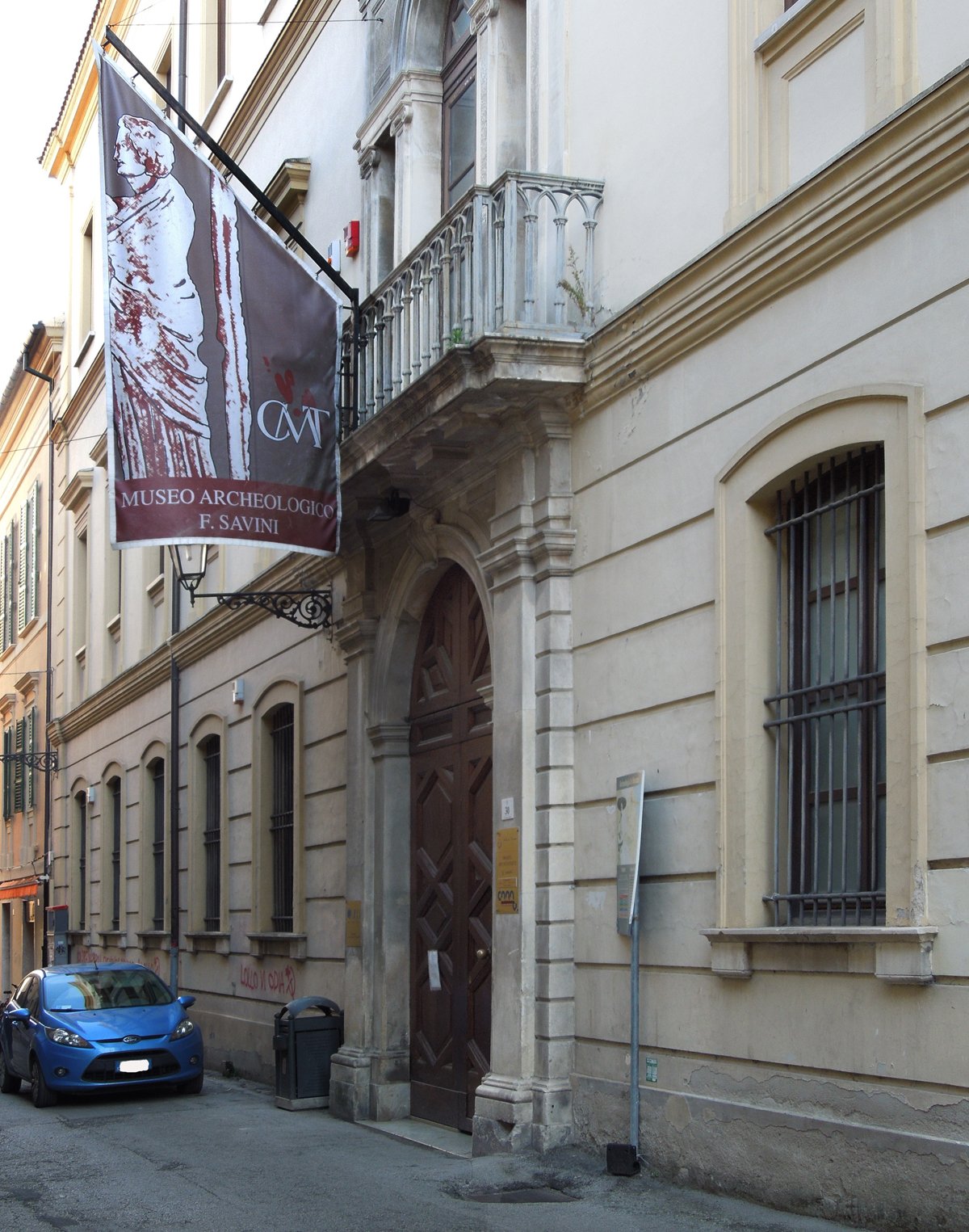 After leaving the Roman theater, you’ll plunge even deeper into history. The Francesco Savini Archaeological Museum, housed in the former courthouse, is a treasure trove of artifacts that tell the story of Teramo from prehistory to the Renaissance. On the ground floor, the finds from Interamnia: the Lion Mosaic and the bust of Septimius Severus are the highlights. Upstairs, you’ll immerse yourself in the territory of the Pretuzi, with ceramics, statues from the nymphaeum of Tortoreto (the muses Calliope, Euterpe, Erato) and a fragment of the blinding of Polyphemus. Unfortunately, the museum is currently closed for restoration after the 2016 earthquake, but it’s worth planning a future visit: it’s truly deserving.
- Via Melchiorre Delfico, Teramo (TE)
- Open in Google Maps
- View on Google Images
You should go if…
Stop no. 4
Palazzo Delfico: Library, History, and Art
 Continuing along Via Delfico, you’ll find yourself in front of another gem: Palazzo Delfico, built between the late 18th and early 19th centuries by the will of brothers Giamberardino and Melchiorre Delfico. Today, after serving as the State Archives for over fifty years, the palace has housed the Melchiorre Delfico Regional Library since 2004. Crossing the entrance with its noble coats of arms, you ascend the double-ramp grand staircase, decorated with plaster statues of Greco-Roman deities. The interior is a true treasure chest: over 300,000 volumes, incunabula, manuscripts, and a picture gallery with works by Abruzzese and national artists. The reading room, created in the former covered courtyard, is a place of silence and beauty. And if you’re passionate about local history, ask for the Delfico collection at the State Archives: it contains an autograph letter by Leopardi and a privilege from Frederick II. A place that smells of knowledge and the past.
- Via Melchiorre Delfico, Teramo (TE)
- Open in Google Maps
- View on Google Images
You should go if…
Stop no. 5
Cathedral Basilica of Santa Maria Assunta and San Berardo
 After a stop at Palazzo Delfico, one of Abruzzo’s most captivating churches awaits you. The Cathedral, built starting in 1158 at the behest of Bishop Guido II, rises on the ruins of the Roman theatre and amphitheatre, whose materials are still visible in the walls. The unique feature? It combines two building bodies: the Guidian nave (Romanesque, 12th century) and the Arcionian nave (Gothic, 14th century), with two facades facing different squares. Step inside and discover the Silver Altarpiece by Nicola da Guardiagrele, a masterpiece of goldsmithing with 35 panels depicting the life of Christ. Don’t miss the polyptych by Jacobello del Fiore and the Baroque Chapel of San Berardo, which holds the relics of the patron saint. As your gaze rises, the 50-meter-high bell tower dominates the city. The atmosphere is intimate, almost mystical. Fun fact: the Cosmatesque portal from 1332 is signed by Deodato di Cosma. A true treasure trove of art and faith, to be visited at a leisurely pace.
- Go to the page: Teramo Cathedral: A Romanesque-Gothic Masterpiece and Silver Altarpiece
- Piazza Ercole Vincenzo Orsini, Teramo (TE)
- Open in Google Maps
- View on Google Images
You should go if…
Stop no. 5
Cathedral Basilica of Santa Maria Assunta and San Berardo
After a stop at Palazzo Delfico, one of Abruzzo’s most captivating churches awaits you. The Cathedral, built starting in 1158 at the behest of Bishop Guido II, rises on the ruins of the Roman theatre and amphitheatre, whose materials are still visible in the walls. The unique feature? It combines two building bodies: the Guidian nave (Romanesque, 12th century) and the Arcionian nave (Gothic, 14th century), with two facades facing different squares. Step inside and discover the Silver Altarpiece by Nicola da Guardiagrele, a masterpiece of goldsmithing with 35 panels depicting the life of Christ. Don’t miss the polyptych by Jacobello del Fiore and the Baroque Chapel of San Berardo, which holds the relics of the patron saint. As your gaze rises, the 50-meter-high bell tower dominates the city. The atmosphere is intimate, almost mystical. Fun fact: the Cosmatesque portal from 1332 is signed by Deodato di Cosma. A true treasure trove of art and faith, to be visited at a leisurely pace.- Go to the page: Teramo Cathedral: Silver Altar Frontal and 14th-Century Frescoes in the Historic Heart
- Piazza Ercole Vincenzo Orsini, Teramo (TE)
- Open in Google Maps
- View on Google Images
You should go if…
Stop no. 6
Civic Museum of Teramo: A Dive into Abruzzese Art
 After the cathedral, I recommend a stroll to the Villa Comunale, where the Civic Museum of Teramo awaits you, housed in a charming neoclassical building from 1923. The collection was born between 1868 and 1888, when altarpieces and treasures arrived from suppressed churches. The 15 rooms take you from the 15th to the 19th century, with a focus on local artists. Don’t miss The Four Seasons by Pasquale Celommi and The Blind Orphan Girl by Raffaello Pagliaccetti, which conveys a unique tenderness. Admission is free, and the young staff is super helpful: every now and then they organize impromptu guided tours. Also, there are audio guides via QR code and bilingual labels. If you get the chance, take a look at the temporary exhibition of ceramics from Castelli: the fragile beauty of the Grue majolica will leave you speechless.
- Go to the page: Teramo Civic Museum: Artifacts of Ancient Interamnia in Palazzo Savini
- Viale Giovanni Bovio, Teramo (TE)
- Open in Google Maps
- View on Google Images
You should go if…

