
Avellino’s historic center reveals itself in a 1-day walking itinerary, perfect for diving into the history and art of Irpinia. The tour starts at Piazza della Libertà, where the majestic Bellerophon Fountain stands, created in 1806 by Francesco Jerace. From here, walk along Corso Vittorio Emanuele to Piazza del Mercato to admire the Clock Tower, built in 1659 and a symbol of civic power. Continue to Avellino Cathedral (Duomo di Santa Maria Assunta), a building of Lombard origin with Baroque interiors and a fine bell tower. The route ends at the War Memorial, a work by Gaetano Chierici, located in the same square. The path is completely flat, lasting about 3 hours, and is suitable for families and visitors of all ages. Don’t forget your camera: each stop offers charming views. To get your bearings, download the official map of the historic center. Useful info: recommended parking at Piazza della Libertà, bars and restaurants along the route for a lunch break. This itinerary is ideal for a cultural weekend or a day trip to discover the beauties of Avellino.
🗺️ Your trip at a glance
In just a few hours, Avellino’s historic center offers a concentrated dose of art and history among fountains, towers, cathedrals, and monuments. A 1-day walking itinerary, simple and engaging, that combines architecture and memory.
- Ideal for: art and history lovers
who want a focused and effortless tour.- Highlights: four iconic stops, flat route, and detailed map
for a complete and organized experience.- For whom: families, couples, and solo travelers
looking for an accessible cultural itinerary.
Itinerary stops
Stop no. 1
Fountain of Bellerophon
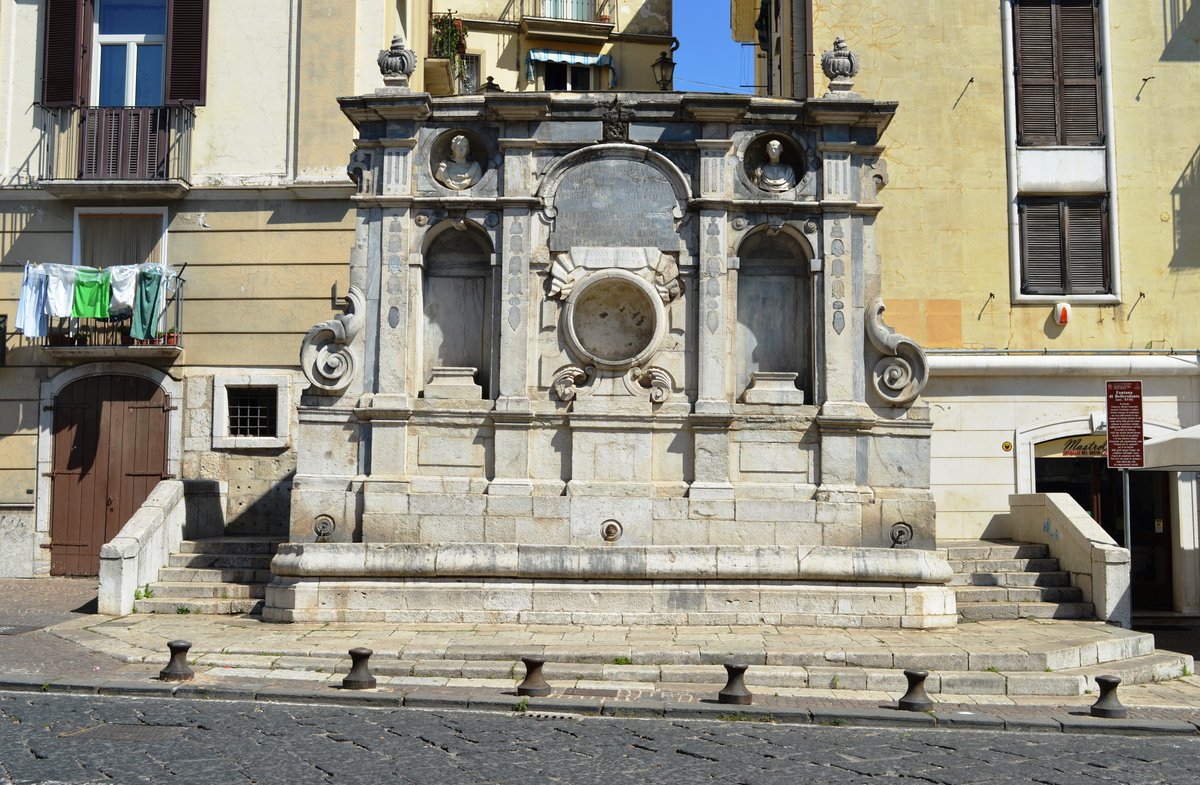 The first stop on our tour of Avellino is the Fountain of Bellerophon, still called ‘fountain of the three spouts’ by locals. It’s here, on Corso Umberto I, that we begin discovering the city. The fountain was commissioned in 1669 by Prince Francesco Marino Caracciolo and entrusted to architect Cosimo Fanzago to embellish an old public watering trough. The water comes from Monte Partenio and flows from three lower spouts – hence the nickname. At the center, a niche once held the statue of Bellerophon slaying the Chimera, but it was stolen after the 1980 earthquake. Today you can still see the busts of a Roman patrician and a matron in the upper niches, and two plaques commemorate the construction and the 1866 restoration. It’s a corner of history blending mythology and noble power, with an old provincial street atmosphere. If you pass by, stop a moment: the water is still very fresh.
- Gradelle alla fontana, Avellino (AV)
- Open in Google Maps
- View on Google Images

You should go if…
Stop no. 2
Clock Tower: Symbol of Rebirth
 You can see the Clock Tower from afar: it dominates Piazza Amendola with its 36 meters of height, a Baroque beacon guiding you through the historic center. Built in the 17th century, perhaps by Cosimo Fanzago, it has a troubled history: the earthquakes of 1688, 1732, and 1805 damaged it, but it was the 1980 quake that nearly destroyed it. Rebuilt with the original stones, today it symbolizes Avellino’s rebirth. As you climb Salita Cosimo Fanzago, notice the rusticated base and three levels: the top houses the bell clock, once used to raise the alarm. Too bad the chimes have been silent for a while—residents hope for restoration. Stop for a moment: from here, your gaze takes in the whole city, a perfect spot to orient yourself before heading to the Cathedral.
- Salita Cosimo Fanzago, Avellino (AV)
- Open in Google Maps
- View on Google Images
You should go if…
Stop no. 3
Cathedral of Santa Maria Assunta
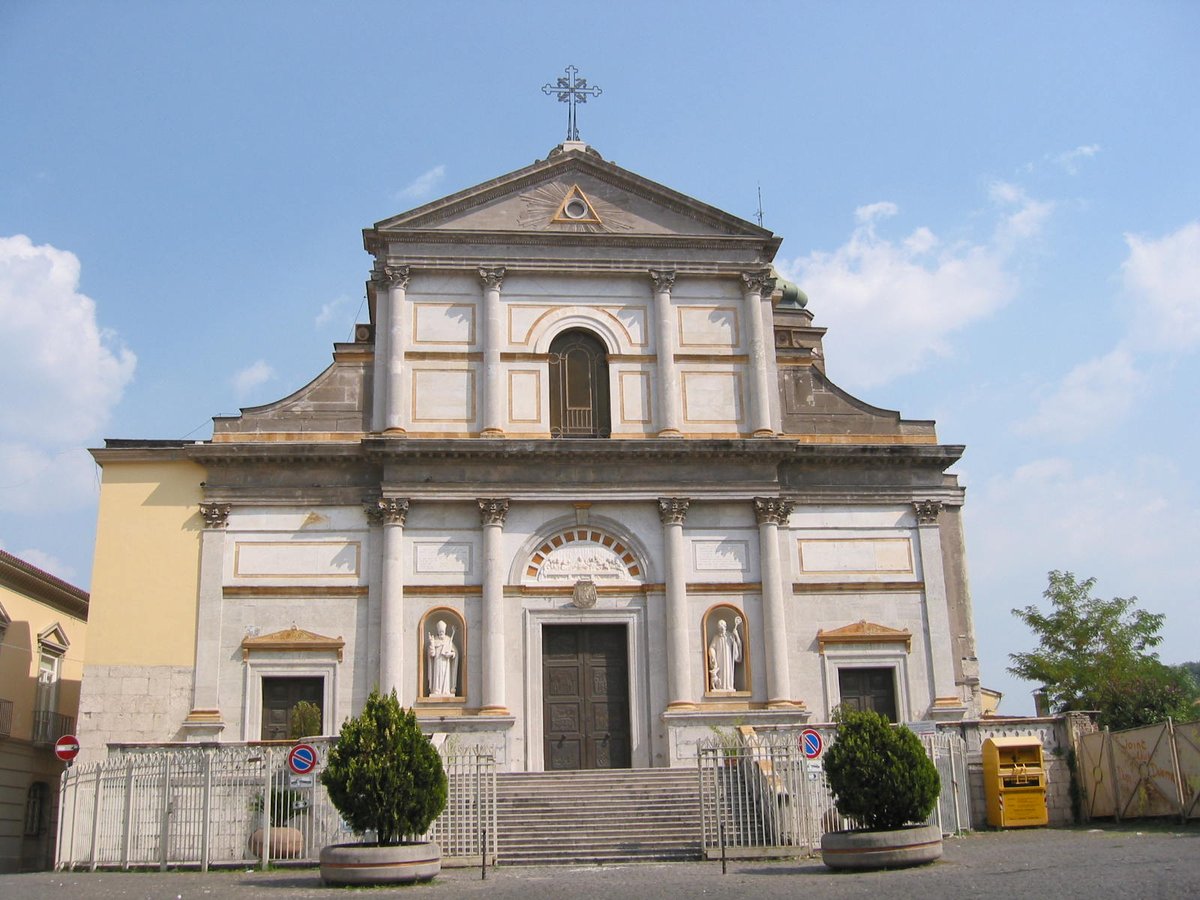 From the Clock Tower, in just a few minutes you’ll reach the Cathedral, which dominates the hill of Terra. Its Neoclassical appearance hides a history spanning nearly a millennium: built starting in 1132 in Romanesque style, it was repeatedly transformed after earthquakes and wars. The current facade in white and gray marble, the work of Pasquale Cardola (1860), is a triumph of elegance. Step inside and be amazed: the coffered ceiling with the Assumption by Michele Ricciardi, the ten chapels with works from the 16th to the 19th centuries, the reliquary of the Sacred Thorn donated by Charles I of Anjou. Don’t miss the Romanesque crypt, the oldest part, with paleo-Christian capitals and bishop burials. Here, in 1166, the relics of the patron saints Modestinus, Florentinus, and Flavianus were found. The Cathedral is alive: every February 14th, San Modestino is celebrated, and on August 15th, the procession of the Assumption winds through the city center.
- Via Sette Dolori, Avellino (AV)
- Open in Google Maps
- View on Google Images
You should go if…
Stop no. 4
War Memorial: Memory of War
 End your walk at the War Memorial in Largo De Luca. Here, a 6.3-meter column of cipollino marble stands on a base of Vesuvian stone. Inaugurated on June 10, 1943, it replaced the previous bronze monument that was melted down for the war effort. On the facade, a bas-relief in Carrara marble depicts the Winged Victory embracing a Roman soldier and an Italian infantryman. On the sides are laurel wreaths. The plaque reads: ‘TO THE FELLOW CITIZENS WHO FELL IN THE GREAT WAR TO RESTORE THE JUST BORDER TO THE HOMELAND’. The monument was restored in 2018 and is now in excellent condition. Every November 4, a ceremony is held with a wreath laying. It is a place for reflection, just steps from the bustling center.
- Via Francesco De Sanctis, Avellino (AV)
- Open in Google Maps
- View on Google Images
You should go if…

