Introduction
If you’re looking for a breathtaking dive into history, the Scolacium Archaeological Park is the right place. Nestled in the greenery of the Costa degli Aranci in Roccelletta di Borgia, this site offers a journey through time: from the remains of Greek Skylletion to Roman Scolacium, up to the imposing Norman basilica. The first thing you notice is the silence, broken only by the rustling of plants and your own awe. The amphitheater, unique in Calabria, makes you imagine gladiators fighting, while the theater invites you to sit on the ancient steps. And then there’s the forum, with its bricks telling centuries of life. A place you wouldn’t expect, but that stays in your heart.
Introduction
If you’re looking for a breathtaking dive into history, the Scolacium Archaeological Park is the right place. Nestled in the greenery of the Costa degli Aranci in Roccelletta di Borgia, this site offers a journey through time: from the remains of Greek Skylletion to Roman Scolacium, up to the imposing Norman basilica. The first thing you notice is the silence, broken only by the rustling of plants and your own awe. The amphitheater, unique in Calabria, makes you imagine gladiators fighting, while the theater invites you to sit on the ancient steps. And then there’s the forum, with its bricks telling centuries of life. A place you wouldn’t expect, but that stays in your heart.
Historical Notes
The history of Scolacium is long and fascinating. Founded by the Greeks as
Skylletion in the 6th century BC, the city became a Roman colony in 123–122 BC at the behest of Gaius Gracchus, under the name
Minervia Scolacium. Its greatest splendor came under Emperor Nerva, who refounded it around 96 AD, enriching it with monuments such as the theater and amphitheater. Life continued until the 7th–8th centuries, when flooding drove the inhabitants toward Squillace. Later, in the Norman period, the majestic basilica of Santa Maria della Roccella arose, never completed due to an earthquake. Today, walking among these ruins is like leafing through the pages of an ancient book, with each layer telling a different chapter.
- 6th century BC – Greek foundation of Skylletion
- 123–122 BC – Roman colony of Minervia Scolacium
- 96 AD – Refoundation by Nerva
- 7th–8th century – Abandonment due to flooding
- 12th–13th century – Construction of the Norman basilica
Historical Notes
The history of Scolacium is long and fascinating. Founded by the Greeks as
Skylletion in the 6th century BC, the city became a Roman colony in 123–122 BC at the behest of Gaius Gracchus, under the name
Minervia Scolacium. Its greatest splendor came under Emperor Nerva, who refounded it around 96 AD, enriching it with monuments such as the theater and amphitheater. Life continued until the 7th–8th centuries, when flooding drove the inhabitants toward Squillace. Later, in the Norman period, the majestic basilica of Santa Maria della Roccella arose, never completed due to an earthquake. Today, walking among these ruins is like leafing through the pages of an ancient book, with each layer telling a different chapter.
- 6th century BC – Greek foundation of Skylletion
- 123–122 BC – Roman colony of Minervia Scolacium
- 96 AD – Refoundation by Nerva
- 7th–8th century – Abandonment due to flooding
- 12th–13th century – Construction of the Norman basilica
Theater and Amphitheater: Roman Gems
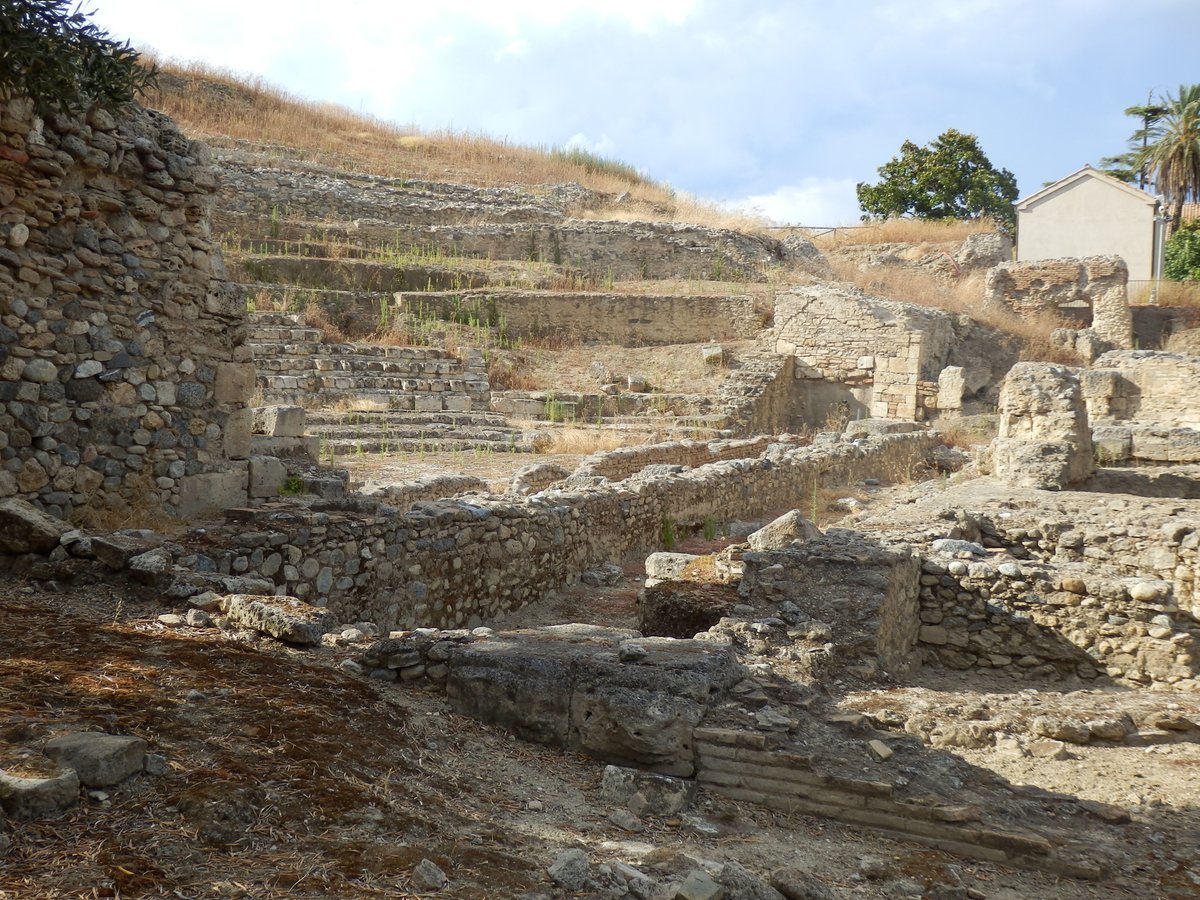
Two monuments will leave you breathless: the theater and the amphitheater. Built in the 1st century BC, the theater takes advantage of the natural slope of the hill and could host up to 3,500 spectators. The terraces are still clearly visible, and from the top you can enjoy a spectacular view of the Gulf of Squillace. Tragedies and comedies were performed here, and in summer it still hosts shows for the Armonie d’Arte festival. A short distance away, the amphitheater is the only Roman example in all of Calabria: an elliptical arena where gladiators fought, with an estimated capacity of 9,000 to 12,000 people. It has never been fully excavated, but its size is impressive. Both tell the story of Scolacium’s grandeur and its role as a cultural center.
Theater and Amphitheater: Roman Gems
Two monuments will leave you breathless: the theater and the amphitheater. Built in the 1st century BC, the theater takes advantage of the natural slope of the hill and could host up to 3,500 spectators. The terraces are still clearly visible, and from the top you can enjoy a spectacular view of the Gulf of Squillace. Tragedies and comedies were performed here, and in summer it still hosts shows for the Armonie d’Arte festival. A short distance away, the amphitheater is the only Roman example in all of Calabria: an elliptical arena where gladiators fought, with an estimated capacity of 9,000 to 12,000 people. It has never been fully excavated, but its size is impressive. Both tell the story of Scolacium’s grandeur and its role as a cultural center.
The Norman Basilica and the Museum
At the entrance to the park, the Roccelletta (Abbey of Santa Maria della Roccella) dominates the scene—a Norman church from the 12th-13th century in red brick, never completed. Its powerful walls and tripartite apse evoke a past of power and faith. Inside, empty, a solemn atmosphere pervades. Moving on, the archaeological museum houses finds from the excavations: vases, coins, mosaics, and an incredible colossal bronze forearm (likely from a giant statue), discovered in 1910 by Paolo Orsi. There is also an olive mill belonging to Baron Mazza, with its old granite millstones, adding a touch of industrial archaeology. A journey that blends eras and styles, offering surprises at every step.
The Norman Basilica and the Museum
At the entrance to the park, the Roccelletta (Abbey of Santa Maria della Roccella) dominates the scene—a Norman church from the 12th-13th century in red brick, never completed. Its powerful walls and tripartite apse evoke a past of power and faith. Inside, empty, a solemn atmosphere pervades. Moving on, the archaeological museum houses finds from the excavations: vases, coins, mosaics, and an incredible colossal bronze forearm (likely from a giant statue), discovered in 1910 by Paolo Orsi. There is also an olive mill belonging to Baron Mazza, with its old granite millstones, adding a touch of industrial archaeology. A journey that blends eras and styles, offering surprises at every step.
Why Visit It
Three good reasons not to miss Scolacium. First: it’s unique. The amphitheater is the only one in Calabria, and the theater is among the best-preserved in the region—a concentration of history you won’t find anywhere else. Second: the price is affordable. For just €5 (and €2 reduced for young people), you can explore the whole park and visit the museum, a bargain for archaeology enthusiasts. Third: the atmosphere is magical. Not too crowded (except during summer events), it lets you explore at your own pace, enjoying the silence and the sea view. Plus, in the summer there are theatrical performances and contemporary art exhibitions that make the experience even more vibrant.
Why Visit It
Three good reasons not to miss Scolacium. First: it’s unique. The amphitheater is the only one in Calabria, and the theater is among the best-preserved in the region—a concentration of history you won’t find anywhere else. Second: the price is affordable. For just €5 (and €2 reduced for young people), you can explore the whole park and visit the museum, a bargain for archaeology enthusiasts. Third: the atmosphere is magical. Not too crowded (except during summer events), it lets you explore at your own pace, enjoying the silence and the sea view. Plus, in the summer there are theatrical performances and contemporary art exhibitions that make the experience even more vibrant.
When to Go
The best time? For me, it’s the late afternoon in spring or early autumn. The low light caresses the red bricks of the basilica and the theater steps, creating long shadows that make everything look even more ancient. Plus, the park closes early (around 4:30 PM or 6:00 PM depending on the season), so arriving around 2:00 PM gives you time for a quiet visit. If you can, avoid the weekend: during the week there are fewer people and you feel almost like a solitary explorer. In summer, instead, the atmosphere changes with evening events: the theater lights up and history comes alive under the stars. Choose according to your mood.
When to Go
The best time? For me, it’s the late afternoon in spring or early autumn. The low light caresses the red bricks of the basilica and the theater steps, creating long shadows that make everything look even more ancient. Plus, the park closes early (around 4:30 PM or 6:00 PM depending on the season), so arriving around 2:00 PM gives you time for a quiet visit. If you can, avoid the weekend: during the week there are fewer people and you feel almost like a solitary explorer. In summer, instead, the atmosphere changes with evening events: the theater lights up and history comes alive under the stars. Choose according to your mood.
Nearby
After your visit, take a stroll along Roccelletta Beach, just a short walk from the park. Golden sand and clear waters: perfect for a refreshing dip (in summer) or a relaxing walk (in the off-season). If you’re still in the mood for history, head to Squillace, a medieval village perched a few kilometers away. Here you can visit the Norman castle and the horse museum, or get lost in the alleys of the old town. And for foodies, try the ‘nduja from Spilinga or Calabrian cured meats at local restaurants. A perfect blend of archaeology, sea, and authentic flavors.
Nearby
After your visit, take a stroll along Roccelletta Beach, just a short walk from the park. Golden sand and clear waters: perfect for a refreshing dip (in summer) or a relaxing walk (in the off-season). If you’re still in the mood for history, head to Squillace, a medieval village perched a few kilometers away. Here you can visit the Norman castle and the horse museum, or get lost in the alleys of the old town. And for foodies, try the ‘nduja from Spilinga or Calabrian cured meats at local restaurants. A perfect blend of archaeology, sea, and authentic flavors.