Lecce in a day? Yes, it’s possible. This walking itinerary takes you from the Roman heart of the city to its Baroque splendor, passing through unmissable monuments. Start at the Roman Amphitheater, symbol of ancient Lupiae, then proceed to the Castle of Charles V, a Renaissance fortress. The Basilica of Santa Croce will leave you breathless with its Baroque facade. Continue to the Roman Theatre, the MUST for local history, and end at Porta Napoli. A compact but rich route, ideal for those with little time who want to savor the essence of Lecce. Each stop is just a few steps from the next, so you can enjoy the city without rushing. Don’t forget to taste a pasticciotto leccese along the way. This itinerary is perfect for an authentic taste of the historic center, between history and Baroque art.
🗺️ Your trip at a glance
From Roman Lupiae to dazzling Baroque, this route lets you experience Lecce in a few hours. A concentrated but complete experience, perfect for those with one day available.
- Ideal for: travelers passionate about history and Baroque architecture who want a compact walking tour
- Highlights: walking itinerary with no wasted time, total immersion in Lecce’s Baroque, essential stops from Roman to Renaissance
- For whom: city-breakers and cultural explorers with little time but a lot of desire to discover
Itinerary stops
Stop no. 1
Roman Amphitheater: The Roman Heart of Lecce
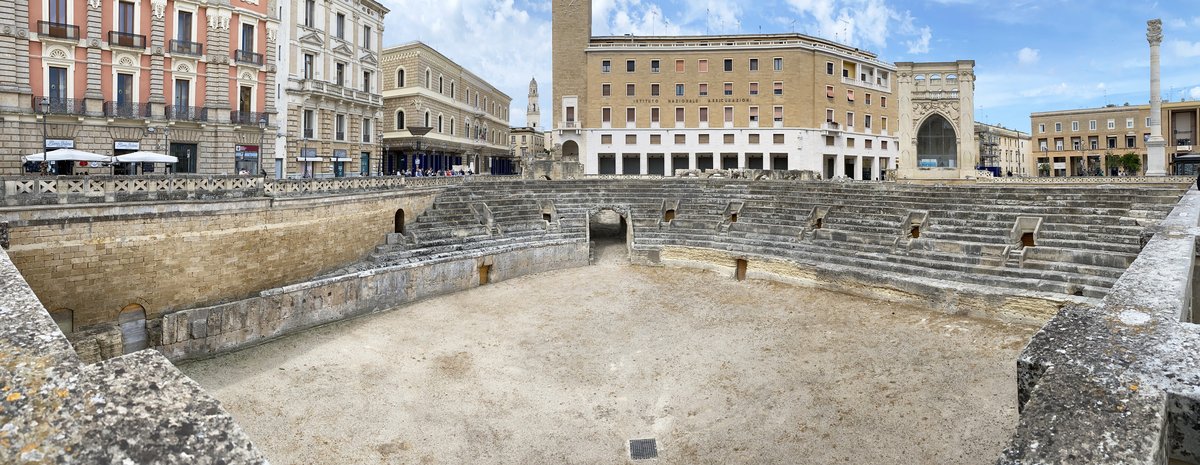 We begin the itinerary right here, in Piazza Sant’Oronzo, where the Roman Amphitheater emerges like a fossil in the heart of the city. Built in the Augustan age and remodeled under Hadrian, it could hold up to 25,000 spectators – a number that underscores the importance of Lupiae. Today only a third of the structure is visible; the rest lies beneath the square and the Church of Santa Maria delle Grazie. Discovered by chance in 1900 during work on the Bank of Italy, the amphitheater was brought to light thanks to archaeologist Cosimo De Giorgi. After a major restoration in 2023, visitors can now also explore the median ambulacrum, the annular corridor that once ran beneath the seating. The elliptical arena (53 x 34 m) is still used for summer shows. Tickets cost €5 (concessions €2), open daily from 10 am to 5 pm. Entering and imagining the gladiator combats or exotic animal hunts – an experience that catapults you straight into ancient Rome.
- Go to the page: Roman Amphitheatre of Lecce: History and Visitor’s Guide
- Piazza Sant’Oronzo, Lecce (LE)
- Open in Google Maps
- View on Google Images

You should go if…
Stop no. 1
Roman Amphitheater: The Roman Heart of Lecce
We begin the itinerary right here, in Piazza Sant’Oronzo, where the Roman Amphitheater emerges like a fossil in the heart of the city. Built in the Augustan age and remodeled under Hadrian, it could hold up to 25,000 spectators – a number that underscores the importance of Lupiae. Today only a third of the structure is visible; the rest lies beneath the square and the Church of Santa Maria delle Grazie. Discovered by chance in 1900 during work on the Bank of Italy, the amphitheater was brought to light thanks to archaeologist Cosimo De Giorgi. After a major restoration in 2023, visitors can now also explore the median ambulacrum, the annular corridor that once ran beneath the seating. The elliptical arena (53 x 34 m) is still used for summer shows. Tickets cost €5 (concessions €2), open daily from 10 am to 5 pm. Entering and imagining the gladiator combats or exotic animal hunts – an experience that catapults you straight into ancient Rome.- Go to the page: Roman Amphitheatre of Lecce: 1st-Century Arena with 25,000 Seats in the Baroque Heart
- Piazza Sant’Oronzo, Lecce (LE)
- Open in Google Maps
- View on Google Images
You should go if…
Stop no. 2
Charles V Castle: The Imperial Fortress
 After the Roman Amphitheater, you move a few steps and find yourself before the imposing bulk of the Charles V Castle. It is the largest castle in Apulia – a full 13,000 square meters – and its history will surprise you. Commissioned by the emperor in 1539 to defend the coast from the Turks, it was designed by Gian Giacomo dell’Acaya over a Norman core from the 12th century. Walking in the courtyard, notice the four lanceolate bastions (Santa Croce, San Martino, San Giacomo, Santissima Trinità) and the Torre Magistra, a witness to the medieval past. Inside, don’t miss the Sala di Maria d’Enghien with its barrel vault, and go down to the underground: here were the prisons (ironically, dell’Acaya himself died there for debts) and a large cistern. Today the castle houses the Museo della Cartapesta (Papier-Mâché Museum) and temporary exhibitions, but a guided tour is a must to access the rooms. Tip: book the tour at 10:00 or 11:00 – it lasts about an hour and includes the ramparts, from which you can enjoy a lovely view of the city.
- Viale Francesco Lo Re, Lecce (LE)
- http://www.castellocarlov.it/
- Open in Google Maps
- View on Google Images
You should go if…
Stop no. 3
Basilica of Santa Croce: The Triumph of Lecce Baroque
 Leaving the Castle of Charles V, you slip into a maze of alleys and emerge before something completely different: the Basilica of Santa Croce. Here, Lecce Baroque reaches its peak. The façade is an explosion of symbols: below, grotesque telamons and fantastic animals represent the pagan world and the Turks defeated at Lepanto; above, thirteen joyous putti display tiara and crown, symbol of the alliance between Church and temporal power. At the center, the rose window from 1646 is a masterpiece of vegetal intertwining. The Latin cross interior surprises you with its harmony: a gilded coffered ceiling, a decorated dome, and a remarkable sixteen Baroque altars. Don’t miss the Altar of Saint Francis of Paola, a masterpiece by Francesco Antonio Zimbalo with 12 reliefs recounting miracles. Little secret: look for Cesare Penna’s self-portrait hidden among the leaves to the left of the rose window. The basilica also houses a relic of the True Cross. It’s a place that leaves you speechless, a true triumph of Lecce stone.
- Go to the page: Basilica of Santa Croce: the masterpiece of Lecce Baroque
- Vico della Saponea, Lecce (LE)
- Open in Google Maps
- View on Google Images
You should go if…
Stop no. 3
Basilica of Santa Croce: The Triumph of Lecce Baroque
Leaving the Castle of Charles V, you slip into a maze of alleys and emerge before something completely different: the Basilica of Santa Croce. Here, Lecce Baroque reaches its peak. The façade is an explosion of symbols: below, grotesque telamons and fantastic animals represent the pagan world and the Turks defeated at Lepanto; above, thirteen joyous putti display tiara and crown, symbol of the alliance between Church and temporal power. At the center, the rose window from 1646 is a masterpiece of vegetal intertwining. The Latin cross interior surprises you with its harmony: a gilded coffered ceiling, a decorated dome, and a remarkable sixteen Baroque altars. Don’t miss the Altar of Saint Francis of Paola, a masterpiece by Francesco Antonio Zimbalo with 12 reliefs recounting miracles. Little secret: look for Cesare Penna’s self-portrait hidden among the leaves to the left of the rose window. The basilica also houses a relic of the True Cross. It’s a place that leaves you speechless, a true triumph of Lecce stone.- Go to the page: Basilica of Santa Croce: Baroque facade with whales, dragons and symbols in Lecce
- Vico della Saponea, Lecce (LE)
- Open in Google Maps
- View on Google Images
You should go if…
Stop no. 4
Roman Theatre of Lecce
 After the Baroque splendor of Santa Croce, you dive into more ancient history. The Roman Theatre, discovered in 1929 during work in the gardens of Palazzo D’Arpe, is a fundamental piece of Roman Lupiae. It dates back to the Augustan age and could host about 5,000 spectators, who watched tragedies and comedies. The cavea, with an external diameter of 40 meters, is carved into the rock and faced with square stones, divided into six wedges of twelve rows each. The orchestra, paved with white limestone slabs, was reserved for dignitaries. Of the stage (7.70 m deep and 30 m wide) only fragments remain, but at the Museum of the Roman Theatre (via degli Ammirati) you can see artifacts and a model of Lupiae. Today the theatre can be visited externally, but during summer performances it comes back to life. A place that lets you breathe the atmosphere of ancient Rome, hidden among the Baroque alleys.
- Go to the page: Roman Theatre of Lecce: History and Augustan Architecture
- Via del Teatro Romano, Lecce (LE)
- Open in Google Maps
- View on Google Images
You should go if…
Stop no. 4
Roman Theatre of Lecce
After the Baroque splendor of Santa Croce, you dive into more ancient history. The Roman Theatre, discovered in 1929 during work in the gardens of Palazzo D’Arpe, is a fundamental piece of Roman Lupiae. It dates back to the Augustan age and could host about 5,000 spectators, who watched tragedies and comedies. The cavea, with an external diameter of 40 meters, is carved into the rock and faced with square stones, divided into six wedges of twelve rows each. The orchestra, paved with white limestone slabs, was reserved for dignitaries. Of the stage (7.70 m deep and 30 m wide) only fragments remain, but at the Museum of the Roman Theatre (via degli Ammirati) you can see artifacts and a model of Lupiae. Today the theatre can be visited externally, but during summer performances it comes back to life. A place that lets you breathe the atmosphere of ancient Rome, hidden among the Baroque alleys.- Go to the page: Roman Theater of Lecce: Underground 1st-2nd Century Theater with 5,000 Seats
- Via del Teatro Romano, Lecce (LE)
- Open in Google Maps
- View on Google Images
You should go if…
Stop no. 5
MUST: The Museum That Tells the Story of Lecce
 From the Roman Theatre, just a few steps away lies the MUST – Historical Museum of the City of Lecce, housed in the former Monastery of Santa Chiara, founded in the 15th century. As you enter, the white of the lime and the gold of Lecce stone envelop you: a blend that already promises beauty. The exhibition path is a journey through the history of Lecce, from prehistory to the 20th century. Don’t miss the ‘The Leccio and the She-Wolf’ section, with Messapian and Roman artifacts (including pieces from the Amphitheatre and Theatre), and the Cosimo Carlucci Gallery, featuring sculptures by the Salento artist. The multimedia room allows you to explore in 3D the facade of Santa Croce and other monuments: a technological gem that helps you visualize what the ancient city looked like. The museum is open Tuesday to Sunday (full ticket €5.50, reduced €3.50, free for under 10s). Take your time: between temporary exhibitions, a bookshop, and a café in the cloister, you can truly breathe the soul of Lecce.
- Via degli Ammirati 11, Lecce (LE)
- http://www.mustlecce.it/
- Open in Google Maps
- View on Google Images
You should go if…
Stop no. 6
Porta Napoli: The Triumphal Entrance
 The last stop on the tour, but not least in importance: Porta Napoli welcomes you with its imposing mass, almost 20 meters high. Built in 1548 to a design by Gian Giacomo dell’Acaya, it is a triumphal arch in honor of Charles V. You pause to observe the details: the Corinthian columns, the Habsburg coat of arms with the double-headed eagle, and the Latin inscription celebrating the emperor as “exterminator of the Turks”. Right here, once upon a time, you would exit toward Naples. The structure, freed from its lateral walls in the 19th century, now stands alone, flanked by the obelisk from 1822 dedicated to Ferdinand I of Bourbon. If you look below, you will see traces of excavations that unearthed Messapian walls from the 4th century BC: a striking contrast between eras. Porta Napoli is the symbol of Lecce’s connection to its history, a mix of power, defense, and Baroque beauty. From here, the historic center bids you farewell and invites you to retrace it with fresh eyes.
- Piazza Angelo Rizzo, Lecce (LE)
- Open in Google Maps
- View on Google Images
You should go if…