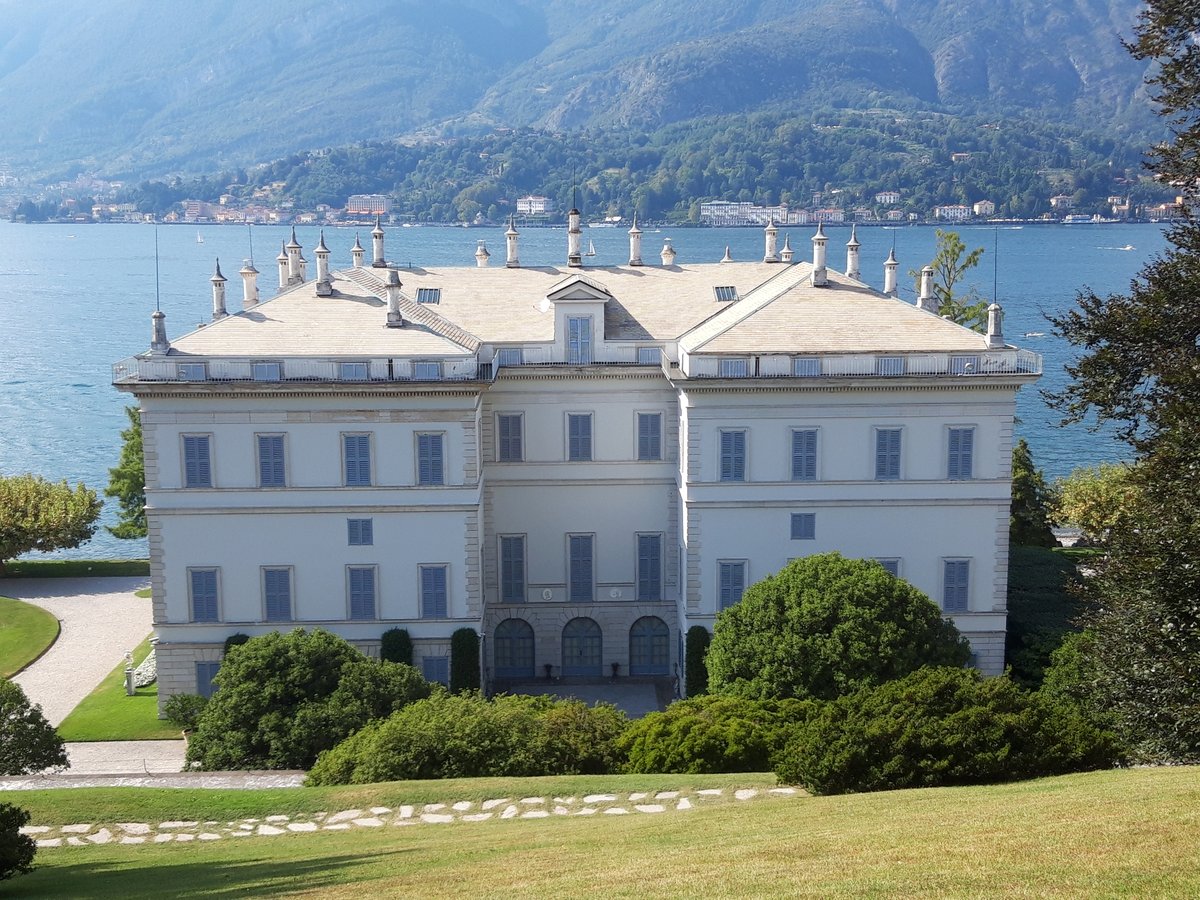
Villa Melzi d’Eril in Bellagio is a neoclassical complex built between 1808 and 1810 for Francesco Melzi d’Eril, with English-style gardens, an orangery-museum and a chapel. The villa’s interior is not open to visitors, but the park overlooking Lake Como can be explored in 1.5–2 hours. It can be reached by boat from Como or by car along the SS583.
• English-style gardens with camellias, azaleas, rhododendrons and rare plants.
• Avenue of the Plane Trees and a Moorish kiosk on the lake.
• Orangery-museum with Napoleonic relics and archaeological collections.
• Family chapel in the hamlet of Loppia.
Introduction: Villa Melzi d’Eril on Lake Como
You arrive in Bellagio, and once past the centre, the lakeside promenade leads you straight to Villa Melzi d’Eril: a neoclassical complex that seems to slip into the water. The villa itself, still a private residence and closed to the public, can only be admired from the outside, with its double-ramp staircase and four Egyptian-style lions. But the reason the trip is worthwhile is what surrounds it: English-style gardens with winding paths, lawns, groves and scattered sculptures, an oriental garden with a water-lily pond, the orangery turned into a museum, and the family chapel at the end of the park. This is not the usual tidy Italian garden: everything here is soft, shaded, designed for walking slowly. Meanwhile, the lake does the rest: every view has Monte San Primo or the Grigne in the background. Bring comfortable shoes and a little time: the visit takes about 1.5–2 hours.
Historical background
The villa was born of the vision of
Francesco Melzi d’Eril, Duke of Lodi and vice-president of the Napoleonic Italian Republic, who in 1808 entrusted the project to architect
Giocondo Albertolli. Construction was completed around 1810, while the interiors became habitable in 1813; the park came later, designed by Luigi Canonica and botanist Luigi Villoresi. When the duke died in 1816, his nephew Giovanni Francesco inherited it and completed the chapel; then it passed to Lodovico and, through his second marriage to Joséphine Barbò, the estate passed to the Gallarati Scotti family, who still care for it. In the 1970s, Lodovico Gallarati Scotti opened everything to the public and created the museum in the orangery, which was redesigned in 2021.
- 1808: Francesco Melzi d’Eril commissions Albertolli to design the villa.
- 1810: construction completed; interiors habitable from 1813.
- 1815: the English garden is created.
- 1816: on the duke’s death, his nephew Giovanni Francesco inherits.
- 1837: Franz Liszt stays here with Marie d’Agoult.
- 1970: the villa and gardens open to the public.
- 2021: the redesigned museum reopens.
The English-Style Gardens: From the Plane Tree Avenue to the Oriental Garden
The park is the first example of an English-style garden on Lake Como, and you can feel it: winding paths, changes in level created on purpose to open up the view, lawns and small woods. You start from the plane tree avenue, pruned into umbrella shapes, which runs alongside the lake. Here you come across the Moorish kiosk, white and light blue, jutting out over the water, with the busts of Ferdinand I and Marianna of Savoy. A little farther on is the Egyptian statue of the goddess Pacht, next to a specimen of Pinus montezuma, and other sculptures brought back from the Egyptian campaign. At the entrance, by contrast, is the most zen corner: the oriental garden, with a lily pond, Japanese maples, little bridges, gravel and an artificial grotto with a fake ruin signed by Canonica. Among the centuries-old trees you can recognize cedars of Lebanon, sequoias and ginkgo biloba. In spring it is the camellias, azaleas and giant rhododendrons that steal the scene.
Orangery Museum and Family Chapel
The former orangery is now the Lodovico Gallarati Scotti Museum, on two floors accessible from the garden. Upstairs, the Art, History, Nature section tells the story of the founder, the construction of the villa, the artists involved, and lakeside holidays; downstairs, the Antiquarium displays Roman, Greek and Etruscan artefacts, Chinese and Japanese ceramics, and Art Deco works. The highlight is the Querini collection, acquired by the duke around 1830, with the lioness goddess Sekhmet, a marine Venus, and a Greek funerary dancer from the 4th century BC. The upper section also contains Napoleonic relics: Napoleon’s bust, the keys of Milan, and the 1796 cannons. At the southern end of the garden, at Loppia, is Albertolli’s neoclassical family chapel: stuccoes and frescoes by Angelo Monticelli, Comolli’s Christ the Redeemer, and the funerary monuments of the Melzi d’Eril and Gallarati Scotti families.
Why visit it
First: few gardens on Lake Como let you walk right at the water’s edge like this one, with its row of plane trees and Moorish kiosk that seem to float. Second: the ticket is affordable and includes gardens, museum and chapel, three different things in a single stroll, from archaeological excavations to Napoleonic relics. Third: it is a place with a precise history, not a postcard. Stendhal, Percy and Mary Shelley, and Franz Liszt all passed through here; in the autumn of 1837 Liszt spent happy moments here and found inspiration for his Dante Sonata in front of the marble group of Dante and Beatrice. I’ll add a practical reason: the villa’s interiors are private, so don’t expect frescoed rooms, but what remains open is more than enough. Accessibility: easy, well-kept paths with a few gentle slopes; it’s best to ask for up-to-date information for wheelchair users.
When to Go
If you can choose, aim for April and May: azaleas, rhododendrons, and camellias are in full bloom, and the lawns look like paintings. The alternative I prefer is early autumn: mild weather, fewer crowds, and the turning leaves of the maples in the oriental garden. Summer is green and shaded, but Bellagio fills up and parking becomes tricky: if you come in high season, move early. As for the time of day, the light of late afternoon is the most flattering: the lake grows calm, the row of plane trees casts long shadows, and the Moorish kiosk lights up. Early morning, on the other hand, has the advantage of walking almost alone, with the sound of water and few visitors around.
In the Surroundings
Once you’ve finished the tour, it’s worth staying in Bellagio. From the historic center, the Salita Serbelloni climbs up—a narrow stairway between shops and colorful houses that leads to the viewpoint: it’s the postcard image of the village. On the other side, Punta Spartivento closes the peninsula with an open view over the two branches of the lake, with the gardens of Villa Serbelloni behind it. If you have time, take the ferry across: in Tremezzo are the gardens of Villa Carlotta, another Lake Como classic, with its collection of statues and blooming rhododendrons. Two villas, two styles, two ways of looking at the same lake, all in a single day.