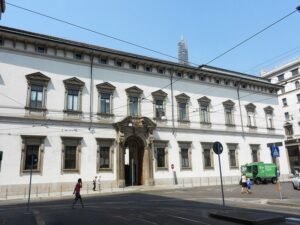
Palazzo Melzi di Cusano: A Neoclassical Discovery on Via Montenapoleone
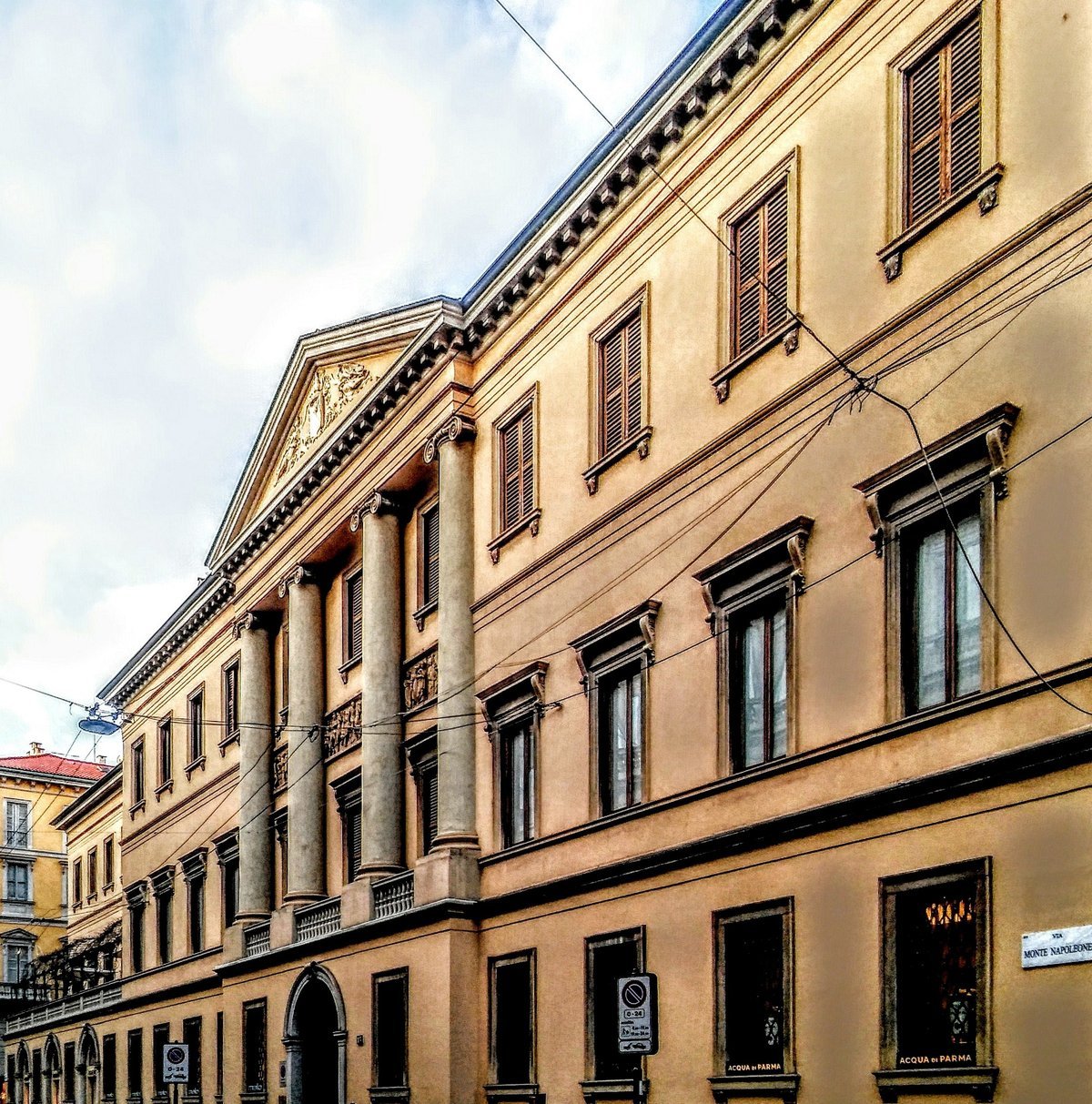
Anyone expecting only polished shop windows along Via Montenapoleone will be astonished. In the midst of Milan’s most elegant shopping quarter, at number 18, there is a palazzo that seems to belong to another era: Palazzo Melzi di Cusano. Its neoclassical façade, with giant Ionic columns and a triangular pediment, pays homage to Palazzo Serbelloni, yet has a character of its own. As soon as you see it, you realize that here history is not a backdrop: it takes center stage. Today, the piano nobile houses Casa Conte, a luxury exhibition space that retains the feel of a private home, and the palazzo provides the setting for exhibitions and events where art and design converse. Even if you don’t step inside, it’s worth looking up: between the first and second floors, a high relief by Gaetano Monti, depicting the Deeds of Francesco Sforza, stands out. A place that takes you by surprise, exactly where you least expect it.
Historical Background
The story goes back a long way: on the site there once stood a
15th-century palace, remodeled in neoclassical style from
1830 to a design by Giovanni Battista Bareggi (completed between 1844 and 1847). Of the ancient building, a
fresco attributed to Bernardino Luini remains. The Magnoni family, who hosted Philip V of Spain and the Duke of Mantua, obtained the title of Counts of Mulazzana; the last heiress married Gaetano Melzi of the Counts of Cusano, and the palace remained with the Melzi family for over a century. It then became a college and was put up for sale on the eve of World War I. Today it hosts exhibitions and events spanning art and design.
- 15th century: earlier palace with chapel.
- Early 1700s: King Philip V hosted by the Magnoni family.
- 1830-1847: Bareggi’s neoclassical renovation.
- 19th century: passes to the Melzi family, hence the name.
- Eve of the Great War: sale.
- Today: Casa Conte and events.
A Neoclassical Gem by Bareggi
The façade is the first thing that catches your eye. The project by Giovanni Battista Bareggi takes up the motif of Palazzo Serbelloni but simplifies it: a slightly projecting central section, framed by a giant Ionic colonnade supporting a triangular pediment and forming a loggia. Compared to the model, the decoration is less elaborate and more massive, almost as if it spoke the language of power. Between the first and second floors, your eye falls on a high relief by Gaetano Monti depicting the Deeds of Francesco Sforza: a tribute to Sforza-era Milan. On the rear wall, meanwhile, you can notice low reliefs that are copies of the sandstone originals, also by Monti. It all tells the story of 19th-century Milan, but with roots firmly planted in the Renaissance. You don’t need to be an architect to appreciate the attention to detail: just take a quiet look, perhaps as the city flows past you.
Interiors, Luini, and Casa Conte
Beyond the façade lies a world that never ceases to amaze. The piano nobile retains a rich original neoclassical decoration, with perfectly preserved stuccoes and mosaic floors. Here, in the salons, lives a piece of older history: the fresco attributed to Bernardino Luini, detached from the chapel of the fifteenth-century palace. A fragment of the Renaissance that miraculously remained in place after the renovation works. Today the spaces are occupied by Casa Conte, a luxury furniture showroom that doesn’t feel like a shop: it feels more like stepping into a Milanese family’s apartment, with contemporary furnishings alongside historic walls. The palace also hosts exhibitions and events, always with a special focus on the dialogue between art and design. It is one of the few places where you can buy a piece of design and, at the same time, feel like you’re inside a museum.
Why Visit
First: because it’s an open-air history lesson on one of Italy’s most famous streets. The neoclassical facade, Monti’s high relief, Luini’s fresco inside: everything is concentrated in a single building. Second: because it’s a rare example of layering – from the fifteenth century to contemporary design – without being a museum. Casa Conte lets you experience the spaces as if they were lived in, and temporary exhibitions make every visit different. Third: because it’s the perfect pretext to look at Via Montenapoleone with fresh eyes, away from the shop windows. Even if you can’t enter, the facade is worth a stop; if you find an event open to the public, don’t let it slip away. It’s the kind of place that makes you say: ‘I didn’t think it was here’.
When to go
The best time? I’d pick a weekday, maybe in the late afternoon, when via Montenapoleone empties of tourists and the low light caresses the columns and the pediment. The palace has a theatrical feel at sunset, with shadows enhancing Monti’s reliefs. If there’s an exhibition or event on those days, even better: you’ll have one more excuse to cross the threshold. In autumn, the combination of clear skies and crisp air makes the façade particularly sharp. But after all, whatever the moment, a stop around here is never wrong: Milan is always changing, and even a building still for two centuries can give you different emotions depending on the time and light.
Nearby
If you’re already in the area, you simply must take advantage of it. Via Montenapoleone is the heart of the Fashion Quadrilateral: after stopping in front of the palace, let yourself be intrigued by the shop windows of Via Sant’Andrea and Via della Spiga. Just a few steps away, but at a leisurely pace, there’s also the Poldi Pezzoli Museum, a house-museum housing an extraordinary art collection that shares with Palazzo Melzi the atmosphere of a historic Milanese residence. If you prefer a different kind of beauty, head towards Piazza della Scala and Teatro alla Scala: another unmissable stop for art and culture lovers. In short, the palace can be the start of an itinerary all about elegance and the city’s memory.