
Discover Vicenza in one day with this itinerary dedicated to the masterpieces of Andrea Palladio, the genius of Renaissance architecture who shaped the city's identity. Start at Piazza dei Signori to admire the Basilica Palladiana, the undisputed symbol, then head to the Teatro Olimpico, the world's first permanent covered theater. Continue to Palazzo Chiericati, now the Civic Art Gallery, and don't miss a stroll along Corso Palladio, the city's elegant main street. Vicenza is a UNESCO World Heritage site precisely for its Palladian architecture, a concentration of beauty that can be comfortably explored on foot. This Vicenza Palladio architecture itinerary will guide you step by step through the most iconic monuments, with practical tips on opening hours and tickets to optimize your day.
🗺️ Your trip at a glance
A walking itinerary through the UNESCO historic center of Vicenza, dedicated to the masterpieces of Andrea Palladio. The route guides you through 10 iconic stops, from the world's first permanent covered theatre to the city's symbolic loggia.
- Ideal for Renaissance architecture enthusiasts, cultural travelers, and those seeking a day trip rich in history.
- Highlights: walking tour through the UNESCO historic center, 10 Palladian stops including the Olympic Theatre and the Basilica, interactive map for easy navigation.
- Perfect for those who want to discover the essence of Vicenza in one day, with a structured itinerary that combines architectural masterpieces and panoramic views from Torre Bissara.
Itinerary stops
Stop no. 1
Olympic Theatre
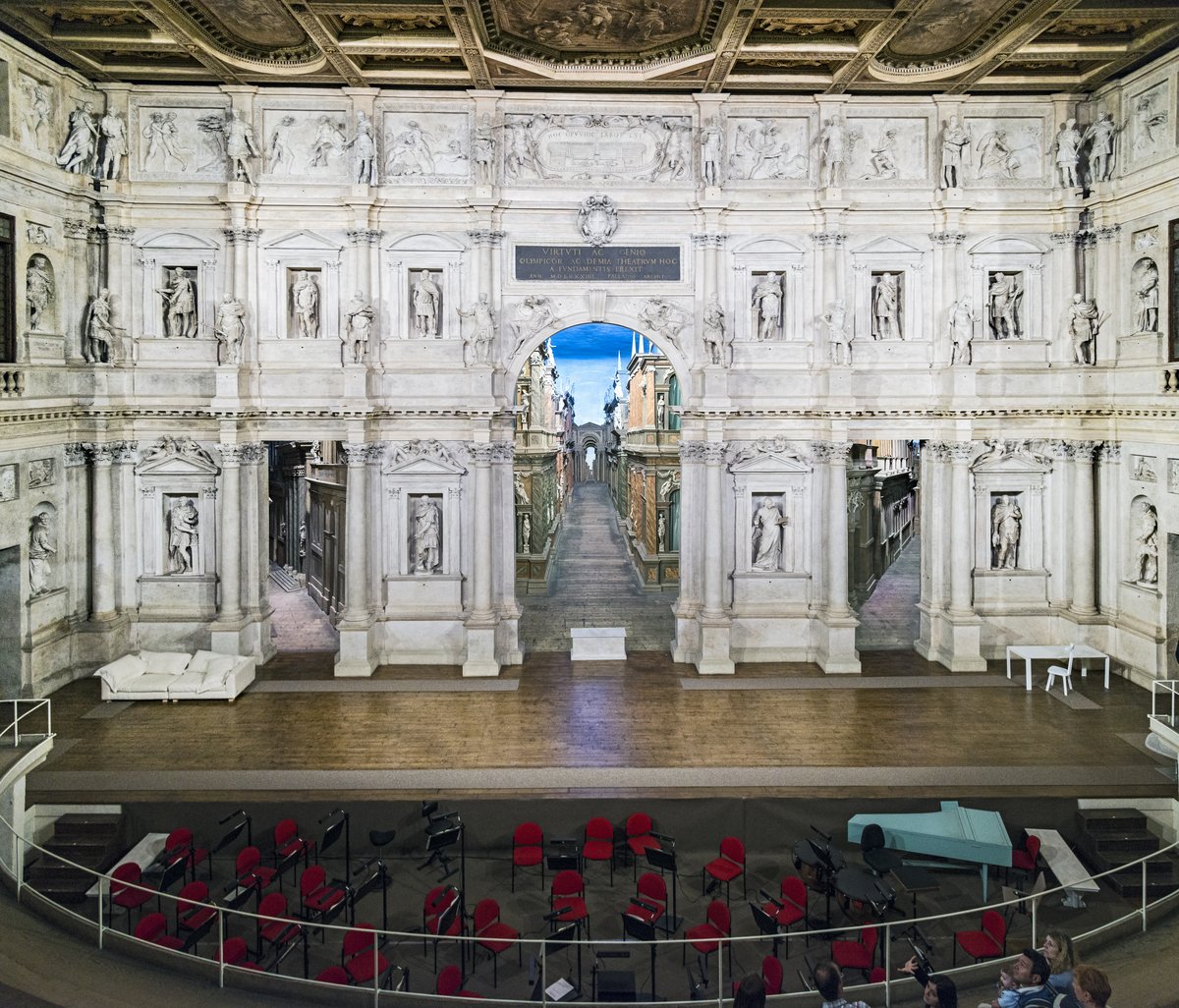 Starting your Palladian Vicenza tour at the Olympic Theatre means immediately immersing yourself in the pinnacle of Andrea Palladio's genius. Located on Stradella del Teatro Olimpico, this is the first permanent covered theatre in Western history, completed in 1585. The elliptical cavea and Vincenzo Scamozzi's fixed scenery with the streets of Thebes create an extraordinary perspective illusion. Notice the details: the faux marble stucco work, the statues of the Olympic academicians, the painted ceiling resembling an open sky. It's an experience that lets you feel firsthand how Palladio revolutionized theatre architecture. Tip: Check opening hours on the official website, as it sometimes closes for rehearsals or events.
- Go to the page: Teatro Olimpico in Vicenza: World's First Covered Theater with Scamozzi's Fixed Stage
- Stradella del Teatro Olimpico, Vicenza (VI)
- https://www.teatrolimpicovicenza.it/
- Open in Google Maps
- View on Google Images

You should go if...
Stop no. 2
Palladian Basilica
 The Palladian Basilica dominates Piazza dei Signori with its majestic presence, a masterpiece by Andrea Palladio that transformed the ancient medieval Palazzo della Ragione. The white loggia with serlianas is the undisputed symbol of the city, added by Palladio between 1549 and 1614 to consolidate the pre-existing structure. Ascending to the upper floor, you access the Hall of the Council of Four Hundred, a monumental space covered by a spectacular inverted ship's hull. Today it hosts temporary exhibitions of international caliber, while the panoramic terrace offers breathtaking views over the rooftops of Vicenza and the Berici Hills. The building has been part of the UNESCO World Heritage Site 'City of Vicenza and the Palladian Villas of the Veneto' since 1994.
- Go to the page: Palladian Basilica: Serliana loggias, 52-meter hall and UNESCO terrace
- Contra' del Monte, Vicenza (VI)
- http://www.basilicapalladiana.vi.it
- Open in Google Maps
- View on Google Images
You should go if...
Stop no. 3
Chiericati Palace
 Leaving the Palladian Basilica behind, you'll immerse yourself in the heart of Corso Andrea Palladio to discover Chiericati Palace, another gem from the architectural genius of Andrea Palladio. The double-order columned facade creates a unique depth effect, while the spacious ground-floor portico invites you inside. Today the palace houses the Civic Museum of Vicenza, with a collection spanning from the Middle Ages to the 18th century, including works by Venetian artists such as Bartolomeo Montagna and Giovanni Buonconsiglio. The frescoed halls preserve highly valuable artworks, including Jacopo Bassano's 'Madonna and Child'. The museum route winds through richly decorated spaces, offering a glimpse into the city's artistic history. Part of the UNESCO World Heritage site since 1994, this building is an outstanding example of how Palladio revolutionized civil architecture.
- Go to the page: Palazzo Chiericati: Civic Museum with Art from the Middle Ages to the 18th Century in a Palladian Palace
- Corso Andrea Palladio, Vicenza (VI)
- Open in Google Maps
- View on Google Images
You should go if...
Stop no. 4
Barbaran da Porto Palace
 Continuing along Contra' Porti, you'll encounter Barbaran da Porto Palace, one of Andrea Palladio's most comprehensive designs for an urban private residence. The facade stands out for its double order of semi-columns creating an elegant rhythm, while the monumental entrance with internal staircase exemplifies spatial mastery. Today the palace hosts the Andrea Palladio International Centre for Architectural Studies, where temporary exhibitions and conferences on Renaissance architecture are organized. The interior halls preserve original 16th-century frescoes and stuccoes, including works by Giovanni Antonio Fasolo and Andrea Vicentino. Listed as a UNESCO World Heritage site since 1994, this building offers an immersive experience into Vicenza's cultural life, away from the more touristy crowds.
- Contra' Porti, Vicenza (VI)
- Open in Google Maps
- View on Google Images
You should go if...
Stop no. 5
Palazzo del Capitaniato
 Leaving behind the elegance of Palazzo Barbaran da Porto, you'll reach the Palazzo del Capitaniato, the last civic work completed by Andrea Palladio in Vicenza between 1571 and 1572. This building stands out for its exposed brick façade with four giant stone semi-columns that create an extraordinary chromatic contrast. Originally the seat of the Venetian Captain, it represented the power of the Serenissima over the city. The ground-floor loggia with three arches served as a space for public hearings, while the interior preserves frescoes by Giovanni Antonio Fasolo celebrating the virtues of Venetian governance. Today it houses municipal offices but remains accessible during opening hours. Its strategic position facing the Basilica Palladiana perfectly completes the Palladian quadrilateral of the main square.
- Contra' del Monte, Vicenza (VI)
- Open in Google Maps
- View on Google Images
You should go if...
Stop no. 6
Porto Palace
 Continuing along Contra' Porti, after admiring the Palazzo del Capitaniato, you'll come across Porto Palace, one of Andrea Palladio's most ambitious residential projects. Commissioned by Iseppo Porto in 1571, this palace represents the perfect synthesis between residential functionality and noble representation. The façade stands out for its rusticated stonework on the ground floor, which contrasts with the elegance of the Ionic semi-columns on the main floor. Unfortunately, the building remained unfinished, as evidenced by the uncompleted side windows and the absence of the right wing planned in the original design. Today it houses private offices, but its majesty is perfectly appreciable from the outside. Its location along the ancient street of patrician palaces ideally completes the Palladian route through the historic center.
- Contra' Porti, Vicenza (VI)
- Open in Google Maps
- View on Google Images
You should go if...
Stop no. 7
Casa Cogollo
 Approaching Casa Cogollo along Corso Andrea Palladio, one immediately notices its elegant facade, distinguished by its sobriety and harmonious proportions. Attributed to Andrea Palladio, this 16th-century residence is also known as 'Palladio's House' due to the tradition that identifies it as the architect's home, although there is no definitive proof. The structure features a piano nobile with pedimented windows and a central portal topped by a balcony, elements typical of the Palladian style. Today, the building houses offices and is not open to the public, but its facade is a perfect example of Renaissance civil architecture that enhances the journey through Vicenza's historic center. Its location along the main street allows visitors to appreciate its details even during a casual stroll.
- Corso Andrea Palladio, Vicenza (VI)
- Open in Google Maps
- View on Google Images
You should go if...
Stop no. 8
Bissara Tower
 Bissara Tower dominates Piazza dei Signori with its 82-meter height, offering one of the most spectacular views over Vicenza's historic center. Built in the 13th century as a civic tower, it has been damaged and rebuilt several times while maintaining its role as an urban landmark. The structure features a stone and brick base, with a bell chamber housing a concert of five bells still in operation today to mark the hours and special occasions. Climbing the 192 steps of the internal staircase (access is possible on specific occasions), you reach the summit from where you can embrace with your gaze the entire Palladian city, from the Palladian Basilica to the roofs of historic houses. The tower has recently been restored to ensure its safety and accessibility, becoming a privileged observation point over Vicenza's UNESCO heritage.
- Piazza dei Signori, Vicenza (VI)
- Open in Google Maps
- View on Google Images
You should go if...
Stop no. 9
Ca' d'Oro
 Leaving the majestic Torre Bissara behind in Piazza dei Signori, one immerses themselves in the heart of Vicenza to discover Ca' d'Oro, located along the vibrant Corso Andrea Palladio. This palace, designed by Andrea Palladio in 1540 for the Capra family, is a shining example of the Renaissance architecture that characterizes the city. The facade, with its central portal topped by a balcony and arched windows, reflects the harmony and proportion typical of the Palladian style. Originally a private residence, it now houses commercial activities but maintains its historical elegance intact. Strolling along the corso, it's impossible not to notice how Ca' d'Oro integrates perfectly with the other Palladian buildings, offering an authentic glimpse of 16th-century urban life. One detail not to be missed is the internal courtyard, accessible on special occasions, which reveals additional decorative elements.
- Corso Andrea Palladio, Vicenza (VI)
- Open in Google Maps
- View on Google Images
You should go if...
Stop no. 10
Civic Museum of Palazzo Chiericati
 Leaving Ca' d'Oro behind, head towards Piazza Giacomo Matteotti to visit the Civic Museum of Palazzo Chiericati, a jewel designed by Andrea Palladio in 1550 for the Chiericati family. This building, with its double-order column facade and open portico, is a perfect example of Palladian architecture that enhances public spaces. Inside, the museum houses a rich collection of artworks, including paintings by Venetian artists such as Francesco Maffei and Giovanni Battista Tiepolo, along with archaeological finds and sculptures that narrate Vicenza's history from the Middle Ages to the 19th century. Particularly evocative is the Renaissance section, with canvases illustrating the local artistic evolution. A practical tip: don't miss the sacred paintings room, where works like Bartolomeo Montagna's "Madonna and Child" stand out. The visit offers a complete immersion into Vicentine culture, enriching the Palladian itinerary with historical and artistic insights.
- Piazza Giacomo Matteotti 37, Vicenza (VI)
- https://www.museicivicivicenza.it/it/mcp/visita.php
- Open in Google Maps
- View on Google Images
You should go if...


