
🧭 What to Expect
Ideal for: those seeking a mix of lake, mountains, and villages Highlights: historic villas, panoramic views, nature trails Why visit: relaxation, culture, and outdoor activities in one destination Don't miss: Villa Carlotta's gardens, Brunate's balcony, hidden castles
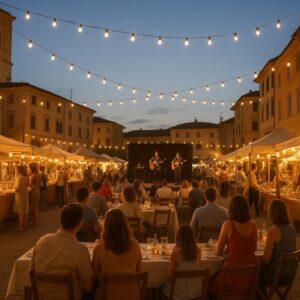
Events nearby


The province of Como is much more than the famous lake that bears its name. Here you'll find a perfect mix of nature, history, and culture, with patrician villas overlooking the water, medieval hilltop villages, and mountains mirrored in the lake. In this guide, I'll take you to discover unmissable places to explore at a leisurely pace: from the main city with its majestic cathedral and lakeside gardens, to the small towns that hide forgotten castles and Romanesque churches. Lake Como is just the beginning: explore the side valleys, hike trails through chestnut woods, and let yourself be surprised by the beauty of villas like Villa Carlotta and Villa del Balbianello. The province of Como is a destination that combines elegance and authenticity, perfect for a weekend getaway or a longer vacation. Every corner tells a story, amid art, nature, and local flavors. With this practical guide, you won't miss a thing.
Overview
- Como Cathedral: A Gothic-Renaissance Masterpiece
- Villa Carlotta: Art, History, and an Enchanted Garden
- Villa Carlotta: Art, History, and an Enchanted Garden
- Villa del Balbianello, a FAI treasure in Tremezzina
- Villa del Balbianello, a FAI treasure in Tremezzina
- Villa Olmo: History and Charm on Lake Como
- Villa Olmo: History and Charm on Lake Como
- A Dive into the Middle Ages: Castello del Baradello
- Voltian Temple: A Tribute to a Genius on the Lake's Shore
- Basilica of Sant'Abbondio: a Romanesque masterpiece
- Teatro Sociale: A Neoclassical Gem Where History Meets Music
- Villa Melzi d'Eril: Bellagio's Neoclassical Gem
- Castello Di Rezzonico: A Medieval Jewel on the Lake
- Castello Di Rezzonico: A Medieval Jewel on the Lake
- Castello di Musso: Ruins on the Lake
- Palazzo Gallio: A Cardinal's Residence with a Lake View
- Silk Museum: Como's Golden Thread
- Voltian Lighthouse: The Symbol of Brunate Overlooking the Lake
- Madonna del Ghisallo Cycling Museum
Itineraries nearby
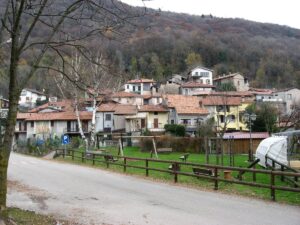


Como Cathedral: A Gothic-Renaissance Masterpiece
- Go to the page: Como Cathedral: Marble Facade with Statues of the Plinys and Juvarra's Dome
- Via Cinque Giornate, Como (CO)
- https://www.cattedraledicomo.it/
- Open in Google Maps
- View on Google Images
- +39 031 3312275
 If you think Como Cathedral is just another cathedral, you're in for a surprise. It's an incredible layering of styles that saw generations of architects from 1396 to 1740. The façade in Musso marble is a late Gothic triumph: three portals, a central rose window, and four pilasters crowned with spires. Observe the Plinys (the Elder and the Younger) on either side of the main portal, sculpted by Tommaso Rodari. Then walk around: on the north side, there's the curious “Frog Door”, with a stone frog among vegetal decorations. Inside, light filters through the neo-Gothic stained glass by the Bertini brothers, while the Gothic nave opens onto a Renaissance presbytery with three apses. The octagonal dome is by Filippo Juvarra, decorated in stucco and gold. Among the artworks, don't miss the Raimondi Altarpiece by Bernardino Luini (1521) and the Flemish tapestries from the 16th century. Fun fact: the cathedral has no bell tower of its own; the bells are on the civic tower of the Broletto, playing in D♭. A place that will make you travel through time.
Villa Carlotta: Art, History, and an Enchanted Garden
- Go to the page: Villa Carlotta: Gardens with 150 Camellias and Canova Sculptures on Lake Como
- Tremezzina (CO)
- https://www.villacarlotta.it/
- Open in Google Maps
- View on Google Images
- +39 0344 40405
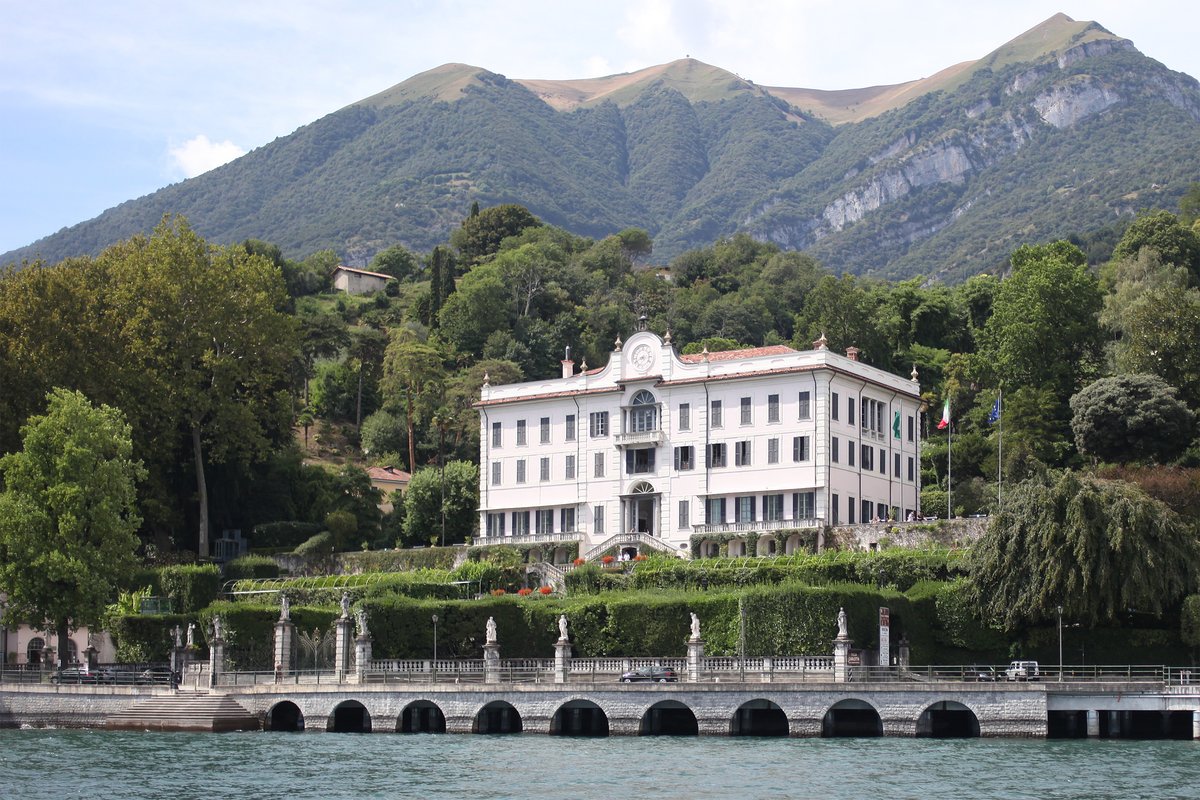 When you arrive at Villa Carlotta, you immediately understand why it’s one of the most beloved spots on Lake Como. Overlooking the water opposite Bellagio, this 17th-century villa is a blend of art and nature that leaves you speechless.
Built at the end of the 1600s for Marquis Giorgio Clerici, it has changed faces many times. The real stroke of genius came from Gian Battista Sommariva, who turned it into a temple of neoclassical art. Inside, you’ll find works by Canova (such as the Penitent Magdalene and Eros and Psyche), Thorvaldsen, and Hayez’s famous painting Romeo’s Last Kiss to Juliet. Later, Princess Marianna of Nassau bought it and gave it to her daughter Carlotta, after whom it is named. Her husband, Duke George II of Saxe-Meiningen, was a passionate botanist and expanded the garden with exotic species from around the world.
Today, the 70,000-square-meter park is a riot of color in spring, with over 150 varieties of rhododendrons and azaleas blooming up to 22 meters tall. But every season has its charm: camellias, cedars, and ancient sequoias, a rock garden, the fern valley, a bamboo garden, and a museum of agricultural tools. In short, every corner is a surprise – and if you stop under the plane tree beloved by Stendhal, you’ll understand why.
Practical info: tickets cost €15, open daily from 10 am to 7 pm in spring/summer. You can arrive by boat directly at the villa’s dock, or by ferry from Bellagio to Cadenabbia and then a 5-minute walk. Bring your camera – you’ll need it.
Villa Carlotta: Art, History, and an Enchanted Garden
- Go to the page: Villa Carlotta: Art and Gardens on Lake Como
- Tremezzina (CO)
- https://www.villacarlotta.it/
- Open in Google Maps
- View on Google Images
- +39 0344 40405
When you arrive at Villa Carlotta, you immediately understand why it’s one of the most beloved spots on Lake Como. Overlooking the water opposite Bellagio, this 17th-century villa is a blend of art and nature that leaves you speechless.Built at the end of the 1600s for Marquis Giorgio Clerici, it has changed faces many times. The real stroke of genius came from Gian Battista Sommariva, who turned it into a temple of neoclassical art. Inside, you’ll find works by Canova (such as the Penitent Magdalene and Eros and Psyche), Thorvaldsen, and Hayez’s famous painting Romeo’s Last Kiss to Juliet. Later, Princess Marianna of Nassau bought it and gave it to her daughter Carlotta, after whom it is named. Her husband, Duke George II of Saxe-Meiningen, was a passionate botanist and expanded the garden with exotic species from around the world.
Today, the 70,000-square-meter park is a riot of color in spring, with over 150 varieties of rhododendrons and azaleas blooming up to 22 meters tall. But every season has its charm: camellias, cedars, and ancient sequoias, a rock garden, the fern valley, a bamboo garden, and a museum of agricultural tools. In short, every corner is a surprise – and if you stop under the plane tree beloved by Stendhal, you’ll understand why.
Practical info: tickets cost €15, open daily from 10 am to 7 pm in spring/summer. You can arrive by boat directly at the villa’s dock, or by ferry from Bellagio to Cadenabbia and then a 5-minute walk. Bring your camera – you’ll need it.
Villa del Balbianello, a FAI treasure in Tremezzina
- Go to the page: Villa del Balbianello: A Gem of Lake Como Where History Meets Cinema
- Via Comoedia 5, Tremezzina (CO)
- https://fondoambiente.it/luoghi/villa-del-balbianello
- Open in Google Maps
- View on Google Images
- faibalbianello@fondoambiente.it
- +39 034 456 110
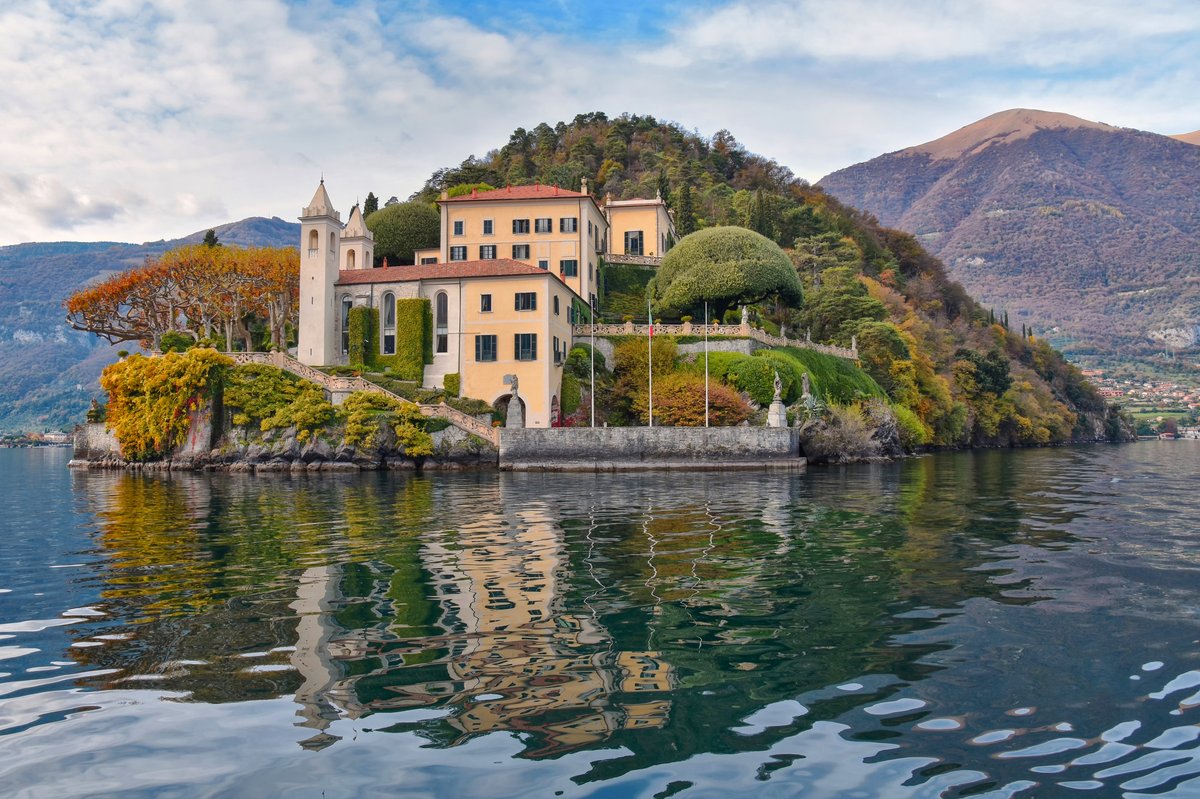 If there is a villa that surprises at every turn, it is Villa del Balbianello. Perched on the wooded promontory of Dosso di Lavedo, in Tremezzina, it dominates Lake Como with a breathtaking view. Built between 1790 and 1793 at the behest of Cardinal Angelo Maria Durini, it stands where a Franciscan monastery once stood. Few know that patriots of the Risorgimento, such as Count Luigi Porro Lambertenghi and Giuseppe Arconati Visconti, also stayed here. Then, in 1988, the last private owner – explorer Guido Monzino, the first Italian to climb Everest – donated it to the FAI, which now manages it with care. The villa is not a single building but a complex: the main residence and the Loggia Durini, an eighteenth-century belvedere with double views over two inlets of the lake. The interiors are a journey through Monzino's memories: the Museum of Expeditions displays maps, travel instruments, and relics of the peoples he encountered, while the rooms are enriched by Flemish tapestries, Chinese terracottas, and reverse glass paintings. But the real spectacle is outside: the terraced garden, with trees pruned into bizarre shapes and avenues of statues, plunges into the lake with a small harbor and staircases lined with plane trees. The villa is also a movie star: scenes from "Star Wars: Episode II – Attack of the Clones" (2002), "Casino Royale" (2006) with James Bond, and the film "A Month by the Lake" (1995) starring Vanessa Redgrave were shot here. To visit, online booking is mandatory on the FAI website. You can reach it on foot from Lenno (about 25 minutes uphill) or by taxi boat. The nearest parking is paid at Via Comoedia. Note: the villa is partially accessible to people with reduced mobility. I recommend taking your time and enjoying every view: the sight from the loggia is something you will never forget.
Villa del Balbianello, a FAI treasure in Tremezzina
- Go to the page: Villa del Balbianello: Terraced Gardens on Lake Como and Star Wars Filming Location
- Via Comoedia 5, Tremezzina (CO)
- https://fondoambiente.it/luoghi/villa-del-balbianello
- Open in Google Maps
- View on Google Images
- faibalbianello@fondoambiente.it
- +39 034 456 110
If there is a villa that surprises at every turn, it is Villa del Balbianello. Perched on the wooded promontory of Dosso di Lavedo, in Tremezzina, it dominates Lake Como with a breathtaking view. Built between 1790 and 1793 at the behest of Cardinal Angelo Maria Durini, it stands where a Franciscan monastery once stood. Few know that patriots of the Risorgimento, such as Count Luigi Porro Lambertenghi and Giuseppe Arconati Visconti, also stayed here. Then, in 1988, the last private owner – explorer Guido Monzino, the first Italian to climb Everest – donated it to the FAI, which now manages it with care. The villa is not a single building but a complex: the main residence and the Loggia Durini, an eighteenth-century belvedere with double views over two inlets of the lake. The interiors are a journey through Monzino's memories: the Museum of Expeditions displays maps, travel instruments, and relics of the peoples he encountered, while the rooms are enriched by Flemish tapestries, Chinese terracottas, and reverse glass paintings. But the real spectacle is outside: the terraced garden, with trees pruned into bizarre shapes and avenues of statues, plunges into the lake with a small harbor and staircases lined with plane trees. The villa is also a movie star: scenes from "Star Wars: Episode II – Attack of the Clones" (2002), "Casino Royale" (2006) with James Bond, and the film "A Month by the Lake" (1995) starring Vanessa Redgrave were shot here. To visit, online booking is mandatory on the FAI website. You can reach it on foot from Lenno (about 25 minutes uphill) or by taxi boat. The nearest parking is paid at Via Comoedia. Note: the villa is partially accessible to people with reduced mobility. I recommend taking your time and enjoying every view: the sight from the loggia is something you will never forget.Villa Olmo: History and Charm on Lake Como
- Go to the page: Villa Olmo: History, Park, and Visits on Lake Como
- Via Simone Cantoni, Como (CO)
- https://www.visitcomo.eu/it/vivere/luoghi-della-cultura/villa_olmo/
- Open in Google Maps
- View on Google Images
 As you stroll along the lakefront of Como, you'll come across one of the most imposing residences on Lake Como: Villa Olmo. Built between 1782 and 1812 by architect Simone Cantoni for Marquis Innocenzo Odescalchi, this neoclassical masterpiece has hosted figures such as Napoleon, Garibaldi, and Emperor Ferdinand I of Austria. Its name comes from an ancient elm tree that once stood here, mentioned by Pliny the Younger. The facade is punctuated by ten Ionic columns and medallions depicting Greek philosophers, while inside highlights include a three-story atrium, the grand staircase, and the ballroom frescoed by Domenico Pozzi. The park is a true gem: around 800 trees including horse chestnuts, cedar of Lebanon, and plane trees, an Italian garden with mythological statues, 19th-century greenhouses, and a neoclassical temple. Today the villa is closed for restoration, but the park is regularly open with free entry (winter hours 7am–7pm, summer hours 7am–11pm). Don't miss the "Kilometer of Knowledge," the path connecting Villa Olmo to Villa del Grumello and Villa Sucota, perfect for a cultural walk between lake and greenery. Bring a book and enjoy the view: it's the ideal place to relax away from the chaos.
Villa Olmo: History and Charm on Lake Como
As you stroll along the lakefront of Como, you'll come across one of the most imposing residences on Lake Como: Villa Olmo. Built between 1782 and 1812 by architect Simone Cantoni for Marquis Innocenzo Odescalchi, this neoclassical masterpiece has hosted figures such as Napoleon, Garibaldi, and Emperor Ferdinand I of Austria. Its name comes from an ancient elm tree that once stood here, mentioned by Pliny the Younger. The facade is punctuated by ten Ionic columns and medallions depicting Greek philosophers, while inside highlights include a three-story atrium, the grand staircase, and the ballroom frescoed by Domenico Pozzi. The park is a true gem: around 800 trees including horse chestnuts, cedar of Lebanon, and plane trees, an Italian garden with mythological statues, 19th-century greenhouses, and a neoclassical temple. Today the villa is closed for restoration, but the park is regularly open with free entry (winter hours 7am–7pm, summer hours 7am–11pm). Don't miss the "Kilometer of Knowledge," the path connecting Villa Olmo to Villa del Grumello and Villa Sucota, perfect for a cultural walk between lake and greenery. Bring a book and enjoy the view: it's the ideal place to relax away from the chaos.A Dive into the Middle Ages: Castello del Baradello
- Go to the page: Baradello Castle Como: Barbarossa's Medieval Tower with 360° Lake View
- Strada degli Alpini, Como (CO)
- Open in Google Maps
- View on Google Images
 If there's a place that makes you feel the Middle Ages, it's Castello del Baradello. Perched on a hill at 430 meters, it dominates Como and the lake with its imposing presence. Frederick Barbarossa had it built in 1158 on the ruins of Byzantine fortifications, and the square tower – 8.5 meters per side, nearly 30 meters high – is still the symbol of Parco Spina Verde. The walk up from Piazza Camerlata is a 20-minute hike on a dirt path: nothing impossible, but you'll feel the incline. Once at the top, the view is 360°: from the lake to the Alps, from the Po Valley to the Apennines on clear days.
Visits are guided only, every hour, and last about 40 minutes. You start in the courtyard and climb the suspended staircase 15 meters high – watch out if you're afraid of heights. Inside the tower, besides the view from above, there's the exhibition 'Fragments… of a City' with artifacts from excavations in the 1970s and 2008-2010. And then there's the medieval cistern, with its pink cocciopesto still visible.
One detail that struck me: here in 1277 Napoleone Torriani was locked in a cage by Ottone Visconti and died of starvation. His story is tied to this place almost as much as Barbarossa's.
Practical info: the castle is open Saturday, Sunday, and holidays from 9:30 AM to 6:00 PM. Adult ticket €7, children 6-14 €5, free for under 5 and disabled visitors with an escort. I recommend booking online to avoid the line. And if you bring kids, no strollers: the path doesn't allow them. For a picnic, at the foot of the tower you'll find Baita Bardello with tables and benches. In short, a perfect destination for those who love history, views, and a good walk.
Voltian Temple: A Tribute to a Genius on the Lake's Shore
- Viale Guglielmo Marconi, Como (CO)
- https://www.visitcomo.eu/it/scoprire/musei/tempio-voltiano/index.html
- Open in Google Maps
- View on Google Images
- musei.civici@comune.como.it
- +39 031 574705
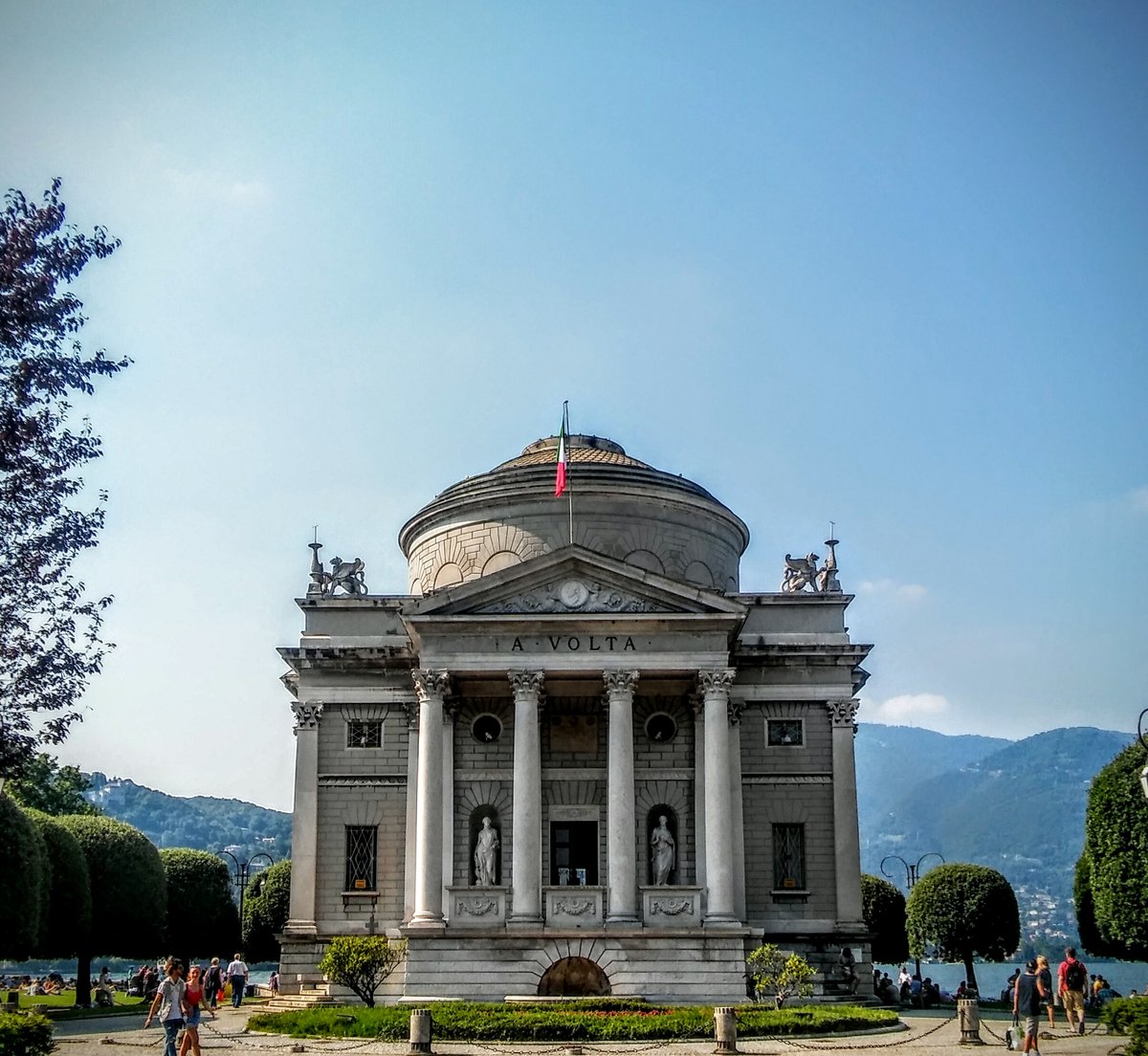 If you're passing through Como, you can't miss the Voltian Temple, a neoclassical gem overlooking the lake. Inaugurated on July 16, 1928, it was commissioned by entrepreneur Francesco Somaini to celebrate the centenary of Alessandro Volta's death, the Como-born genius behind the battery. Architect Federico Frigerio designed it inspired by the Pantheon: outside, white limestone stands out against the blue of the lake; inside, a central dome and polychrome marble floors create a solemn atmosphere. Climbing the stairs – watch out, they're a bit steep – you reach the upper floor where original instruments, manuscripts, and even Volta's desk are displayed. I was fascinated by the original voltaic pile, a stack of copper and zinc discs that changed the world. The museum is small but dense: in about an hour you'll get a clear idea of his work. And if you like, stop in the inner courtyard: the light filtering through the dome is perfect for a photo. Hours: Tuesday to Sunday, 10-6 (last entry at 5:30 PM). Full ticket: €5, reduced: €3. I recommend booking online to avoid queues, especially on weekends. And don't forget to check out the 2025 program: there are lectures and concerts that make the visit even more special.
Basilica of Sant'Abbondio: a Romanesque masterpiece
- Via Sant'Abbondio, Como (CO)
- Open in Google Maps
- View on Google Images
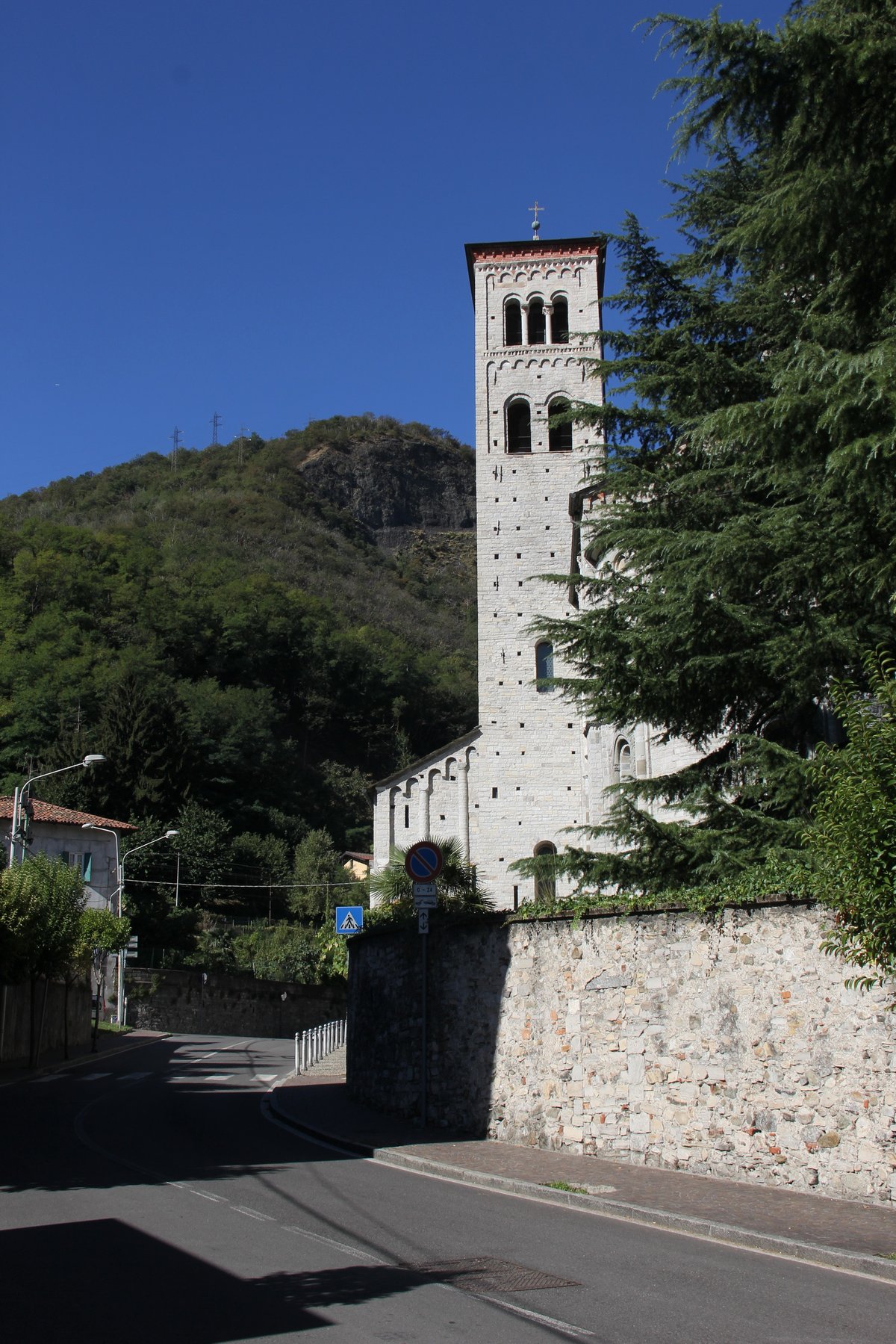 Just outside Como's center, beyond the Cosia River, lies the Basilica of Sant'Abbondio, one of the most captivating examples of Romanesque architecture in Lombardy. Its history begins in the 5th century with an early Christian church dedicated to Saints Peter and Paul, but the current building was rebuilt between 1050 and 1095 by Benedictine monks, who brought Nordic influences evident in the twin bell towers – a rarity in Italy. Consecrated by Pope Urban II in 1095, the basilica underwent centuries of modifications, but a 19th-century restoration by Serafino Balestra returned it to its original Romanesque appearance.
Upon entering, you are struck by the five-aisle layout, with massive granite columns and capitals ranging from cubic forms to floral decorations. Light filters through single-lancet windows, creating an intimate atmosphere. In the apse area, a 14th-century fresco cycle by the Master of Sant'Abbondio depicts the life of Christ: from the Nativity to the Passion, with realistic details offering a glimpse of medieval customs. Also noteworthy is the statue of Sant'Abbondio by Tommaso Rodari (late 15th century), restored in 2021.
Next to the basilica stands the monastery, now home to the Faculty of Law of the University of Insubria. Admission is free, and the church is open daily. If you're passing through Como, don't miss this gem: it's a place that speaks of faith and history, far from the tourist crowds.
Teatro Sociale: A Neoclassical Gem Where History Meets Music
- Via Vincenzo Bellini 3, Como (CO)
- https://teatrosocialecomo.it/
- Open in Google Maps
- View on Google Images
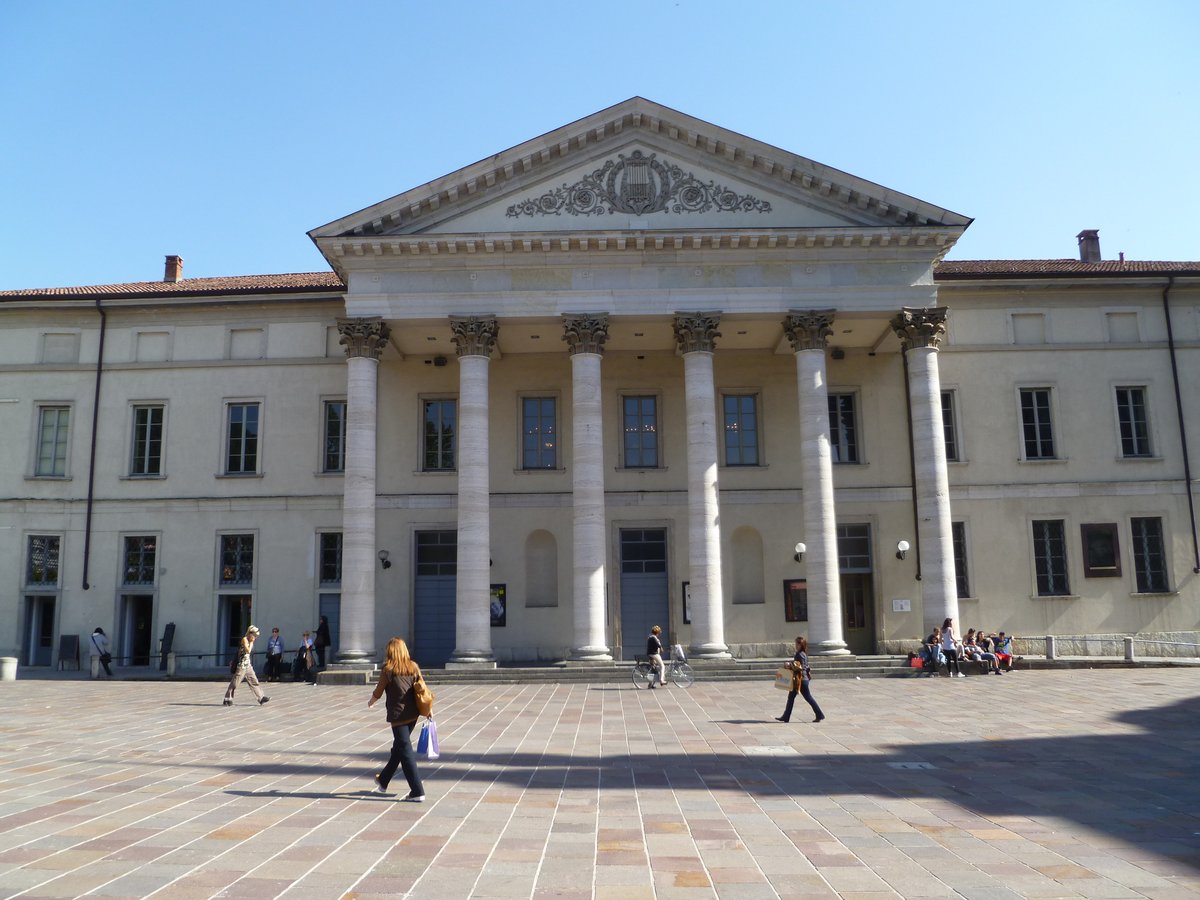 In the heart of Como, just steps from the lake, the Teatro Sociale is an institution that tells two centuries of culture. Inaugurated on August 28, 1813 with the opera Adriano in Siria, it is a classic Italian-style horseshoe theater with three tiers of boxes and two galleries, seating 999. The neoclassical façade, with Corinthian columns, was completed between 1819 and 1821 on a design by Giuseppe Cusi and Luigi Canonica. The construction was supported by none other than Alessandro Volta, who sat on the city council in 1811. Among the first great artists to tread the boards were Nicolò Paganini in 1823 and Franz Liszt in 1837. During World War II, after the 1943 bombings damaged La Scala, the Milanese theater relocated here for the 1943-44 season. Inside, the historic curtain by Alessandro Sanquirico, recently restored, stands out, along with the Sala Bianca, completely repainted at the start of the 20th century. The acoustics are excellent, as evidenced by the stage dimensions (21.5 x 13.5 meters) and the hall's shape. Now managed by the AsLiCo association, the Sociale offers a varied program: opera, drama, dance, and concerts, with a 2025/2026 season dedicated to sports for the Winter Olympics. Not to be missed is the summer Arena, reopened in 2013 for the bicentennial, hosting the “Como Città della Musica” festival. The theater is easily reachable: Como Lago station is 200 meters away, and the box office (tel. 031 270170) is open Tuesday and Thursday 10-14, Wednesday and Friday 10-15. For little ones, there's Opera Education with dedicated shows. In short, a dive into history that continues to live every evening.
Villa Melzi d'Eril: Bellagio's Neoclassical Gem
- Via Melzi D'Eril, San Giovanni (CO)
- https://www.giardinidivillamelzi.it/
- Open in Google Maps
- View on Google Images
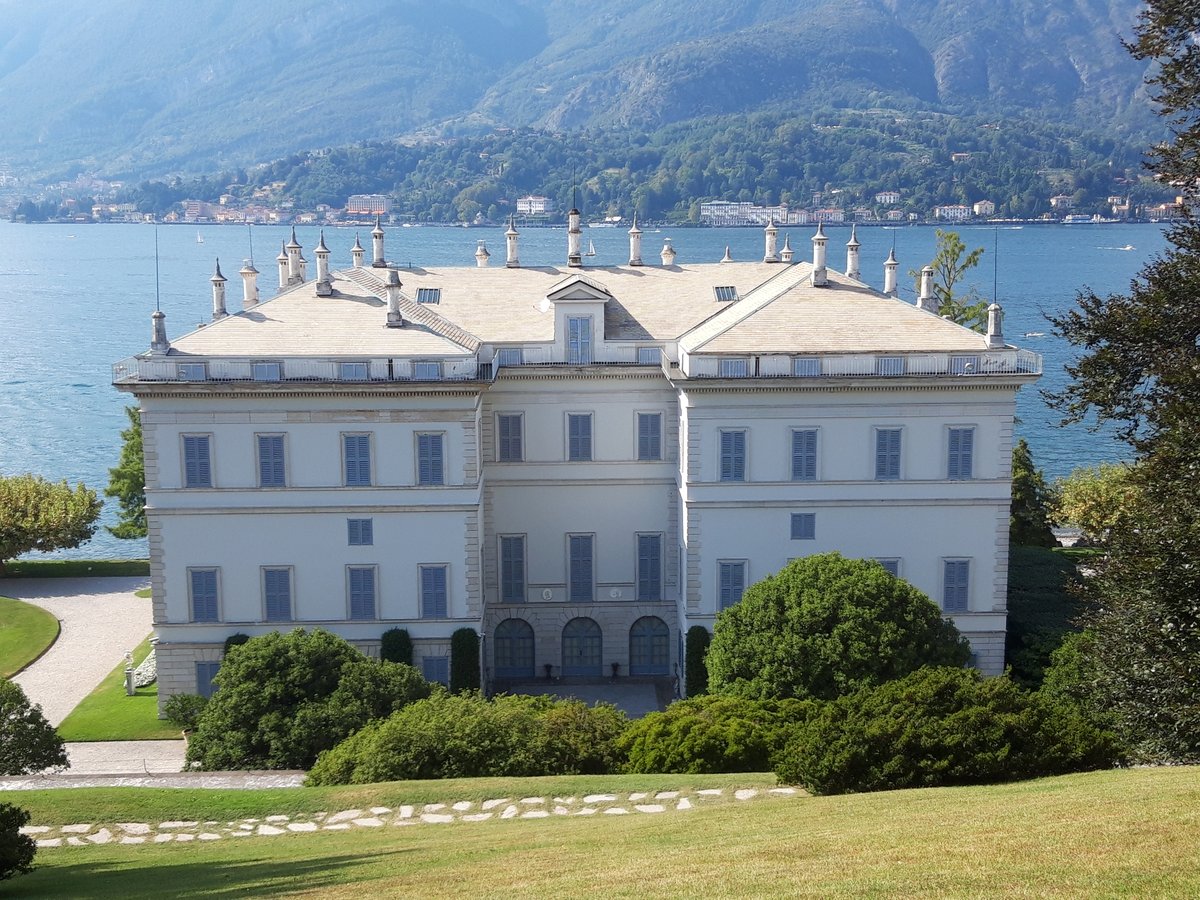 If there's one place that captures the essence of Lake Como in all its glory, it's Villa Melzi d'Eril in Bellagio. Built between 1808 and 1810 for Francesco Melzi d'Eril, Duke of Lodi and Vice President of the Italian Republic under Napoleon, this neoclassical villa is much more than a historic residence: it's an experience that blends art, nature, and history.
You won't be able to visit the villa's interiors (it's still a private residence), but the English gardens and the museum in the orangery will win you over. Designed by Luigi Canonica and Luigi Villoresi (the same architects behind the park of the Royal Villa of Monza), the gardens stretch for about a hectare along the shore, offering postcard-perfect views. Strolling along winding paths, you'll encounter the Moorish kiosk jutting out over the lake, the Japanese pond with water lilies and maples, and a collection of sculptures spanning from ancient Egypt to Neoclassicism. Don't miss the statue of Dante and Beatrice by Comolli, which inspired Franz Liszt for his 'Dante Sonata'.
The Lodovico Gallarati Scotti Museum, housed in the citrus greenhouse, is a gem: the upper floor tells the story of the villa and its illustrious guests (Stendhal, Liszt, the Shelleys), while the Antiquarium on the lower floor displays archaeological finds, Oriental ceramics, and Napoleonic relics such as the bust of Napoleon and the keys of Milan. End your visit with the neoclassical family chapel, the Melzi family mausoleum.
Practical info: the gardens, museum, and chapel are open from March to October, daily from 9:30 AM to 6:30 PM. Ticket price is €6.50 (reduced €5). Best time to visit? Spring, for the blooming of azaleas and rhododendrons. Arrive by ferry from Como: it's the most scenic way.
Castello Di Rezzonico: A Medieval Jewel on the Lake
- Go to the page: Rezzonico Castle: History and Breathtaking Views on Lake Como
- Via al castello, San Siro (CO)
- Open in Google Maps
- View on Google Images
 The Castello di Rezzonico, part of San Siro, is one of those places that capture you at first glance. Perched on a rocky promontory, it dominates Lake Como opposite Dervio. Built in the 14th century by the Della Torre family—which gave birth to Pope Clement XIII—it is a typical walled castle: a fortified area of about 2,000 sqm that housed dwellings and the main tower, designed to protect residents during raids. Today it is a private residence, so you cannot visit inside, but its crenellated mass is worth a stop. From the Regina state road you can see it soaring with its tall medieval tower with Ghibelline battlements. Strolling through the village of Santa Maria Rezzonico, among porticoes and alleys, you can reach the foot of the castle and a small pebble beach. Too bad you can't enter, but the view from up there must be spectacular. If a special event happens—like a wedding—maybe you can get a peek at the courtyard. Otherwise, you'll have to settle for admiring it from outside, and even that is impressive.
Castello Di Rezzonico: A Medieval Jewel on the Lake
- Go to the page: Castello di Rezzonico: Medieval Fortress with Tower and Dungeons on Lake Como
- Via al castello, San Siro (CO)
- Open in Google Maps
- View on Google Images
The Castello di Rezzonico, part of San Siro, is one of those places that capture you at first glance. Perched on a rocky promontory, it dominates Lake Como opposite Dervio. Built in the 14th century by the Della Torre family—which gave birth to Pope Clement XIII—it is a typical walled castle: a fortified area of about 2,000 sqm that housed dwellings and the main tower, designed to protect residents during raids. Today it is a private residence, so you cannot visit inside, but its crenellated mass is worth a stop. From the Regina state road you can see it soaring with its tall medieval tower with Ghibelline battlements. Strolling through the village of Santa Maria Rezzonico, among porticoes and alleys, you can reach the foot of the castle and a small pebble beach. Too bad you can't enter, but the view from up there must be spectacular. If a special event happens—like a wedding—maybe you can get a peek at the courtyard. Otherwise, you'll have to settle for admiring it from outside, and even that is impressive.Castello di Musso: Ruins on the Lake
- Go to the page: Musso Castle: Medieval Ruins with Breathtaking Views of Lake Como
- Da Dongo a S.Eufemia (antica via Regina), Dongo (CO)
- Open in Google Maps
- View on Google Images
 Perched on the rocky spur of the Sasso di Musso, Castello di Musso dominates Lake Como from a height of about 300 meters. Today only evocative ruins remain, but the story they tell is tumultuous. The first fortifications date back to the Gauls, then the castle became a possession of the Malacrida in the 14th century. In the 16th century it passed to Gian Giacomo Trivulzio, who expanded it and even established a mint to coin money. But the most fascinating figure was Gian Giacomo Medici (known as il Medeghino), who from 1522 to 1532 made the fortress his headquarters, terrorizing the lake with pirate raids. The fortress was protected by a double wall and a ditch of sharpened stakes. In 1532, after a siege, the Grisons razed it to the ground. Today, reaching the ruins requires a walk (free access) that rewards with an incredible view of the lake. Nearby, don't miss the Giardino del Merlo, a botanical garden created in the 19th century among the ruins, with exotic plants like palms and banana trees. It's a pity so little remains of the castle, but the atmosphere is powerful: here you can breathe a past of battles and intrigues. If you're in the area, the climb is worth it.
Palazzo Gallio: A Cardinal's Residence with a Lake View
- Via Tolomeo Gallio, Gravedona ed Uniti (CO)
- Open in Google Maps
- View on Google Images
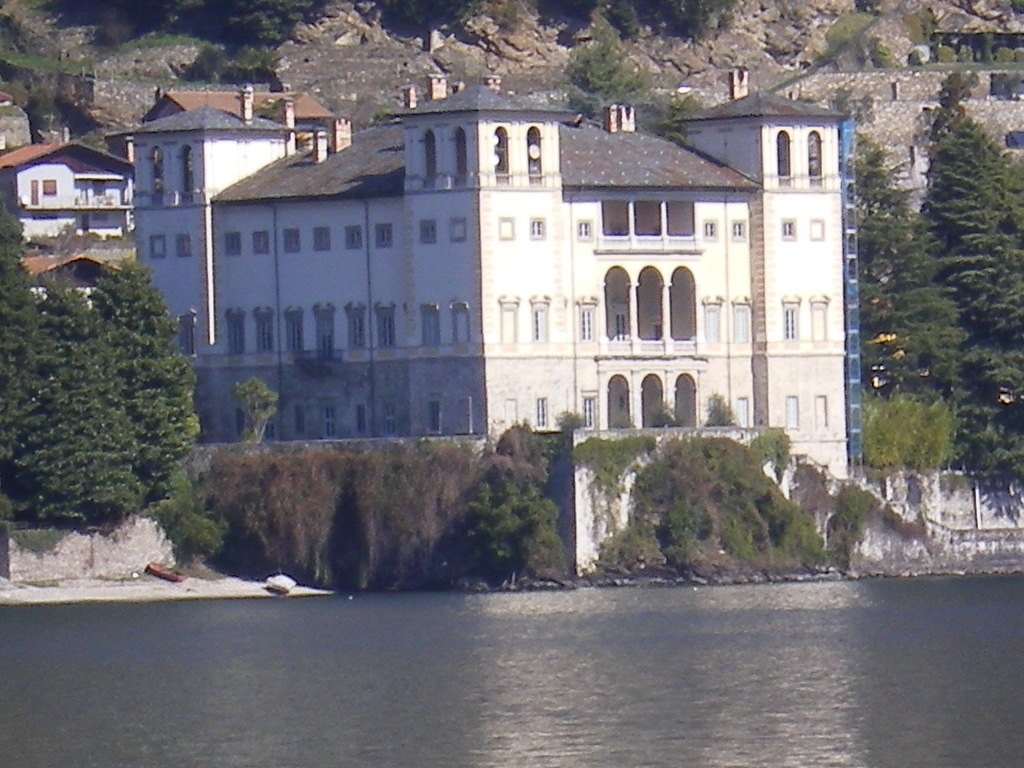 If you think Lake Como is only about elegant villas and Italian gardens, get ready to discover a different, more authentic side. In Gravedona, in Alto Lario, stands Palazzo Gallio, also known as the Palace of the Four Towers. Built from 1586 at the behest of Cardinal Tolomeo Gallio, a papal Secretary of State, this imposing building dominates the town from a rocky promontory. The project, probably by Pellegrino Tibaldi (or perhaps Giovanni Antonio Piotti—sources are not unanimous), features a square layout with four corner towers that recall the site's ancient defensive purpose. Two superimposed loggias face the lake and the mountain respectively: from here, the view stretches over Monte Legnone and Monte Legnoncino, a spectacle that alone is worth the visit. Inside, a large central hall extends over two floors and is now used for exhibitions, concerts, and weddings. Unfortunately, you won't find lavish furnishings: work ended after the cardinal's death in 1607, and the palace was never inhabited as a residence. During the Spanish and French dominations, it was used as a hospital, and in the 19th century as a silk mill. Only recently has it become the seat of the Mountain Community and a national monument. The real treasure, however, might be the terraced garden behind the building. Rare plants and dozens of camellia trees populate it, and every year, the week before Easter, the Camellia Show is held. If you want to visit, keep in mind that access is only possible by reservation (minimum 15 people) or during events. Recent restorations of the chapel and roof (ongoing until spring 2025) are restoring the palace to its former splendor. In short, a place still little visited by mass tourism, offering an authentic experience between history and nature.
Silk Museum: Como's Golden Thread
- Via Castelnuovo 9, Como (CO)
- https://www.museosetacomo.com/
- Open in Google Maps
- View on Google Images
- info@museosetacomo.com
- +39 031 303180
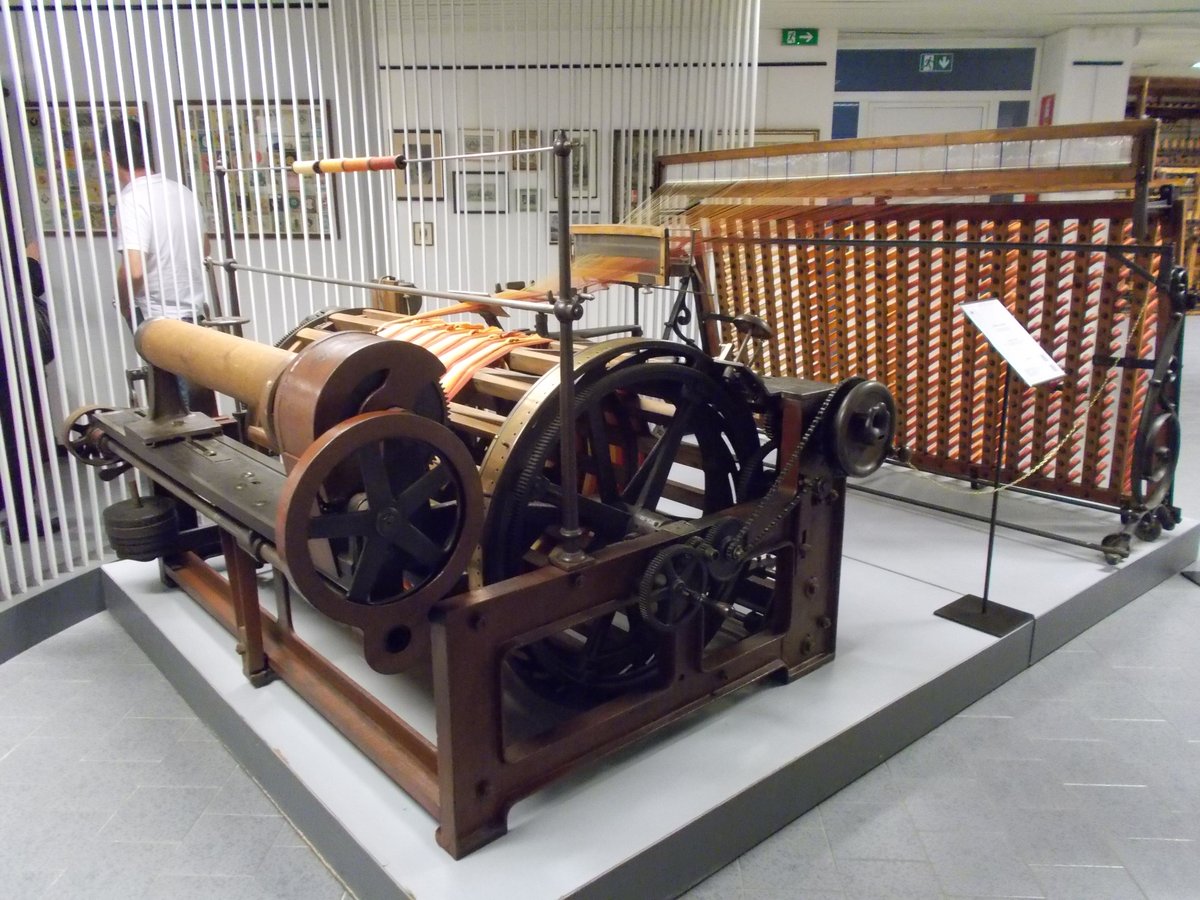 If you think silk is just an elegant fabric, get ready to think again. The Silk Museum of Como takes you into a world of silkworms, looms, and colors, telling a story that starts in the 15th century and stretches to high-fashion runways. Housed in the former silk factory that is now the Istituto Setificio Paolo Carcano, the museum spans 900 square meters and lets you experience every stage of production: from silkworm rearing (did you know each cocoon contains about 1,500 meters of thread?) to dyeing, from hand printing to weaving with still-functional vintage machinery.
The visit is a multisensory experience thanks to recent PNRR upgrades: beyond the classic audio guide tour, you can try the olfactory path, the tactile route, and even a digital webapp for families. If you have visual impairments, there’s the DescriVedendo project with Augmented Reality texts. Temporary exhibitions, like the one on textile sustainability, are also featured.
Practical info: located at Via Castelnuovo 9, open Tuesday to Sunday (Tuesday only afternoon, other days 10am-1pm and 2pm-6pm). Full ticket €7, reduced for students and under 18 at €4. Book a guided tour or a weaving workshop: it’s ideal for understanding why Como is the world capital of silk.
Voltian Lighthouse: The Symbol of Brunate Overlooking the Lake
- Via Giacomo Scalini, Brunate (CO)
- https://www.lombardiabeniculturali.it/architetture/schede/CO250-00742/
- Open in Google Maps
- View on Google Images
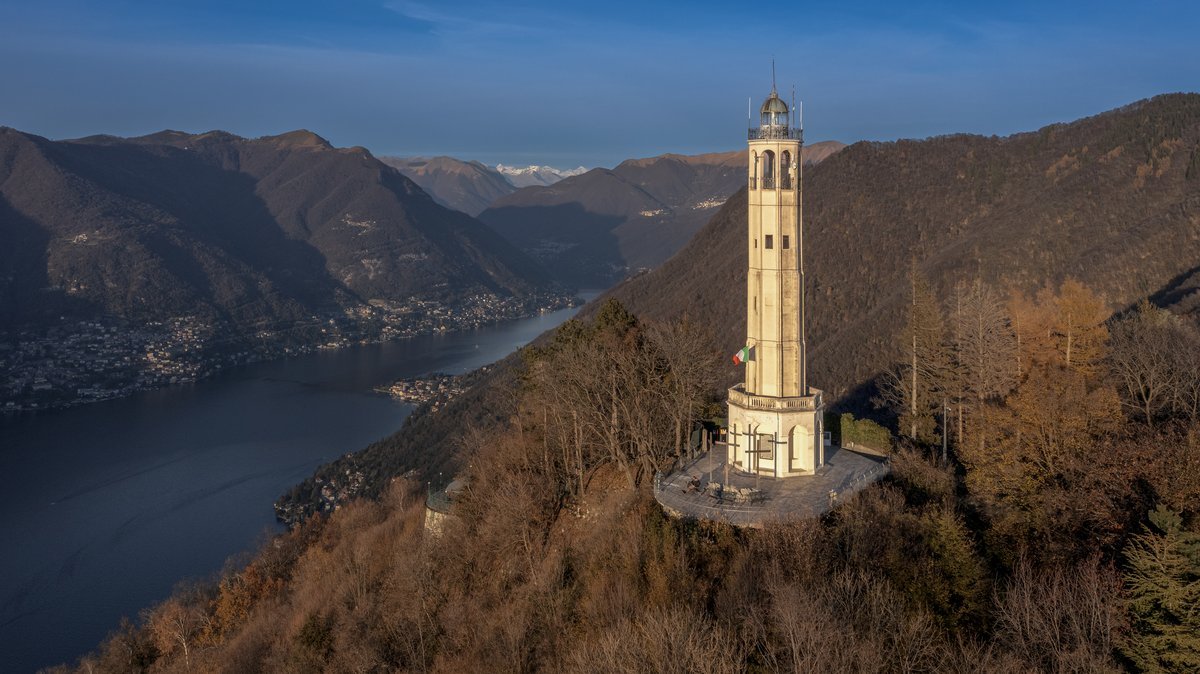 The Voltian Lighthouse is a monument that doesn't go unnoticed. Perched at 909 meters above sea level on the summit of Monte Tre Croci in Brunate, it was built in 1927 to commemorate the centenary of the death of Alessandro Volta, the genius from Como who invented the battery. Designed by engineer Gabriele Giussani, it is a 29-meter-high octagonal tower made of reinforced concrete, with a glass and aluminum lantern. To reach the top, you have to climb its 143 spiral steps: a bit of an effort, but rewarded with a 360-degree panorama. On clear days, you can see the Alps, Monte Rosa, the Po Valley, and even Milan. In the evening, the lighthouse illuminates the valley with beams of white, red, and green light – not only the colors of the Italian flag, but also symbols of faith, science, and charity, values dear to Volta. Admission costs €2 (€1 for under 18s and groups), and it is usually open on Saturdays, Sundays, and holidays, but hours vary with the seasons and bad weather: it's best to check before you go. The most convenient way to get there is to take the funicular from Como to Brunate and then walk (about 15-20 minutes), or by car, but the road is narrow and parking is scarce. I recommend comfortable shoes and a camera: the view is postcard-perfect.
Madonna del Ghisallo Cycling Museum
- Via Marie Therese Steiert 4, Magreglio (CO)
- https://www.museodelghisallo.it/it/
- Open in Google Maps
- View on Google Images
- info@museodelghisallo.it
- +39 031 965885
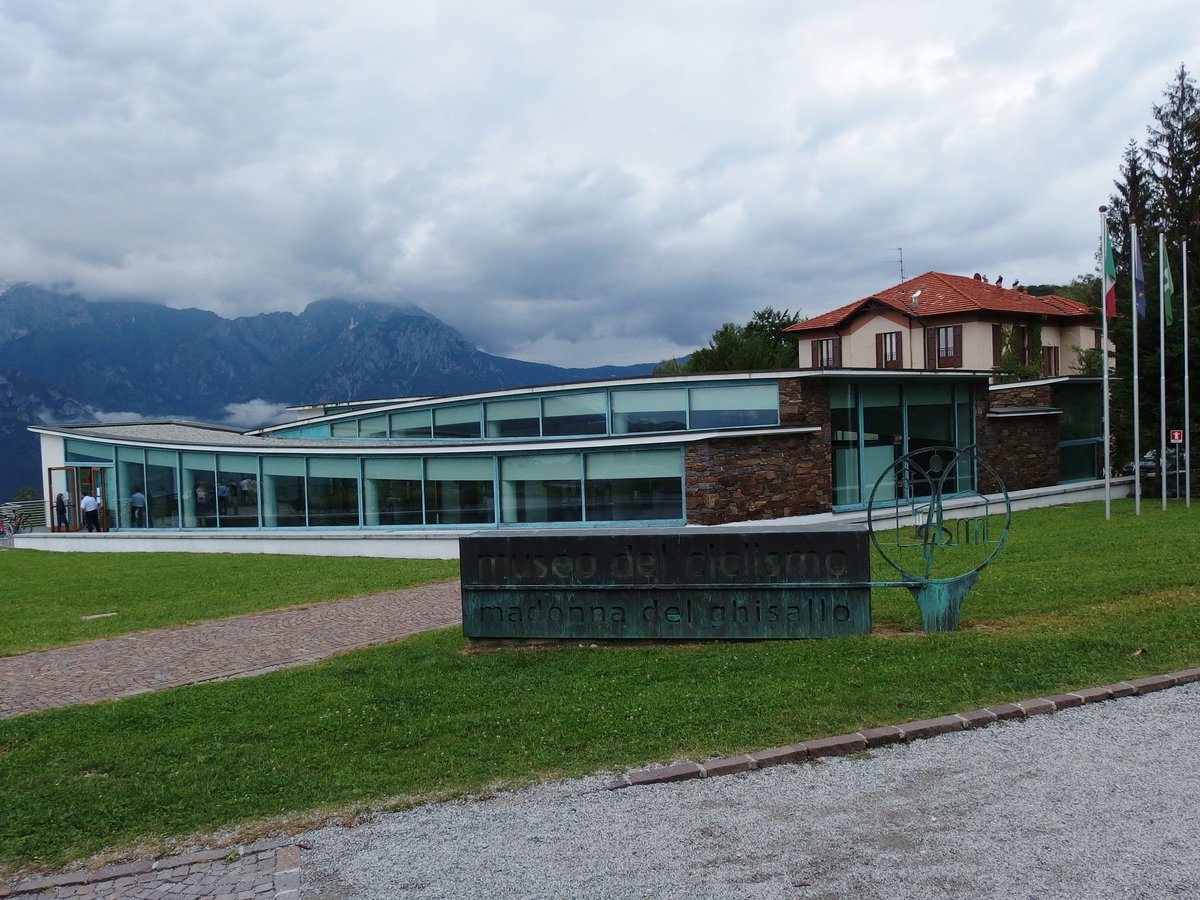 For decades, the Ghisallo climb has been an iconic ascent for every cyclist, and the museum beside the sanctuary is the crowning achievement of an endless passion. Inaugurated in 2006 at the behest of Fiorenzo Magni, the Cycling Museum is a must for two-wheel enthusiasts. The building itself is a work of art: designed by architect Davide Bergna, it unfolds along ramps reminiscent of mountain switchbacks, with a large window overlooking the Grigne. Inside, a unique collection: historic bicycles of Bartali, Coppi, Merckx, and Moser, as well as the largest collection of pink jerseys from the Giro d'Italia, thanks to the "Giro for Ghisallo" project by La Gazzetta dello Sport. There are also sections dedicated to women's cycling and paracycling, and a cinema room with 100 films. The exhibit takes visitors on an emotional journey: from early-century military bicycles to the "bridge" case with champions' bikes, up to the Great Encyclopedia of Cycling. Intense atmosphere: you can feel the effort and glory of epic climbs. The museum is open from March to November, daily 9:30 AM - 5:30 PM (full ticket €6). Perfect to combine with a ride on the hill or a visit to the sanctuary, where the first memorabilia donated by champions are preserved. A place that unites sport, history, and devotion.